The Story
Plant Bio
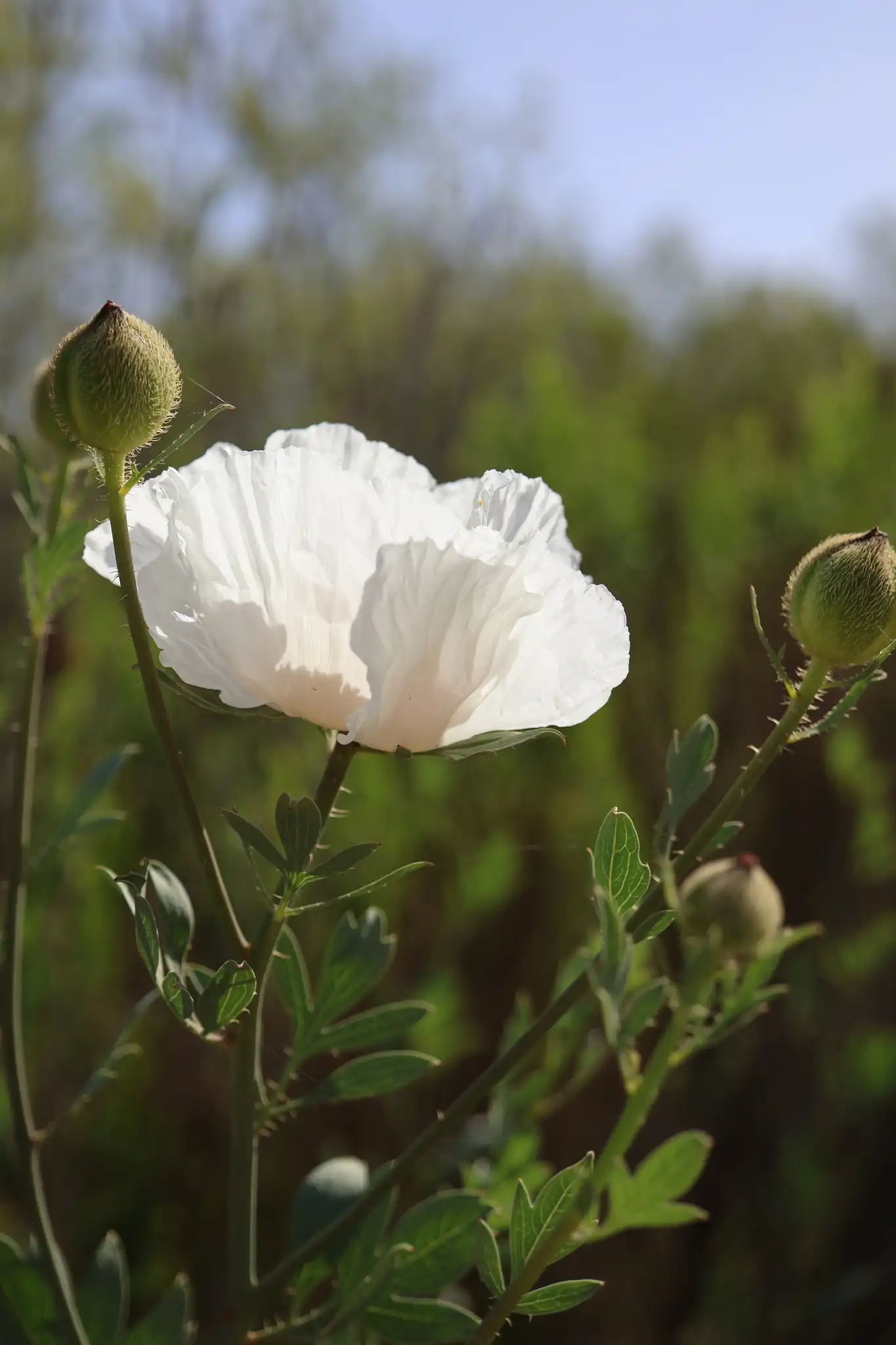
Romneya trichocalyx, the bristly matilija poppy, is a woody-based perennial subshrub native to southwestern California and northwestern Baja California that reaches three to eight feet in height. Deeply lobed, glaucous gray-green foliage carries large, solitary terminal flowers with white crinkled petals surrounding a dense central mass of golden-yellow stamens.
This species spreads indefinitely via an expansive underground rhizome network, rapidly forming wide, suckering clumps in light soils. It is distinguished from Romneya coulteri by its bristly sepals and compact, erect habit.
Uses & Benefits:
Essentials
At a Glance
Plant Type
Perennial
Height
98"
Width
100"
Light
Full Sun
Zones
7, 8, 9, 10
Water
Low
Humidity
Low
Lifespan
Perennial
Native To
North America
Toxicity
Toxic if ingested; sap irritates skin
Bloom period
Spring – Summer
In flower about 6 months of the year
Planting
How to Grow
- Select a site in full sun with sandy, gravelly, or sharply drained soil.
- Plant undisturbed root balls or bare-root divisions carefully during winter dormancy without tearing deep roots.
- Water sparingly during the first growing season to establish roots, then halt irrigation during summer.
- Cut back top growth to 2 to 4 inches above ground level in late fall or early winter.
Pro Tip
Cut the entire clump back to near ground level in late fall or winter during dormancy; selective pruning into leafless wood during the active growing season damages top growth.
Keep It Thriving
Care Guide
Do
- Provide full sun exposure and sharply draining mineral soils.
- Cut stems down to ground level during late fall or winter dormancy.
- Restrict summer irrigation to prevent root rot pathogens.
Don't
- Do not irrigate during summer dormancy, which causes fatal root rot.
- Do not attempt to dig up or relocate established plants.
- Do not apply fertilizer, which creates weak, sappy growth.
Seasonal Care Calendar
| Task | Jan | Feb | Mar | Apr | May | Jun | Jul | Aug | Sep | Oct | Nov | Dec |
|---|---|---|---|---|---|---|---|---|---|---|---|---|
| Pest Check | ||||||||||||
| Plant | ||||||||||||
| Propagate | ||||||||||||
| Prune |
Watch Out For
Pests & Diseases
Common Pests
Common Diseases
In the Garden
Landscape Uses & Companions
Landscape Uses
Multiply
Propagation Methods
Good to Know
Common Questions
Bristly Matilija Poppy questions
What zones can Bristly Matilija Poppy grow in?
Bristly Matilija Poppy is hardy in USDA Zones 7–10: in that range it survives winter in the ground. Colder than Zone 7, grow it in a container you can move to shelter for the winter, or as an annual.
Is Bristly Matilija Poppy deer resistant?
Yes — Bristly Matilija Poppy is rated deer-resistant. Deer typically pass it over, though extreme hunger can override any plant's defenses.
When does Bristly Matilija Poppy bloom?
Bristly Matilija Poppy typically blooms from spring to summer. Exact timing shifts a week or two with your zone — Sow's bloom calendar maps it to your garden.
Does Bristly Matilija Poppy need full sun?
Bristly Matilija Poppy does best in full sun (6+ hours).
Is Bristly Matilija Poppy drought tolerant?
Yes — once established (usually after the first full season), Bristly Matilija Poppy handles dry spells with minimal watering. Water deeply its first year to build the root system that makes that possible.
More Romneya to compare
Keep exploring
Explore the genus
Hardy in your zone?
Grow Bristly Matilija Poppy with confidence
See it in a design of your actual yard, get zone-matched care reminders, and track it season by season in your garden journal.