The Story
Plant Bio
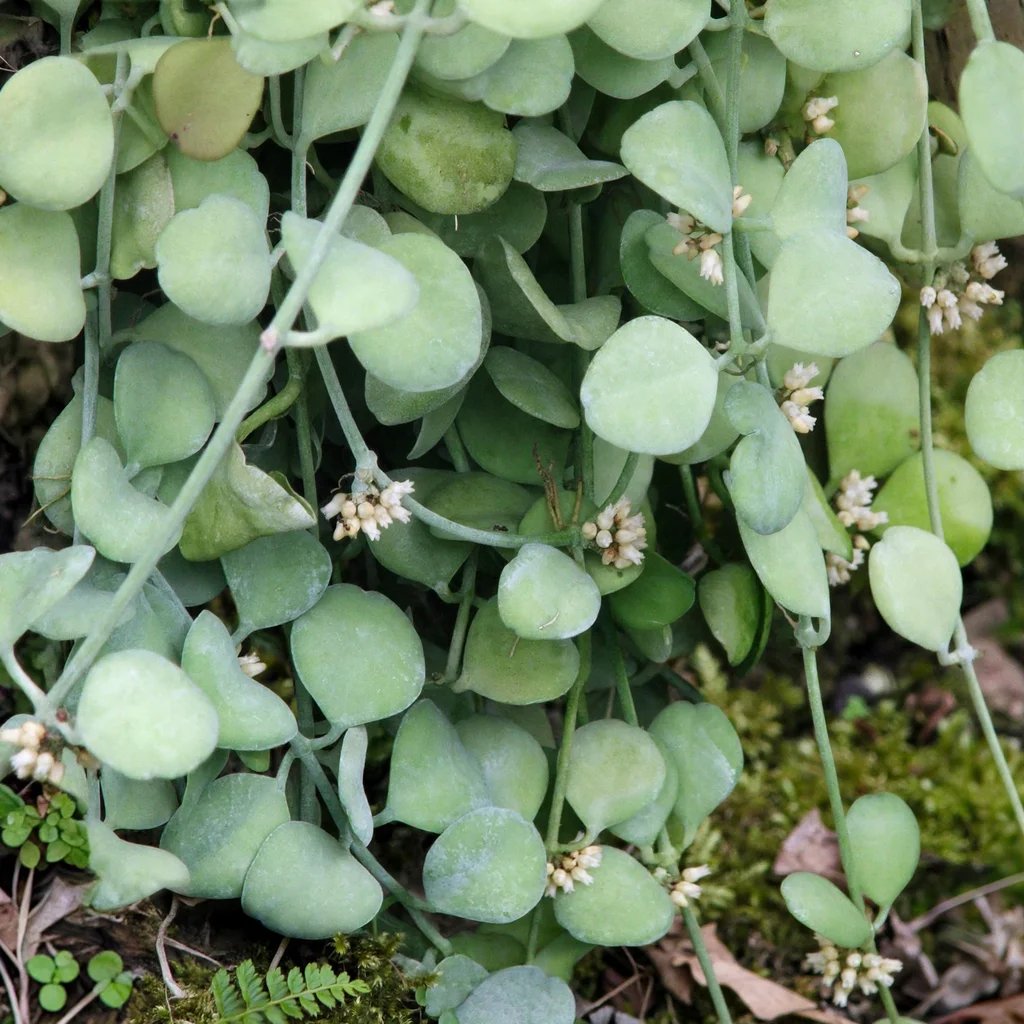
Dischidia minor, treated as Dischidia nummularia, is a slender evergreen epiphyte that climbs by adventitious roots and hangs in festooning strings from trunks and branches. In a basket it trails 20 to 60 inches, rooting along the stem where it meets moist bark rather than drawing from soil.
Its leaves sit opposite in pairs, very thick and lens-shaped like coins or buttons, 6 to 15 mm long and blue-gray to light green. The flowers are tiny waxy white to yellowish-white bells borne in clusters of one to five close to the stem, followed by paired smooth lance-shaped follicles.
Uses & Benefits:
Essentials
At a Glance
Plant Type
Vine
Height
60"
Width
20"
Light
Partial Sun, Shade
Zones
9, 10
Water
Low-moderate, keep fairly dry
Humidity
High, 60%+
Lifespan
Perennial evergreen vine
Native To
Tropical Asia to Queensland, Australia
Toxicity
Unknown
Bloom period
Spring – Summer
In flower about 6 months of the year
Planting
How to Grow
- Give bright indirect light with good air movement, tolerating only early-morning sun and no midday sun.
- Mount on bark or plant in very open bark-based epiphyte mix, never dense potting soil.
- Water moderately then allow to dry; the thick leaves store water and stems rot if kept wet.
- Hold above 50 degrees Fahrenheit with 60 percent or higher humidity; bring indoors well before fall cold.
Pro Tip
Mount on bark or pot in open bark mix and let it dry between waterings; dense potting soil traps water around the stem and rots it.
Keep It Thriving
Care Guide
Do
- Give bright indirect light and steady ventilation.
- Use an open bark mount or bark-based mix.
- Allow the mount to dry between waterings.
Don't
- Do not plant in dense potting soil.
- Do not give direct midday sun.
- Do not expose to frost or temperatures below 50 degrees Fahrenheit.
Seasonal Care Calendar
| Task | Jan | Feb | Mar | Apr | May | Jun | Jul | Aug | Sep | Oct | Nov | Dec |
|---|---|---|---|---|---|---|---|---|---|---|---|---|
| Pest Check | ||||||||||||
| Plant | ||||||||||||
| Propagate | ||||||||||||
| Winter Prep |
Watch Out For
Pests & Diseases
Common Pests
Common Diseases
In the Garden
Landscape Uses & Companions
Landscape Uses
Companion Plants
Multiply
Propagation Methods
Good to Know
Common Questions
String of Nickels questions
What zones can String of Nickels grow in?
String of Nickels is hardy in USDA Zones 9–10: in that range it survives winter in the ground. Colder than Zone 9, grow it in a container you can move to shelter for the winter, or as an annual.
When does String of Nickels bloom?
String of Nickels typically blooms from spring to summer. Exact timing shifts a week or two with your zone — Sow's bloom calendar maps it to your garden.
Does String of Nickels need full sun?
String of Nickels does best in part shade.
Is String of Nickels drought tolerant?
Yes — once established (usually after the first full season), String of Nickels handles dry spells with minimal watering. Water deeply its first year to build the root system that makes that possible.
Keep exploring
Explore the genus
Hardy in your zone?
Grow String of Nickels with confidence
See it in a design of your actual yard, get zone-matched care reminders, and track it season by season in your garden journal.