The Story
Plant Bio
Colvillea racemosa, the sole species in its genus, is a fast-growing deciduous tree from western Madagascar reaching 25 to 50 feet in cultivation with an open spreading crown. It carries bipinnate fern-like leaves to 3 feet long with 20 to 30 pairs of pinnae, light green when new and bright green at maturity, dropping in cool or dry winters.
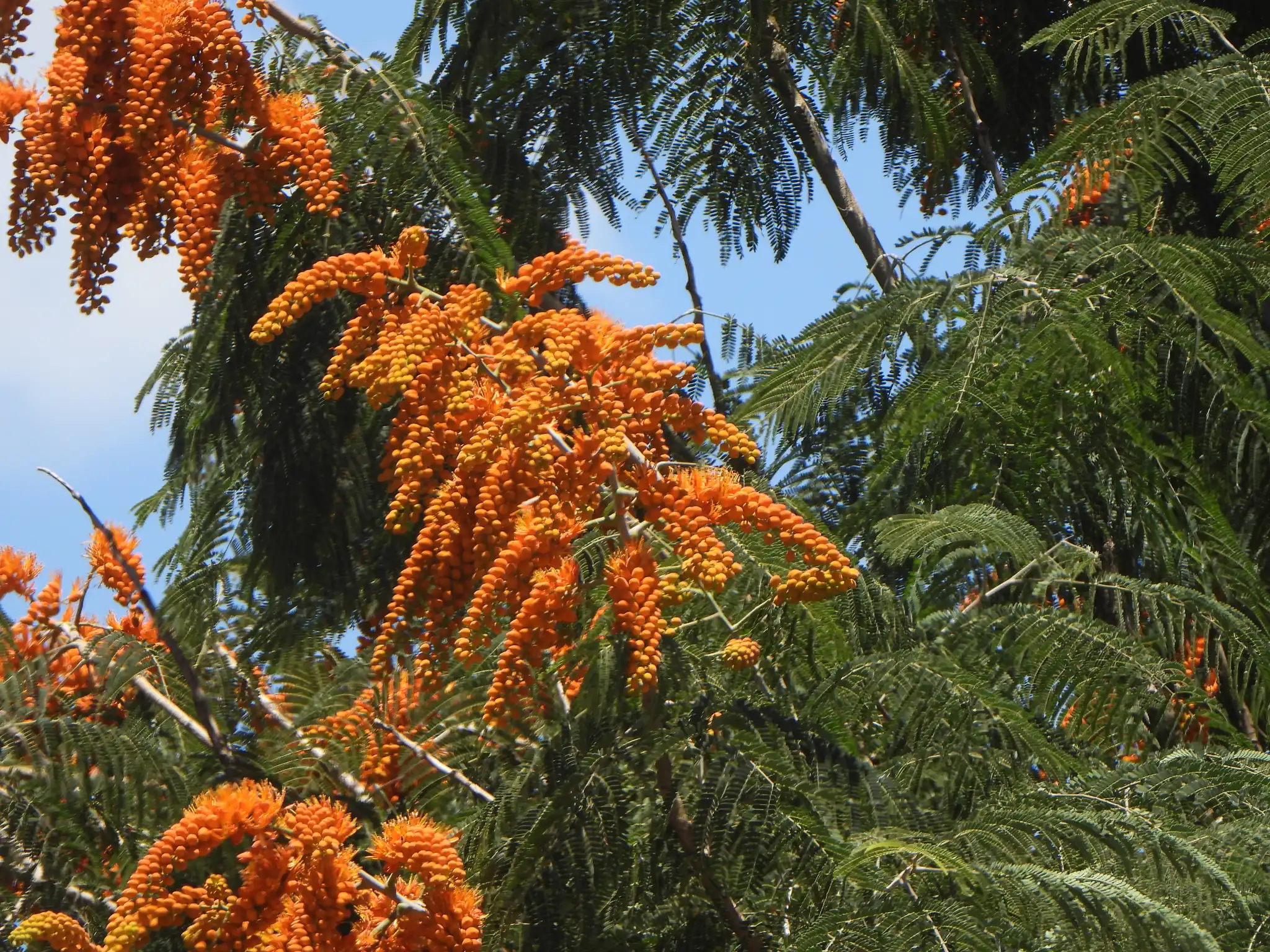
The flowers are scarlet to orange-red in dense terminal cylindrical racemes 6 to 18 inches long, borne in clusters near the branch tips with prominent exserted yellow stamens. The display differs from royal poinciana in its upright cone form rather than a flat-topped crown, followed by flat oblong woody pods 6 to 12 inches long.
Uses & Benefits:
Essentials
At a Glance
Plant Type
Tree
Height
600"
Width
480"
Light
Full Sun, Partial Sun
Zones
9, 10
Water
Moderate
Humidity
Tolerant
Lifespan
Long-lived tree
Native To
Madagascar
Toxicity
Toxic to humans and animals
Bloom period
Fall – Winter
In flower about 6 months of the year
Planting
How to Grow
- Choose a full-sun site with 35 to 40 feet of crown room in rich to sandy, well-drained soil.
- Plant in spring after frost, setting the root ball level with the soil surface and watering in deeply.
- Water regularly through the first season, then taper to deep occasional watering once established.
- Prune in late winter to shape the crown and remove crossing limbs.
- Protect from frost or move containers under cover when temperatures approach freezing.
Pro Tip
Give it full sun and room for the wide crown, and when it drops leaves in a cool or dry winter leave it dry rather than watering to force new growth.
Keep It Thriving
Care Guide
Do
- Grow in full sun in moist but well-drained soil.
- Water young trees regularly until established.
- Prune in late winter to encourage strong structure.
Don't
- Do not plant in waterlogged soil or heavy clay that stays wet.
- Do not overwater in winter when the tree is leafless.
- Do not crowd the wide spreading crown against buildings or power lines.
Seasonal Care Calendar
| Task | Jan | Feb | Mar | Apr | May | Jun | Jul | Aug | Sep | Oct | Nov | Dec |
|---|---|---|---|---|---|---|---|---|---|---|---|---|
| Mulch | ||||||||||||
| Pest Check | ||||||||||||
| Plant | ||||||||||||
| Prune | ||||||||||||
| Winter Prep |
Watch Out For
Pests & Diseases
Common Pests
Common Diseases
In the Garden
Landscape Uses & Companions
Landscape Uses
Multiply
Propagation Methods
Good to Know
Common Questions
Colville's Glory questions
What zones can Colville's Glory grow in?
Colville's Glory is hardy in USDA Zones 9–10: in that range it survives winter in the ground. Colder than Zone 9, winters are too cold for it to survive outdoors.
When does Colville's Glory bloom?
Colville's Glory typically blooms from fall to winter. Exact timing shifts a week or two with your zone — Sow's bloom calendar maps it to your garden.
Does Colville's Glory need full sun?
Colville's Glory does best in full sun to part shade. In hot climates, afternoon shade keeps blooms fresher longer.
Is Colville's Glory drought tolerant?
Yes — once established (usually after the first full season), Colville's Glory handles dry spells with minimal watering. Water deeply its first year to build the root system that makes that possible.
Keep exploring
Explore the genus
Hardy in your zone?
Grow Colville's Glory with confidence
See it in a design of your actual yard, get zone-matched care reminders, and track it season by season in your garden journal.