The Story
Plant Bio
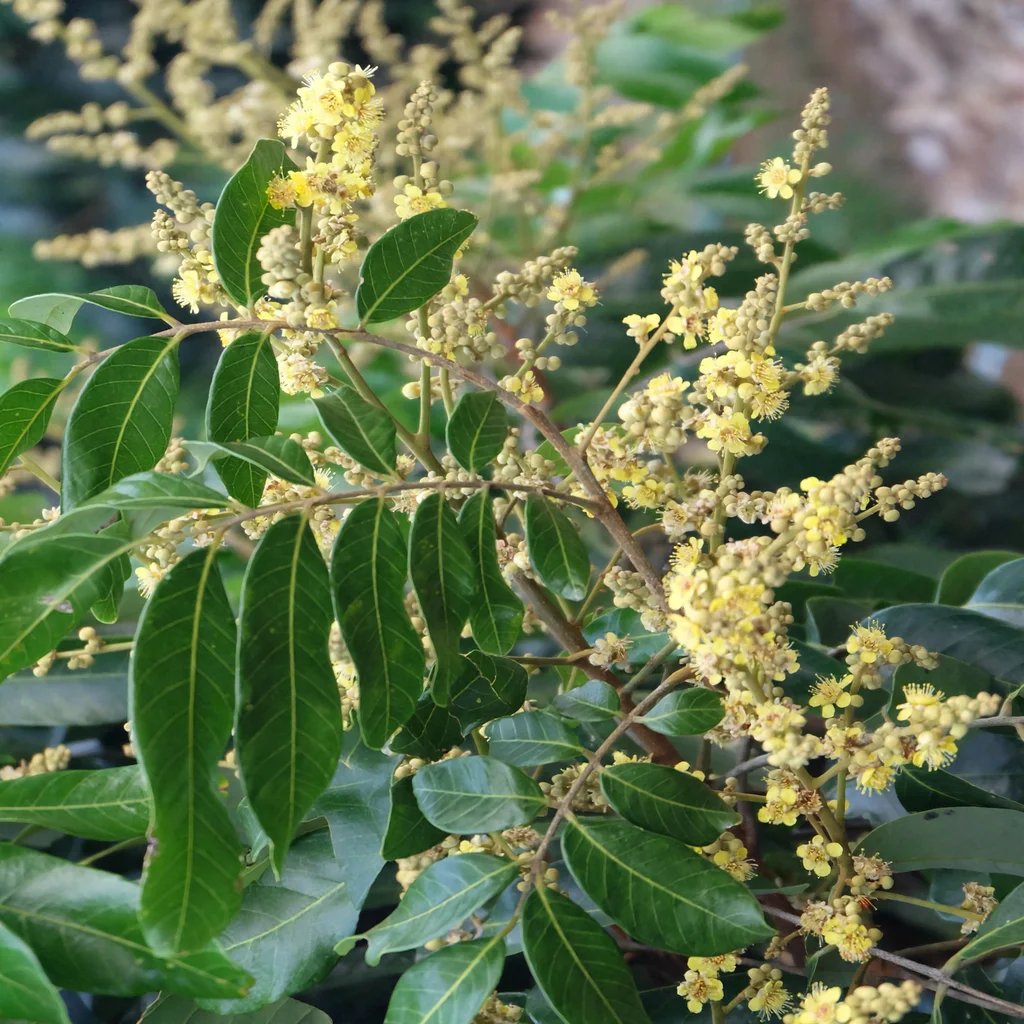
Euphoria longana, the cultivated longan botanically accepted as Dimocarpus longan, is a symmetrical evergreen monoecious tree reaching 30 to 40 feet in South Florida with a dense round-oblong crown, corky bark and spreading branches. The leaves are alternate pinnate to 12 inches long with six to nine pairs of glossy leathery dark-green wavy blunt leaflets.
This species bears terminal erect widely branched panicles 4 to 18 inches long with sequential male, female and bisexual flowers in pale yellow to white in spring, followed 140 to 190 days later by summer clusters of thin-skinned fruit. It bears erratically without a cool dry winter below 59 degrees Fahrenheit from October to February, and warm rainy winters produce vegetative growth with little fruit.
Uses & Benefits:
Essentials
At a Glance
Plant Type
Fruit Vegetable
Height
480"
Width
480"
Light
Full Sun, Partial Sun
Zones
10
Water
Moderate
Humidity
High
Lifespan
Long-lived tree
Native To
Southern China and Southeast Asia
Toxicity
Unknown
Bloom period
Spring
In flower about 3 months of the year
Planting
How to Grow
- Plant in full sun with 22 feet or more clearance from structures and power lines to allow a 30 to 40 foot crown.
- Dig a hole three times the pot width in rich acidic sandy loam, set the root ball level with grade and backfill with native soil only.
- Water young trees regularly through the first year, then irrigate bearers from flowering through harvest and keep fall to winter drier to induce bloom.
- Mulch 2 to 4 inches deep starting 6 inches from the trunk and stake only if needed with a degradable tie.
- Feed young trees lightly every 6 to 8 weeks the first year, then feed mature trees 2 to 3 times per year at bloom, late spring and before harvest with foliar minors April to September.
Pro Tip
Withhold water in fall and early winter to impose a mild drought that induces bloom, then irrigate regularly from flowering through harvest.
Keep It Thriving
Care Guide
Do
- Plant in full sun in fertile well-drained sandy loam and irrigate from flowering through harvest.
- Prune after harvest to hold the tree at 10 to 20 feet for picking and hurricane resistance.
- Apply foliar minor elements April to September and correct chlorosis with iron sulfate or chelate.
Don't
- Do not plant where soil stays flooded for 5 to 10 days or where salt spray reaches foliage.
- Do not expect seedling trees to come true or bear early; layered trees bear in 2 to 3 years and seedlings take to 6 years.
- Do not overwater in fall and winter when a cool dry rest is needed for bloom.
Seasonal Care Calendar
| Task | Jan | Feb | Mar | Apr | May | Jun | Jul | Aug | Sep | Oct | Nov | Dec |
|---|---|---|---|---|---|---|---|---|---|---|---|---|
| Fertilize | ||||||||||||
| Harvest | ||||||||||||
| Pest Check | ||||||||||||
| Plant | ||||||||||||
| Prune |
Watch Out For
Pests & Diseases
Common Pests
Common Diseases
In the Garden
Landscape Uses & Companions
Landscape Uses
Companion Plants
Multiply
Propagation Methods
Good to Know
Common Questions
Longan questions
What zones can Longan grow in?
Longan is hardy in USDA Zone 10: in that range it survives winter in the ground. Colder than Zone 10, grow it in a container you can move to shelter for the winter, or as an annual.
When does Longan bloom?
Longan typically blooms in spring. Exact timing shifts a week or two with your zone — Sow's bloom calendar maps it to your garden.
Does Longan need full sun?
Longan does best in full sun to part shade. In hot climates, afternoon shade keeps blooms fresher longer.
Keep exploring
Explore the genus
Hardy in your zone?
Grow Longan with confidence
See it in a design of your actual yard, get zone-matched care reminders, and track it season by season in your garden journal.