The Story
Plant Bio
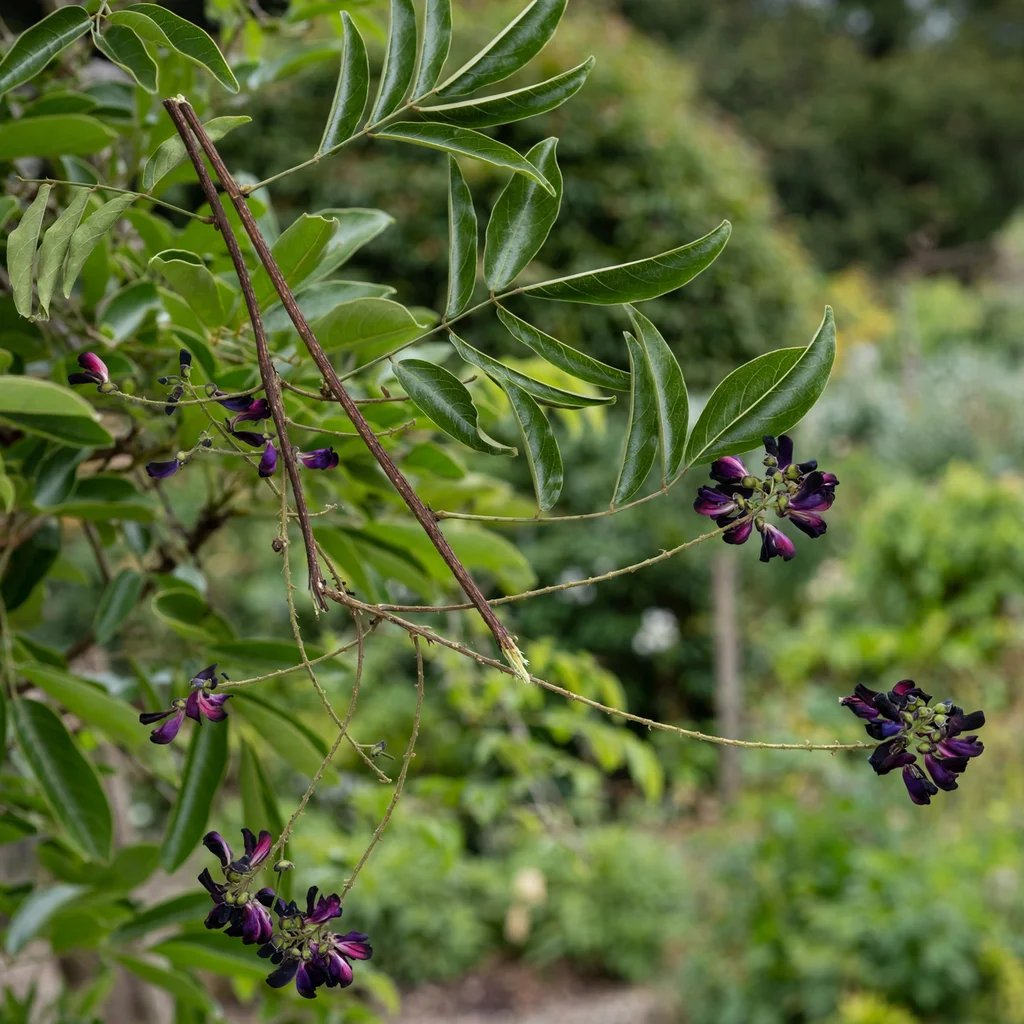
Millettia reticulata, sold as evergreen wisteria, is a vigorous woody twining vine from southern China that climbs twenty to thirty feet where hardy, forming a dense multi-stemmed cover of glossy pointed green leaves. The pea-shaped flowers open dark purple to burgundy-pink in outward-facing racemes, fragrant and held out from the foliage rather than hanging in long pendants.
Unlike true Chinese and Japanese wisterias, it flowers in summer into fall and has not shown their invasive running and seeding behavior in gardens. It holds foliage through winter in the warmest zones but thins or drops leaves in cold winters, and its seed pods cause nausea and vomiting if eaten.
Uses & Benefits:
Essentials
At a Glance
Plant Type
Vine
Height
300"
Width
72"
Light
Full Sun, Partial Sun
Zones
8, 9, 10
Water
Medium
Humidity
Unknown
Lifespan
Woody perennial vine
Native To
S China
Toxicity
Toxic if ingested
Bloom period
Summer – Fall
In flower about 6 months of the year
Planting
How to Grow
- Plant in full sun to part sun in rich, well-drained acidic to neutral soil, spacing plants 6 feet apart.
- Set a sturdy arbor, pergola or fence before planting and tie young stems to the support.
- Water regularly until established, then water during dry spells in the first seasons.
- Feed twice during the growing season with a slow-release fertilizer and mulch roots before a cold snap.
- Prune in early spring to shorten long shoots and keep the vine within 20 feet.
Pro Tip
Cut long whips back in early spring and keep it on a stout pergola or fence; a light trellis will be pulled down once the stems turn woody.
Keep It Thriving
Care Guide
Do
- Provide a stout arbor, pergola or fence from day one
- Plant in rich, well-drained soil
- Water regularly until established
- Mulch roots before a cold snap
Don't
- Do not plant on a flimsy trellis it will overwhelm
- Do not eat seeds or pods; keep away from dogs and cats
- Do not leave long whips unpruned where they can climb into trees
Seasonal Care Calendar
| Task | Jan | Feb | Mar | Apr | May | Jun | Jul | Aug | Sep | Oct | Nov | Dec |
|---|---|---|---|---|---|---|---|---|---|---|---|---|
| Fertilize | ||||||||||||
| Mulch | ||||||||||||
| Plant | ||||||||||||
| Prune |
Watch Out For
Pests & Diseases
Common Pests
Common Diseases
In the Garden
Landscape Uses & Companions
Landscape Uses
Companion Plants
Good to Know
Common Questions
Evergreen Wisteria questions
What zones can Evergreen Wisteria grow in?
Evergreen Wisteria is hardy in USDA Zones 8–10: in that range it survives winter in the ground. Colder than Zone 8, grow it in a container you can move to shelter for the winter, or as an annual.
When does Evergreen Wisteria bloom?
Evergreen Wisteria typically blooms from summer to fall. Exact timing shifts a week or two with your zone — Sow's bloom calendar maps it to your garden.
Does Evergreen Wisteria need full sun?
Evergreen Wisteria does best in full sun to part shade. In hot climates, afternoon shade keeps blooms fresher longer.
Keep exploring
Explore the genus
Hardy in your zone?
Grow Evergreen Wisteria with confidence
See it in a design of your actual yard, get zone-matched care reminders, and track it season by season in your garden journal.