The Story
Plant Bio
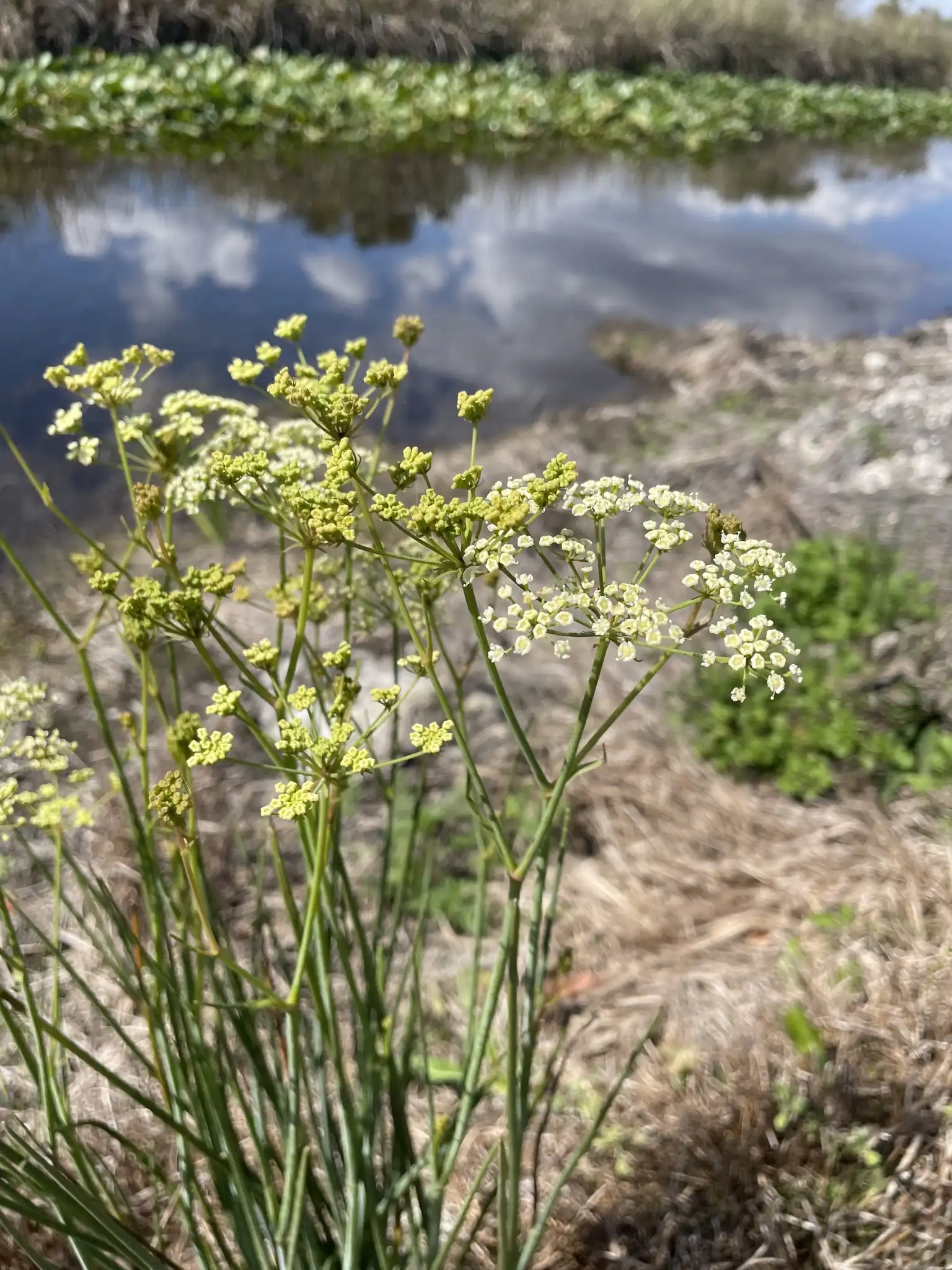
Tiedemannia filiformis is an erect herbaceous perennial of southeastern freshwater wetlands, growing three to five feet tall from a basal rosette on a taproot. The stems are slender and sparingly branched, carrying reduced needle-like leaves and ending in large compound umbels of small white flowers.
What sets it apart is the foliage: a dense tuft of round, hollow, quill-like leaves up to three feet long that reads as a grass tuft until it blooms. The fruit that follows is a flattened, brown, winged schizocarp, and the plant demands saturated organic muck and fails in ordinary dry beds.
Uses & Benefits:
Essentials
At a Glance
Plant Type
Perennial
Height
60"
Width
24"
Light
Full Sun
Zones
7, 8, 9, 10
Water
High - wetland
Humidity
High
Lifespan
Perennial
Native To
Southeastern USA
Toxicity
Toxic if ingested, skin irritant
Bloom period
Late summer – Fall
In flower about 4 months of the year
Planting
How to Grow
- Choose a full-sun hollow that stays saturated, such as a pond margin or rain garden basin dug into organic muck.
- Set the crown level with the soil surface in spring after hard frost has passed, and flood or water deeply to settle.
- Hold 1 to 3 inches of standing fresh water over the root zone through summer; refill before the muck cracks.
- Leave the basal tuft in place over winter; cut away only dead flower stalks in early spring.
- Reset seedlings only if the clump crowds, keeping roots wet at all times.
Pro Tip
Never let the muck dry out; keep the crown in shallow standing water through summer and do not drain the bed for winter.
Keep It Thriving
Care Guide
Do
- Keep soil saturated with fresh water at all times.
- Grow in full sun in organic muck.
- Leave seed heads for pollinators and predatory insects.
Don't
- Do not plant in a dry perennial bed or let the wetland drain.
- Do not expose to salt or brackish flooding; fresh water only.
- Do not eat any part; keep away from livestock and avoid confusion with spotted water hemlock.
Seasonal Care Calendar
| Task | Jan | Feb | Mar | Apr | May | Jun | Jul | Aug | Sep | Oct | Nov | Dec |
|---|---|---|---|---|---|---|---|---|---|---|---|---|
| Deadhead | ||||||||||||
| Plant | ||||||||||||
| Propagate | ||||||||||||
| Spring Cleanup | ||||||||||||
| Winter Prep |
Watch Out For
Pests & Diseases
Common Pests
Common Diseases
In the Garden
Landscape Uses & Companions
Landscape Uses
Multiply
Propagation Methods
Good to Know
Common Questions
Water Cowbane questions
What zones can Water Cowbane grow in?
Water Cowbane is hardy in USDA Zones 7–10: in that range it survives winter in the ground. Colder than Zone 7, grow it in a container you can move to shelter for the winter, or as an annual.
When does Water Cowbane bloom?
Water Cowbane typically blooms from late summer to late fall. Exact timing shifts a week or two with your zone — Sow's bloom calendar maps it to your garden.
Does Water Cowbane need full sun?
Water Cowbane does best in full sun (6+ hours).
Keep exploring
Explore the genus
Hardy in your zone?
Grow Water Cowbane with confidence
See it in a design of your actual yard, get zone-matched care reminders, and track it season by season in your garden journal.