The Story
Plant Bio
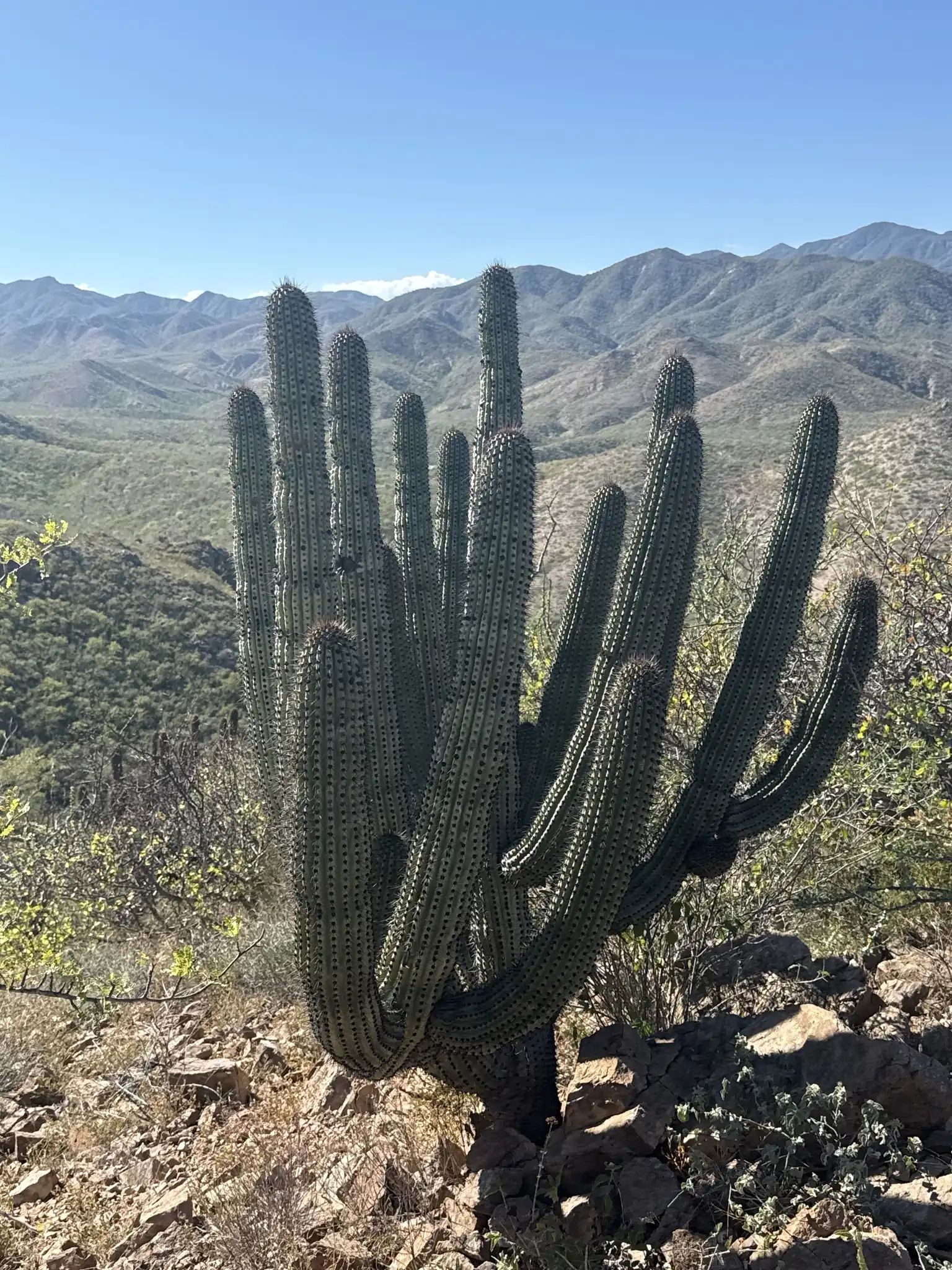
Stenocereus thurberi is an evergreen columnar cactus forming a massive basal clump of many narrow upright stems from a short trunk, reaching 16 to 20 feet tall with stems about 6 inches thick. The stems are green and ribbed with 12 to 19 low ribs, lined with areoles bearing dark brown to black spines to about half an inch that turn gray with age; the plant has no leaves.
Unlike the single-trunked saguaro it grows beside, it branches from the base into an organ-pipe cluster and is more frost-tender, suffering damage below about 25F. Its solitary funnel-shaped flowers open at night in late spring to summer, cream-white to light pink and 2 to 3 inches across, followed by sweet red pitaya dulce fruit relished by bats and desert wildlife.
Uses & Benefits:
Essentials
At a Glance
Plant Type
Cactus Succulent
Height
240"
Width
144"
Light
Full Sun
Zones
9, 10
Water
Low
Humidity
Low
Lifespan
Long-lived
Native To
Sonoran Desert, Arizona and northwest Mexico
Toxicity
Unknown; spiny, fruit edible
Bloom period
Late spring – Early fall
In flower about 5 months of the year
Planting
How to Grow
- Set in full sun in very well-drained gravelly or sandy soil, on a slope or raised mound where water never stands.
- Plant at the same depth or slightly high, backfilling with a 50/50 mineral cactus mix and top-dressing with gravel to keep the stem base dry.
- Water deeply but infrequently the first summer to establish, then cut back to little supplemental water; keep almost dry in winter.
- Protect below freezing with frost cloth and an overhead dry cover; damage starts near 25F and brief exposure near 23F can kill stems.
- Give young plants light nurse shade from adjacent desert shrubs in extreme heat, moving to full exposure as the clump matures.
Pro Tip
Plant high in a 50/50 mineral mix in full sun and keep it dry in winter; cold plus wet rots the roots long before cold alone damages the stems.
Keep It Thriving
Care Guide
Do
- Give full sun and sharp drainage with air movement around the stems.
- Check areoles and stem bases for cochineal, mealybugs, and scale through summer.
- Protect from frost and winter rain in a greenhouse, cold frame, or indoors.
Don't
- Do not overwater or plant in clay or rich moisture-holding soil.
- Do not prune healthy columns; remove only damaged or rotted stems.
- Do not use broad insecticides that kill the moths and beneficial insects that visit night flowers.
Seasonal Care Calendar
| Task | Jan | Feb | Mar | Apr | May | Jun | Jul | Aug | Sep | Oct | Nov | Dec |
|---|---|---|---|---|---|---|---|---|---|---|---|---|
| Pest Check | ||||||||||||
| Plant | ||||||||||||
| Propagate | ||||||||||||
| Prune | ||||||||||||
| Winter Prep |
Watch Out For
Pests & Diseases
Common Pests
Common Diseases
In the Garden
Landscape Uses & Companions
Landscape Uses
Multiply
Propagation Methods
Good to Know
Common Questions
Organ Pipe Cactus questions
What zones can Organ Pipe Cactus grow in?
Organ Pipe Cactus is hardy in USDA Zones 9–10: in that range it survives winter in the ground. Colder than Zone 9, grow it in a container you can move to shelter for the winter, or as an annual.
When does Organ Pipe Cactus bloom?
Organ Pipe Cactus typically blooms from late spring to early fall. Exact timing shifts a week or two with your zone — Sow's bloom calendar maps it to your garden.
Does Organ Pipe Cactus need full sun?
Organ Pipe Cactus does best in full sun (6+ hours).
Is Organ Pipe Cactus drought tolerant?
Yes — once established (usually after the first full season), Organ Pipe Cactus handles dry spells with minimal watering. Water deeply its first year to build the root system that makes that possible.
Keep exploring
Explore the genus
Hardy in your zone?
Grow Organ Pipe Cactus with confidence
See it in a design of your actual yard, get zone-matched care reminders, and track it season by season in your garden journal.