The Story
Plant Bio
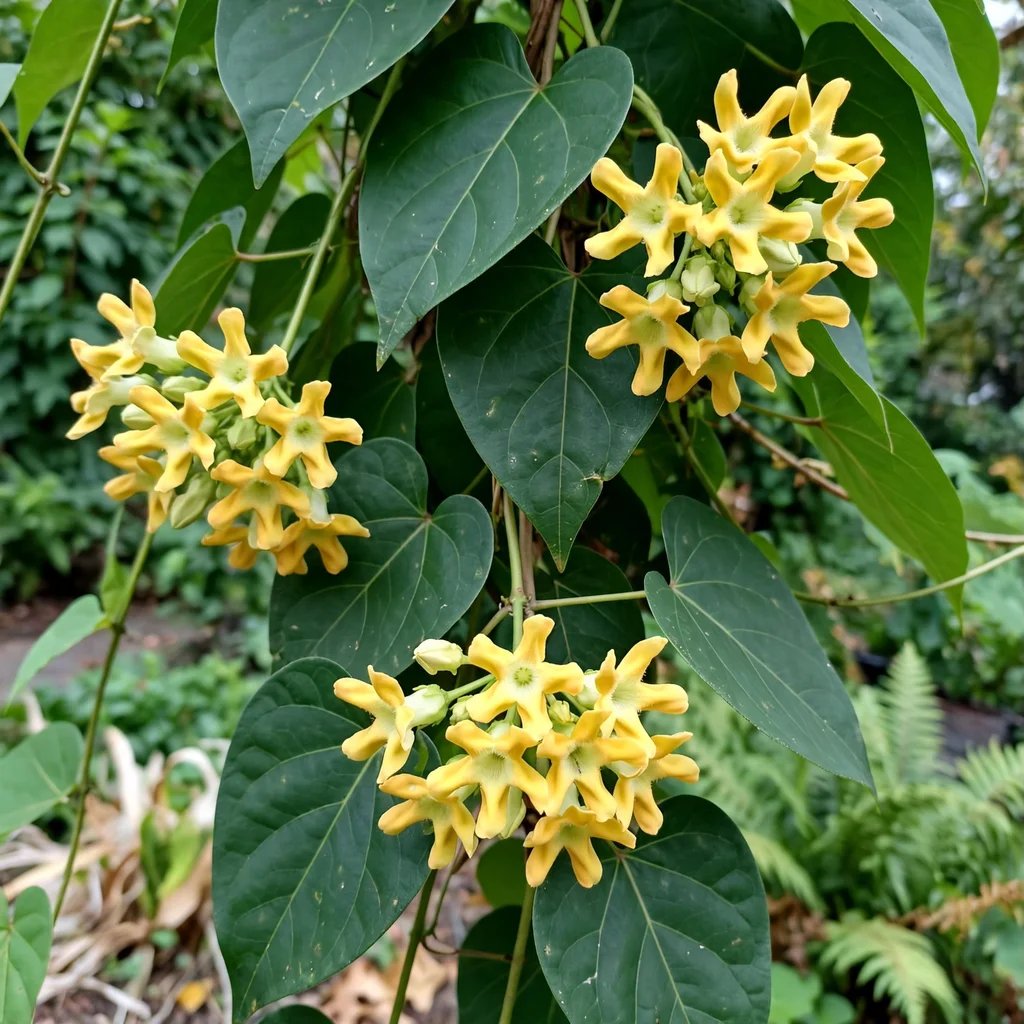
Telosma cordata is an evergreen woody twiner from lowland tropical Asia, climbing 8 to 20 feet in the ground where hardy when given a trellis or other support. It bears opposite heart-shaped dark green leaves to 5 inches long and 4 inches wide on long petioles, holding through winter in frost-free climates.
The flowers are borne in rounded clusters of 10 to 20 tubular blossoms about 5/8 inch long, opening yellowish-green and aging to golden yellow with narrow spreading lobes. They release a heavy sweet perfume after dark from spring through fall, with the strongest scent at night when moths visit the flowers.
Uses & Benefits:
Essentials
At a Glance
Plant Type
Vine
Height
236"
Width
35"
Light
Full Sun, Partial Sun
Zones
10
Water
Moderate
Humidity
Tolerant of humid tropical air
Lifespan
Woody perennial vine
Native To
Tropical Asia
Toxicity
Toxic - contains alkaloids
Bloom period
Spring – Fall
In flower about 9 months of the year
Planting
How to Grow
- Plant after last frost in full sun in fertile, well-drained sandy loam with pH 6.1-7.5.
- Set a sturdy trellis at planting and tie young twining stems until they grip and climb.
- Water regularly to establish, then water moderately and never leave the pot standing in water.
- Move container plants indoors before first frost to a bright frost-free spot and keep barely moist through winter.
- Prune lightly after flowering to keep the vine within bounds.
Pro Tip
Plant in full sun in fertile, well-drained sandy loam and train to a fixed trellis; in zones below 10 keep it in a pot and move it indoors before first frost.
Keep It Thriving
Care Guide
Do
- Give full sun and a sturdy support from the start.
- Use fertile, well-drained soil and avoid waterlogging.
- Overwinter containers indoors where winters drop below freezing.
Don't
- Do not plant in poorly drained or flood-prone soil.
- Do not leave containers outdoors below zone 10 in winter.
- Do not eat leaves or stems, which contain alkaloids; use only cooked flowers and with caution.
Seasonal Care Calendar
| Task | Jan | Feb | Mar | Apr | May | Jun | Jul | Aug | Sep | Oct | Nov | Dec |
|---|---|---|---|---|---|---|---|---|---|---|---|---|
| Fertilize | ||||||||||||
| Pest Check | ||||||||||||
| Plant | ||||||||||||
| Stake | ||||||||||||
| Winter Prep |
Watch Out For
Pests & Diseases
Common Pests
Common Diseases
In the Garden
Landscape Uses & Companions
Landscape Uses
Multiply
Propagation Methods
Good to Know
Common Questions
Tonkin Jasmine questions
What zones can Tonkin Jasmine grow in?
Tonkin Jasmine is hardy in USDA Zone 10: in that range it survives winter in the ground. Colder than Zone 10, grow it in a container you can move to shelter for the winter, or as an annual.
When does Tonkin Jasmine bloom?
Tonkin Jasmine typically blooms from spring to fall. Exact timing shifts a week or two with your zone — Sow's bloom calendar maps it to your garden.
Does Tonkin Jasmine need full sun?
Tonkin Jasmine does best in full sun to part shade. In hot climates, afternoon shade keeps blooms fresher longer.
Is Tonkin Jasmine drought tolerant?
Yes — once established (usually after the first full season), Tonkin Jasmine handles dry spells with minimal watering. Water deeply its first year to build the root system that makes that possible.
Keep exploring
Explore the genus
Hardy in your zone?
Grow Tonkin Jasmine with confidence
See it in a design of your actual yard, get zone-matched care reminders, and track it season by season in your garden journal.