The Story
Plant Bio
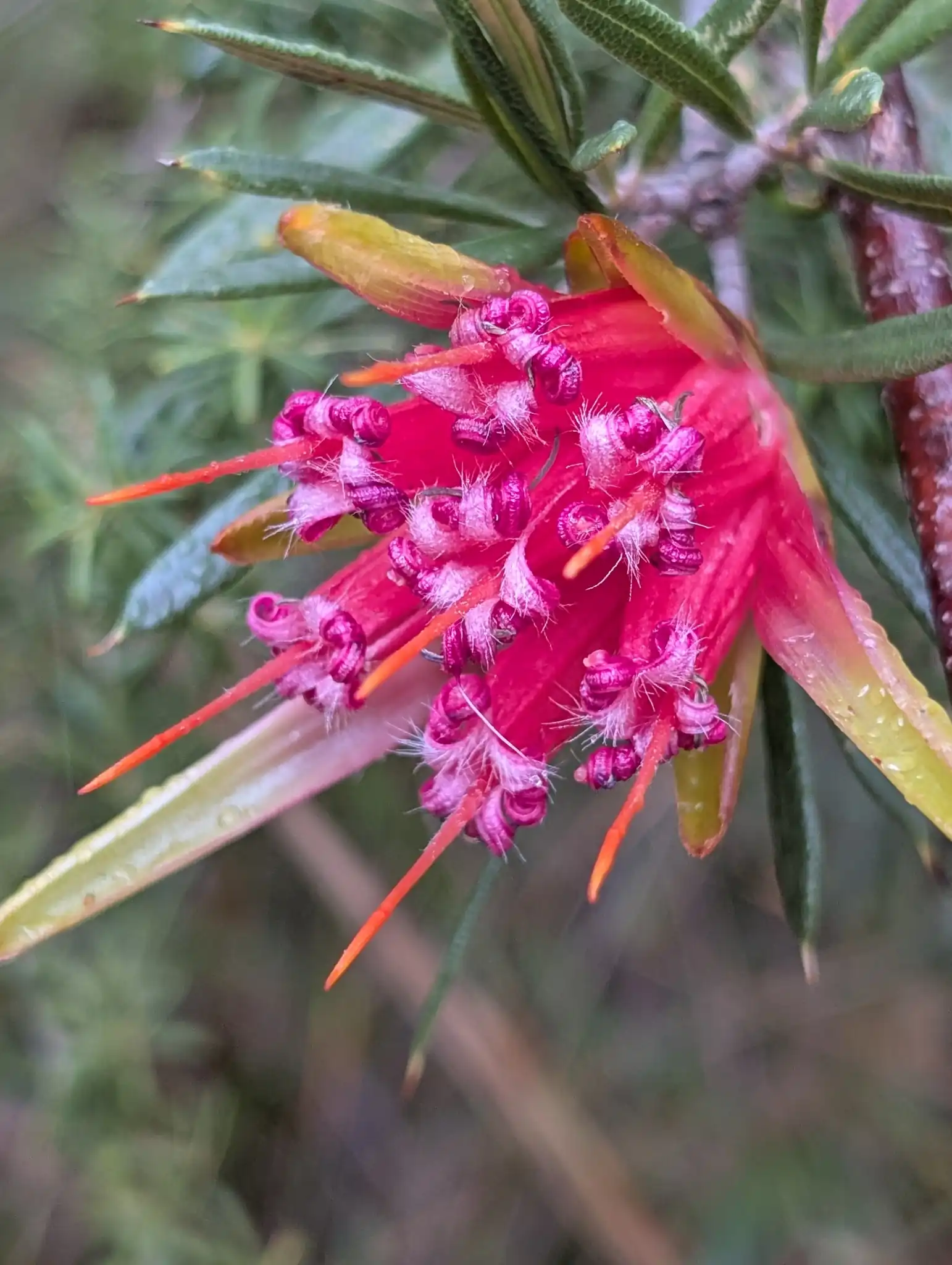
Lambertia formosa is an erect, multi-stemmed evergreen shrub featuring stiff, narrow leaves with sharp terminal points arranged in whorls of three. Terminal clusters of seven bright red, tubular flowers appear intermittently throughout the year, with a peak display from spring into summer.
The flower clusters are encased in overlapping red and gold bracts and produce prominent woody seed capsules with horn-like protrusions that resemble a devil's face. Its rigid, needle-tipped foliage acts as a natural physical barrier, requiring thoughtful placement away from high-traffic pathways.
Uses & Benefits:
Essentials
At a Glance
Plant Type
Shrub
Height
79"
Width
59"
Light
Full Sun, Partial Sun
Zones
9, 10
Water
Low
Humidity
Moderate
Lifespan
Perennial
Native To
Eastern Australia
Toxicity
Non-toxic (sharp foliage)
Bloom period
Spring – Summer
In flower about 6 months of the year
Planting
How to Grow
- Select a site in full sun to light shade with sharply draining, lean sandy or gravelly soil.
- Dig a planting hole twice as wide as the root ball and install the shrub flush with the surrounding soil level.
- Water in thoroughly upon planting, then allow the root zone to dry out significantly between infrequent irrigations.
- Apply a light gravel or sand mulch around the base to keep root crowns free from excess moisture.
Pro Tip
Plant in sharply draining sandstone or sandy soil devoid of rich compost, and never cut back into old leafless wood, which lacks latent buds to resprout.
Keep It Thriving
Care Guide
Do
- Ensure soil drainage is sharp and fast-draining at all times.
- Use low-phosphorus or native-specific plant fertilizers sparingly.
- Lightly tip-prune green growth after the main spring flower flush.
Don't
- Do not amend the soil with rich compost or heavy organic fertilizers.
- Do not cut back into old, bare brown wood when pruning.
- Do not overwater or allow roots to sit in stagnant moisture.
Seasonal Care Calendar
| Task | Jan | Feb | Mar | Apr | May | Jun | Jul | Aug | Sep | Oct | Nov | Dec |
|---|---|---|---|---|---|---|---|---|---|---|---|---|
| Fertilize | ||||||||||||
| Mulch | ||||||||||||
| Pest Check | ||||||||||||
| Prune |
Watch Out For
Pests & Diseases
Common Pests
Common Diseases
In the Garden
Landscape Uses & Companions
Landscape Uses
Companion Plants
Multiply
Propagation Methods
Good to Know
Common Questions
Mountain Devil questions
What zones can Mountain Devil grow in?
Mountain Devil is hardy in USDA Zones 9–10: in that range it survives winter in the ground. Colder than Zone 9, grow it in a container you can move to shelter for the winter.
When does Mountain Devil bloom?
Mountain Devil typically blooms from spring to summer. Exact timing shifts a week or two with your zone — Sow's bloom calendar maps it to your garden.
Does Mountain Devil need full sun?
Mountain Devil does best in full sun to part shade. In hot climates, afternoon shade keeps blooms fresher longer.
Is Mountain Devil drought tolerant?
Yes — once established (usually after the first full season), Mountain Devil handles dry spells with minimal watering. Water deeply its first year to build the root system that makes that possible.
Keep exploring
Explore the genus
Hardy in your zone?
Grow Mountain Devil with confidence
See it in a design of your actual yard, get zone-matched care reminders, and track it season by season in your garden journal.