The Story
Plant Bio
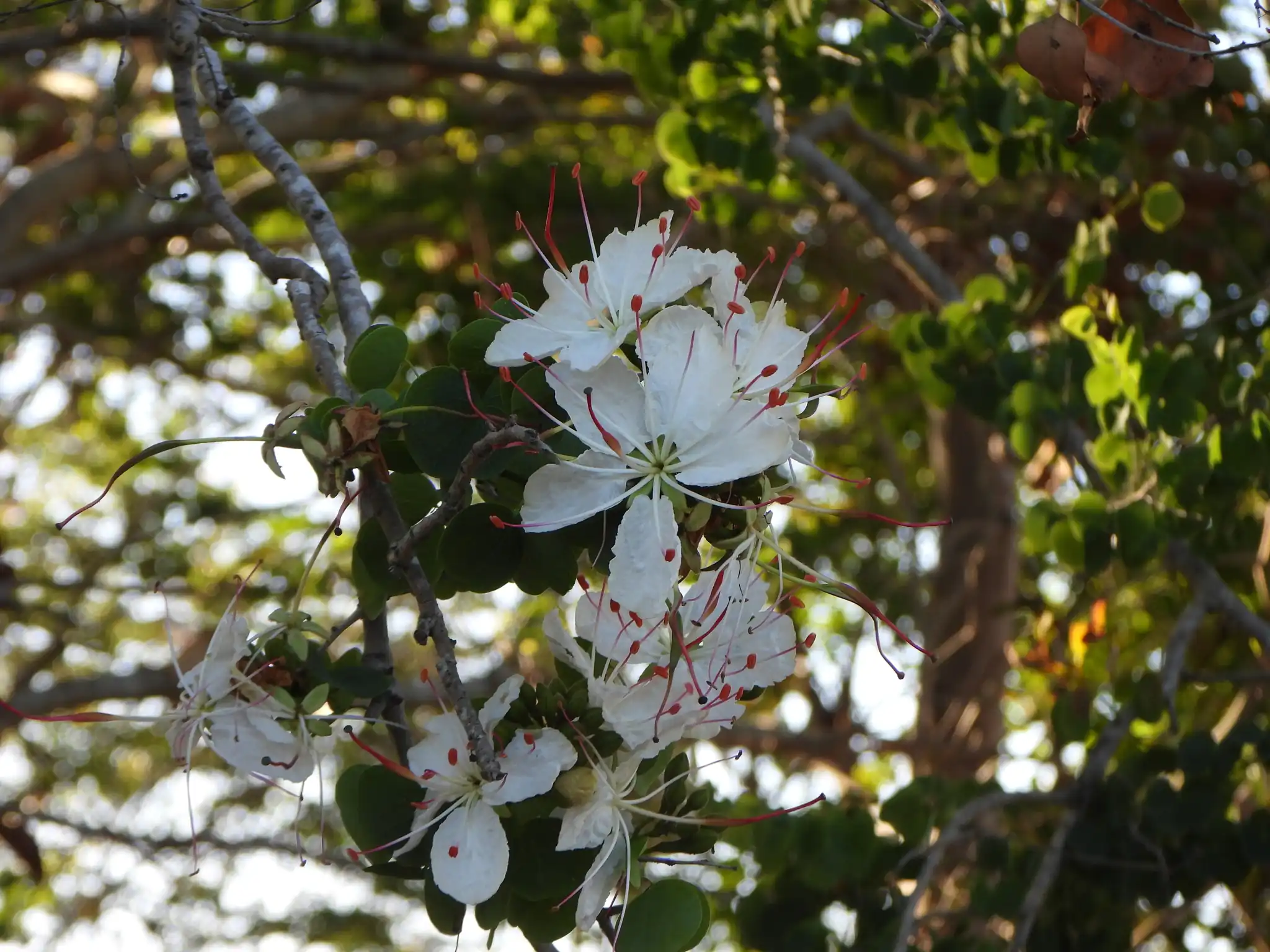
Lysiphyllum hookeri is an evergreen to semi-deciduous tree native to tropical and subtropical northern Australia, reaching fifteen to thirty feet in height with a broad, spreading crown. Its pale grey-green leaves consist of twin bi-lobed leaflets resembling butterfly wings that fold slightly along a central gland during periods of moisture stress.
The species produces fragrant white flowers up to three inches across featuring long, spidery, bright red stamens that draw nectar-feeding pollinators. It forms a gnarled, multi-stemmed framework with age and thrives in poor, rocky soils through symbiotic nitrogen fixation.
Uses & Benefits:
Essentials
At a Glance
Plant Type
Tree
Height
360"
Width
157"
Light
Full Sun
Zones
10
Water
Low
Humidity
High
Lifespan
Perennial
Native To
Australia
Toxicity
Non-Toxic
Bloom period
Spring – Summer
In flower about 6 months of the year
Planting
How to Grow
- Select a planting site in full sun with deep, well-draining sandy, granitic, or limestone soil.
- Dig a hole twice as wide as the root ball and equal in depth, keeping the root collar level with the surrounding grade.
- Backfill with native soil without adding rich organic amendments, firming gently to eliminate air pockets.
- Water thoroughly at planting and supply weekly irrigation until the taproot establishes over the first season.
Pro Tip
Prune light outer branches to shape the canopy, avoiding deep cuts into old leafless wood which fails to produce new growth buds.
Keep It Thriving
Care Guide
Do
- Plant in full sun to encourage heavy flowering and dense foliage.
- Ensure soil drains freely to prevent waterlogging around the root zone.
- Tip-prune young branches after flowering to shape the canopy.
Don't
- Do not overwater established trees, as saturated soil promotes root rot.
- Do not cut heavily into thick, leafless woody branches lacking dormant buds.
- Do not apply high-nitrogen fertilizers that spur weak, leggy growth.
Seasonal Care Calendar
| Task | Jan | Feb | Mar | Apr | May | Jun | Jul | Aug | Sep | Oct | Nov | Dec |
|---|---|---|---|---|---|---|---|---|---|---|---|---|
| Fertilize | ||||||||||||
| Pest Check | ||||||||||||
| Prune | ||||||||||||
| Winter Prep |
Watch Out For
Pests & Diseases
Common Pests
Common Diseases
In the Garden
Landscape Uses & Companions
Landscape Uses
Multiply
Propagation Methods
Good to Know
Common Questions
Pegunny questions
What zones can Pegunny grow in?
Pegunny is hardy in USDA Zone 10: in that range it survives winter in the ground. Colder than Zone 10, winters are too cold for it to survive outdoors.
When does Pegunny bloom?
Pegunny typically blooms from spring to summer. Exact timing shifts a week or two with your zone — Sow's bloom calendar maps it to your garden.
Does Pegunny need full sun?
Pegunny does best in full sun (6+ hours).
Is Pegunny drought tolerant?
Yes — once established (usually after the first full season), Pegunny handles dry spells with minimal watering. Water deeply its first year to build the root system that makes that possible.
Keep exploring
Explore the genus
Hardy in your zone?
Grow Pegunny with confidence
See it in a design of your actual yard, get zone-matched care reminders, and track it season by season in your garden journal.