The Story
Plant Bio
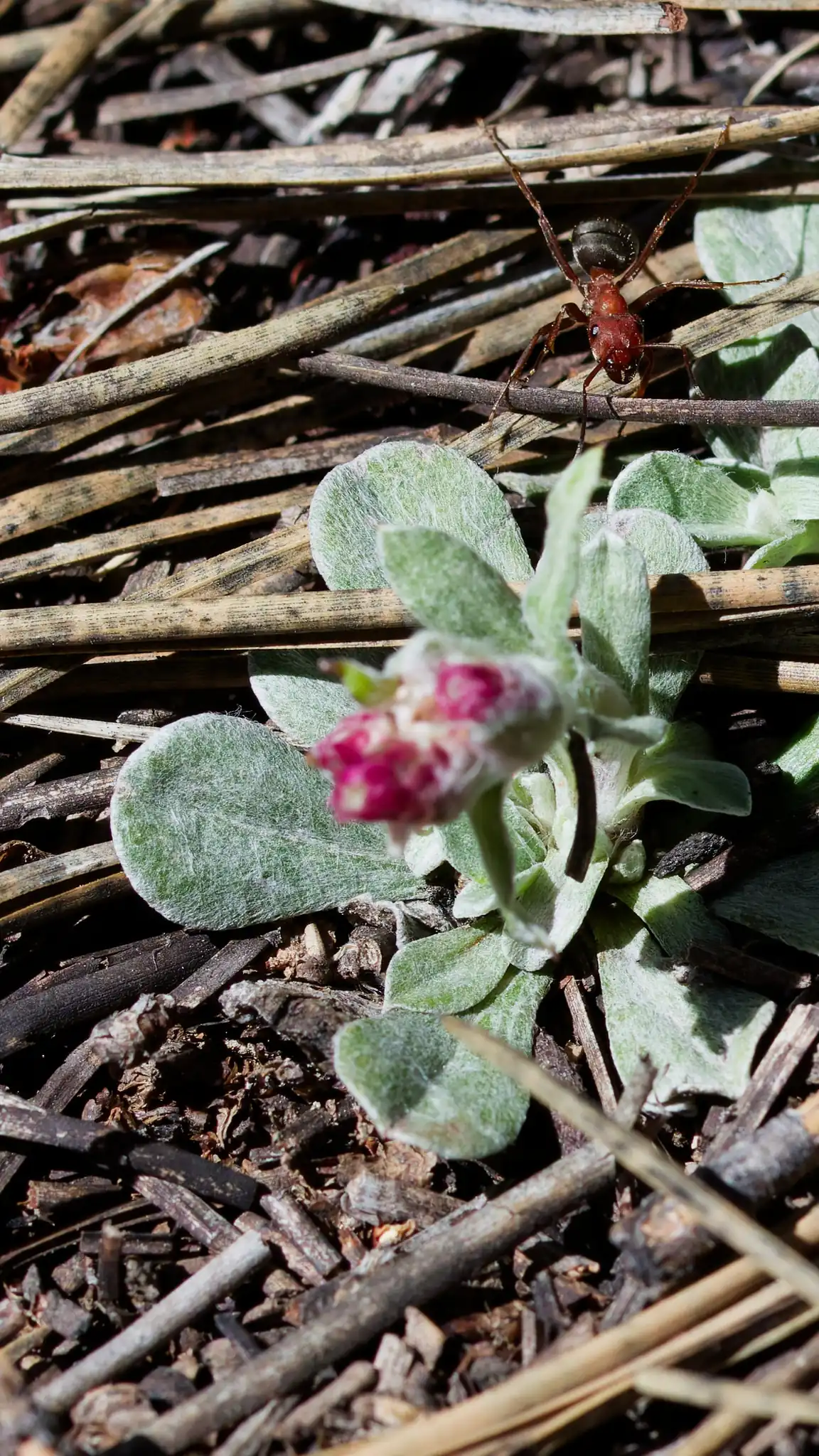
Antennaria rosea is a mat-forming North American perennial that spreads by stolons to form low evergreen rosettes. The leaves are spoon-shaped and covered in dense felted hairs that give the mat a silvery gray-green cast and reduce water loss.
It is dioecious, with male and female flowers borne on separate plants in tight clusters of rayless heads. The papery bracts around each head open pink to rose and age toward white or reddish-brown, while the central discs remain white.
Uses & Benefits:
Essentials
At a Glance
Plant Type
Groundcover
Height
12"
Width
15"
Light
Full Sun
Zones
4, 5, 6, 7, 8
Water
Low
Humidity
Low
Lifespan
Perennial
Native To
North America
Toxicity
Non-toxic
Bloom period
Early summer – Late summer
In flower about 3 months of the year
Planting
How to Grow
- Set plants 12 inches apart in full sun in sandy or rocky soil with pH 4.8 to 7.4.
- Plant crowns level with the soil surface over a gravel mulch to keep rosettes dry.
- Water to establish, then keep dry to average; never leave standing water around the mat.
- Remove spent flower stems after bloom and clear dead foliage to keep the mat tight.
Pro Tip
Plant it high on a gravel mulch and never let winter water stand around the crowns; wet soil kills it faster than cold.
Keep It Thriving
Care Guide
Do
- Grow in very well-drained soil with drip irrigation and open airflow
- Divide congested mats in spring every 2 to 3 years
- Top-dress with gravel to lift crowns above winter wet
Don't
- Do not plant in heavy clay or low spots that hold water
- Do not water overhead in humid weather
- Do not bury crowns under organic mulch that holds moisture
Seasonal Care Calendar
| Task | Jan | Feb | Mar | Apr | May | Jun | Jul | Aug | Sep | Oct | Nov | Dec |
|---|---|---|---|---|---|---|---|---|---|---|---|---|
| Divide | ||||||||||||
| Pest Check | ||||||||||||
| Plant | ||||||||||||
| Prune | ||||||||||||
| Winter Prep |
Watch Out For
Pests & Diseases
Common Pests
Common Diseases
In the Garden
Landscape Uses & Companions
Landscape Uses
Multiply
Propagation Methods
Good to Know
Common Questions
Rosy Pussytoes questions
What zones can Rosy Pussytoes grow in?
Rosy Pussytoes is hardy in USDA Zones 4–8: in that range it survives winter in the ground. Warmer than Zone 8, winter isn't the problem: it prefers colder winters, and summer heat can shorten its life.
Is Rosy Pussytoes deer resistant?
Yes — Rosy Pussytoes is rated deer-resistant. Deer typically pass it over, though extreme hunger can override any plant's defenses.
When does Rosy Pussytoes bloom?
Rosy Pussytoes typically blooms in summer. Exact timing shifts a week or two with your zone — Sow's bloom calendar maps it to your garden.
Does Rosy Pussytoes need full sun?
Rosy Pussytoes does best in full sun (6+ hours).
Is Rosy Pussytoes drought tolerant?
Yes — once established (usually after the first full season), Rosy Pussytoes handles dry spells with minimal watering. Water deeply its first year to build the root system that makes that possible.
More Antennaria to compare
Keep exploring
Explore the genus
Hardy in your zone?
Grow Rosy Pussytoes with confidence
See it in a design of your actual yard, get zone-matched care reminders, and track it season by season in your garden journal.