The Story
Plant Bio
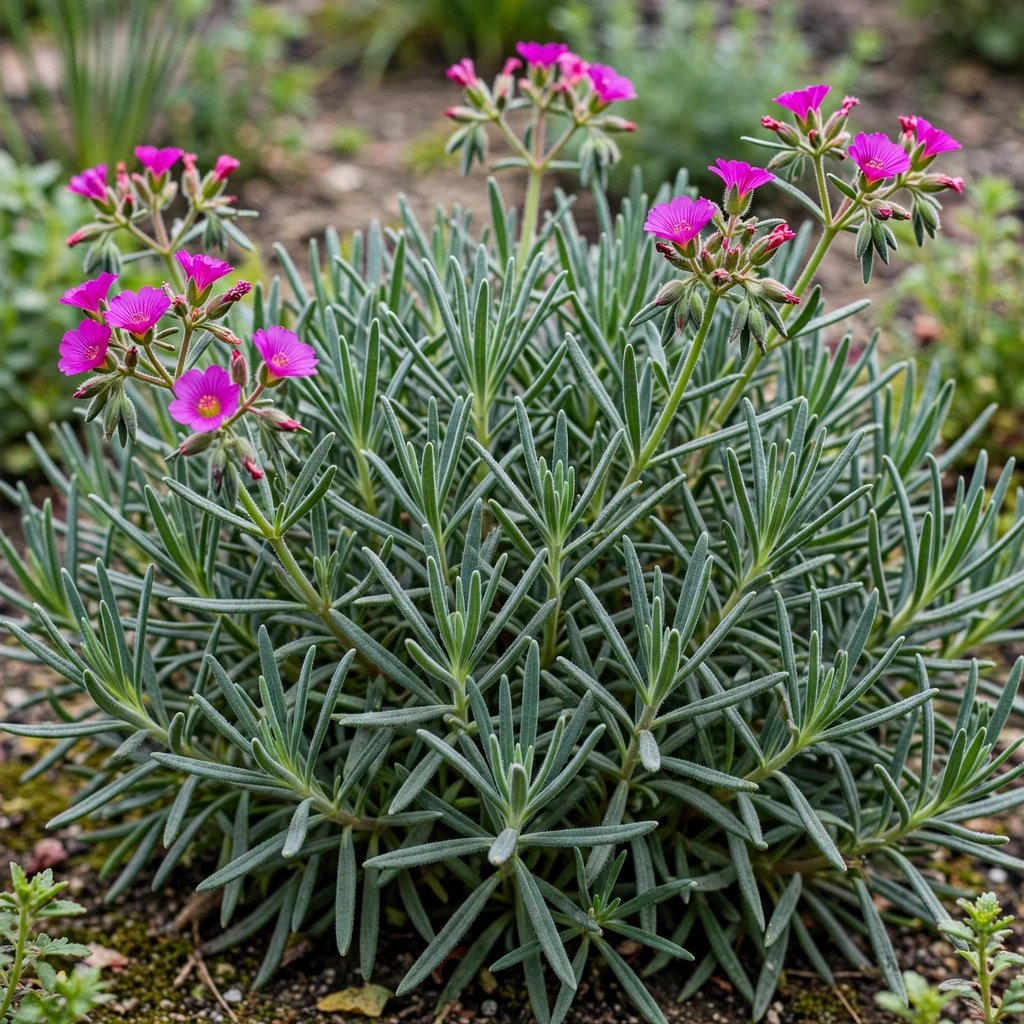
Calandrinia umbellata, sold as rock purslane though now placed as Montiopsis umbellata, is a tufted evergreen perennial from arid stony slopes and interior valleys of Chile and Argentina, forming a loose mound about six inches high and eight inches wide. It holds narrow succulent bluish-green to gray-green hairy leaves that stay evergreen, topped in summer by loose umbel-like clusters of cup-shaped magenta to crimson-violet flowers.
Unlike larger purslanes it stays a tight short-lived tuft that blooms as a terminal corymb of six to thirty upturned three-quarter-inch cups, each with five to seven petals and two sepals. It demands sharp gritty drainage and dies in standing winter water, thriving in hot dry sun once established and dropping seed freely so seedlings replace the mother plant.
Uses & Benefits:
Essentials
At a Glance
Plant Type
Perennial
Height
6"
Width
8"
Light
Full Sun, Partial Sun
Zones
7, 8, 9, 10
Water
Low
Humidity
Low
Lifespan
Short-lived perennial
Native To
Chile, Argentina
Toxicity
Possibly toxic
Bloom period
Early summer – Fall
In flower about 6 months of the year
Planting
How to Grow
- Plant in full sun in gritty sandy or rocky soil that drains instantly.
- Set crowns at soil level in spring after frost, spacing eight inches apart.
- Water in once, then water sparingly only during prolonged dry heat.
- Trim spent flower stems to extend bloom and leave a few pods to self-sow.
- Shelter from winter rain with an overhang or gravel mulch; do not use bark that holds water.
Pro Tip
Site it in sheltered scree that never puddles in winter; cold rarely kills it, wet soil does, so let self-sown seedlings renew the clump rather than cutting into old wood.
Keep It Thriving
Care Guide
Do
- Plant in sharp sand and gravel with no standing water
- Give full hot sun with airflow
- Allow some seed to drop to renew short-lived clumps
Don't
- Do not overwater or fertilize richly
- Do not cut into the old woody base
- Do not plant in clay or low wet ground
Seasonal Care Calendar
| Task | Jan | Feb | Mar | Apr | May | Jun | Jul | Aug | Sep | Oct | Nov | Dec |
|---|---|---|---|---|---|---|---|---|---|---|---|---|
| Deadhead | ||||||||||||
| Pest Check | ||||||||||||
| Plant | ||||||||||||
| Propagate | ||||||||||||
| Winter Prep |
Watch Out For
Pests & Diseases
Common Pests
Common Diseases
In the Garden
Landscape Uses & Companions
Landscape Uses
Companion Plants
Multiply
Propagation Methods
Good to Know
Common Questions
Rock Purslane questions
What zones can Rock Purslane grow in?
Rock Purslane is hardy in USDA Zones 7–10: in that range it survives winter in the ground. Colder than Zone 7, grow it in a container you can move to shelter for the winter, or as an annual.
When does Rock Purslane bloom?
Rock Purslane typically blooms from summer to fall. Exact timing shifts a week or two with your zone — Sow's bloom calendar maps it to your garden.
Does Rock Purslane need full sun?
Rock Purslane does best in full sun to part shade. In hot climates, afternoon shade keeps blooms fresher longer.
Is Rock Purslane drought tolerant?
Yes — once established (usually after the first full season), Rock Purslane handles dry spells with minimal watering. Water deeply its first year to build the root system that makes that possible.
More Calandrinia to compare
Keep exploring
Explore the genus
Hardy in your zone?
Grow Rock Purslane with confidence
See it in a design of your actual yard, get zone-matched care reminders, and track it season by season in your garden journal.