The Story
Plant Bio
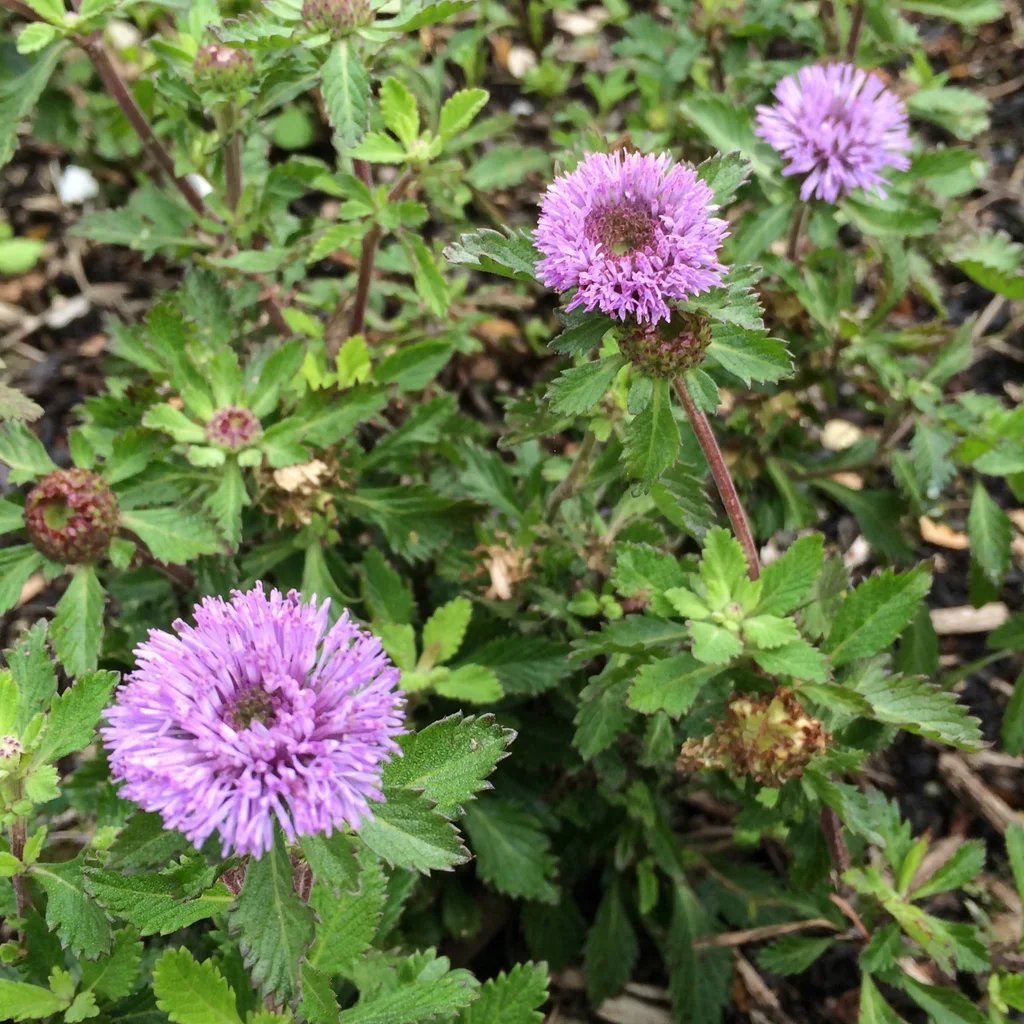
Centratherum punctatum, still sold as Centratherum intermedium, is a spreading tender perennial reaching 1 to 2 feet tall and 2 to 4 feet wide with alternate elliptic olive to light green leaves 2 to 3 inches long with coarsely toothed margins and a light fragrance when crushed. The display comes from 1-inch fluffy button heads of lavender to pink disk florets with no rays, borne on leafy stems through the warm months into fall.
Plants labelled Centratherum intermedium are this same species, a fast mound that sprawls and self-seeds where summers are long and whose crown is killed outright by hard frost. The selection 'Pineapple Sangria' holds the same lavender-blue buttons from early summer to first hard frost on a dense 2-foot mound whose foliage smells of pineapple when crushed.
Uses & Benefits:
Essentials
At a Glance
Plant Type
Perennial
Height
24"
Width
36"
Light
Full Sun, Partial Sun
Zones
9, 10
Water
Low to moderate
Humidity
Low to average
Lifespan
Tender perennial, annual in frost zones
Native To
Central and South America
Toxicity
Unknown
Bloom period
Summer – Fall
In flower about 6 months of the year
Planting
How to Grow
- Plant out after last frost in full sun to partial shade in well-drained sand, loam, or clay.
- Space 36 to 60 inches apart to allow sprawling stems to close into a mound.
- Water to establish, then water sparingly; established plants tolerate drought but not frozen soil.
- Deadhead spent buttons to limit self-seeding and shear lightly to keep the mound dense.
- Pull and compost after first hard frost except in zones 9 to 11, where crowns resprout in spring.
Pro Tip
Deadhead before seed ripens and shear sprawling stems back to a leaf node; crowns resprout in spring in zones 9 to 11 and are killed by freezing farther north.
Keep It Thriving
Care Guide
Do
- Plant in full sun for densest growth and most buttons.
- Provide sharp drainage in sand, loam, or clay.
- Deadhead to control self-seeding.
Don't
- Do not expect crowns to survive freezing; treat as annual north of zone 9.
- Do not plant where self-seeding is unwanted, as it reseeds freely.
Seasonal Care Calendar
| Task | Jan | Feb | Mar | Apr | May | Jun | Jul | Aug | Sep | Oct | Nov | Dec |
|---|---|---|---|---|---|---|---|---|---|---|---|---|
| Deadhead | ||||||||||||
| Plant | ||||||||||||
| Propagate | ||||||||||||
| Prune | ||||||||||||
| Winter Prep |
Watch Out For
Pests & Diseases
Common Pests
Common Diseases
In the Garden
Landscape Uses & Companions
Landscape Uses
Multiply
Propagation Methods
Good to Know
Common Questions
Brazilian Buttonflower questions
What zones can Brazilian Buttonflower grow in?
Brazilian Buttonflower is hardy in USDA Zones 9–10: in that range it survives winter in the ground. Colder than Zone 9, grow it in a container you can move to shelter for the winter, or as an annual.
When does Brazilian Buttonflower bloom?
Brazilian Buttonflower typically blooms from summer to fall. Exact timing shifts a week or two with your zone — Sow's bloom calendar maps it to your garden.
Does Brazilian Buttonflower need full sun?
Brazilian Buttonflower does best in full sun to part shade. In hot climates, afternoon shade keeps blooms fresher longer.
Is Brazilian Buttonflower drought tolerant?
Yes — once established (usually after the first full season), Brazilian Buttonflower handles dry spells with minimal watering. Water deeply its first year to build the root system that makes that possible.
Keep exploring
Explore the genus
Hardy in your zone?
Grow Brazilian Buttonflower with confidence
See it in a design of your actual yard, get zone-matched care reminders, and track it season by season in your garden journal.