The Story
Plant Bio
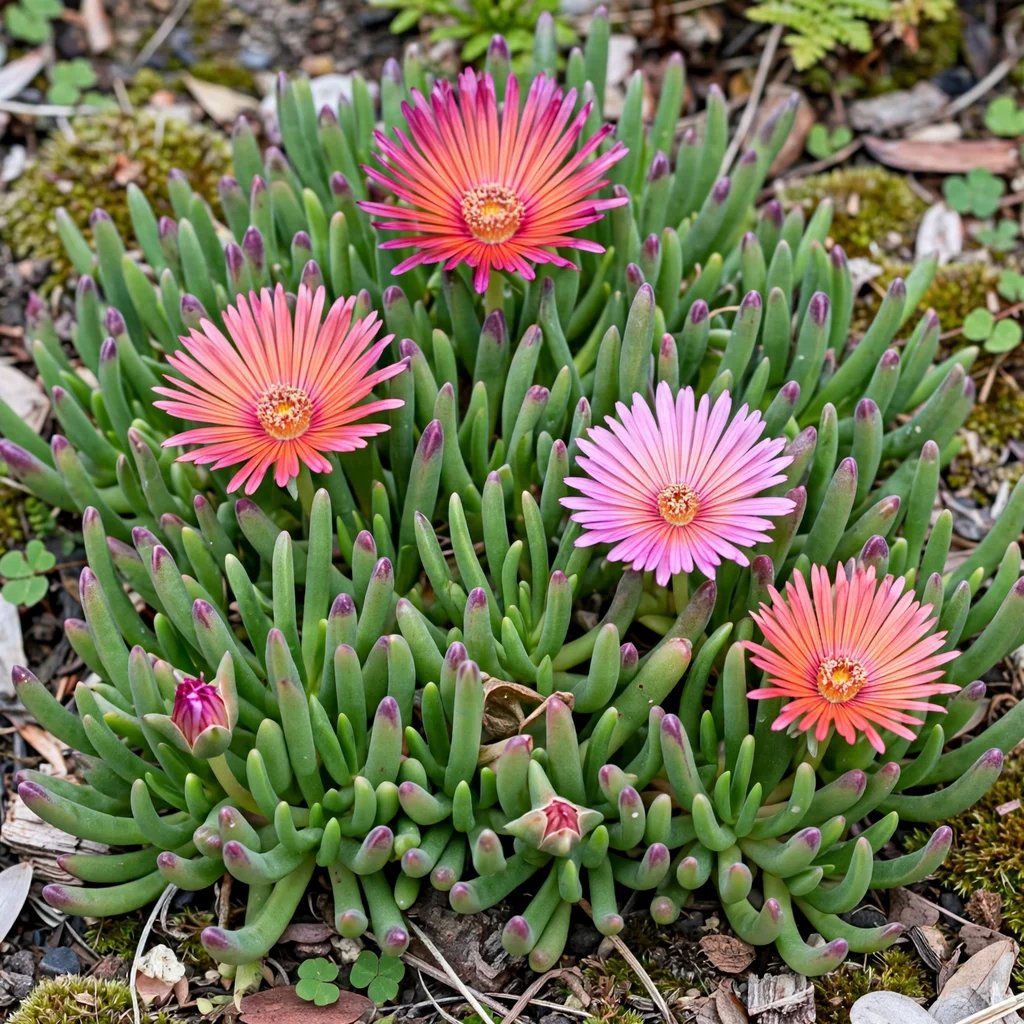
Cephalophyllum framesii is a mat-forming evergreen succulent from South Africa that spreads by creeping stems which are red when young and gray with age. The foliage is held in clusters of thick, upright, three-sided leaves that grow through winter and rest during hot, dry summers.
Plants still sold as 'stayneri' make a carpet 3 to 4 inches high and up to 3 feet wide, with 2- to 3-inch green leaves that are rounded behind, flat in front, and tipped purple-red in sun. The 1.5-inch daisy flowers sit just above the leaves in winter into spring, deep pink tinged orange with a yellow center.
Uses & Benefits:
Essentials
At a Glance
Plant Type
Cactus Succulent
Height
4"
Width
36"
Light
Full Sun, Partial Sun
Zones
9, 10
Water
Low
Humidity
Low - dry tolerant
Lifespan
Perennial succulent
Native To
South Africa
Toxicity
Unknown
Bloom period
Winter – Spring
In flower about 6 months of the year
Planting
How to Grow
- Plant in spring after frost in full sun to light shade.
- Set the crown at soil level in very well-drained sandy or gritty soil.
- Water in once, then water sparingly through winter growth.
- Keep dry in summer heat; resume light watering with cool fall growth.
- Protect pots below 25F.
Pro Tip
Plant it high on sharp sand or grit and hold off summer water; soak lightly only when growth resumes in cool weather.
Keep It Thriving
Care Guide
Do
- Give full sun with some light shade inland.
- Use very sharp drainage with sand or grit.
- Water sparingly during winter growth.
Don't
- Do not plant in heavy clay or wet soil.
- Do not irrigate heavily in summer dormancy.
- Do not expose to temperatures below 25F.
Seasonal Care Calendar
| Task | Jan | Feb | Mar | Apr | May | Jun | Jul | Aug | Sep | Oct | Nov | Dec |
|---|---|---|---|---|---|---|---|---|---|---|---|---|
| Deadhead | ||||||||||||
| Pest Check | ||||||||||||
| Plant | ||||||||||||
| Winter Prep |
Watch Out For
Pests & Diseases
Common Pests
Common Diseases
In the Garden
Landscape Uses & Companions
Landscape Uses
Companion Plants
Multiply
Propagation Methods
Good to Know
Common Questions
Stayner's Ice Plant questions
What zones can Stayner's Ice Plant grow in?
Stayner's Ice Plant is hardy in USDA Zones 9–10: in that range it survives winter in the ground. Colder than Zone 9, grow it in a container you can move to shelter for the winter, or as an annual.
When does Stayner's Ice Plant bloom?
Stayner's Ice Plant typically blooms from winter to spring. Exact timing shifts a week or two with your zone — Sow's bloom calendar maps it to your garden.
Does Stayner's Ice Plant need full sun?
Stayner's Ice Plant does best in full sun to part shade. In hot climates, afternoon shade keeps blooms fresher longer.
Is Stayner's Ice Plant drought tolerant?
Yes — once established (usually after the first full season), Stayner's Ice Plant handles dry spells with minimal watering. Water deeply its first year to build the root system that makes that possible.
Keep exploring
Explore the genus
Hardy in your zone?
Grow Stayner's Ice Plant with confidence
See it in a design of your actual yard, get zone-matched care reminders, and track it season by season in your garden journal.