The Story
Plant Bio
Adromischus maculatus is a low mat-forming perennial succulent from the Western and Eastern Cape with short woody decumbent stems to six inches and fibrous roots that form small clusters. Its thick water-storing leaves and sharply drained sandstone habitat explain its need for gritty mix and a strict soak-dry cycle in cultivation.
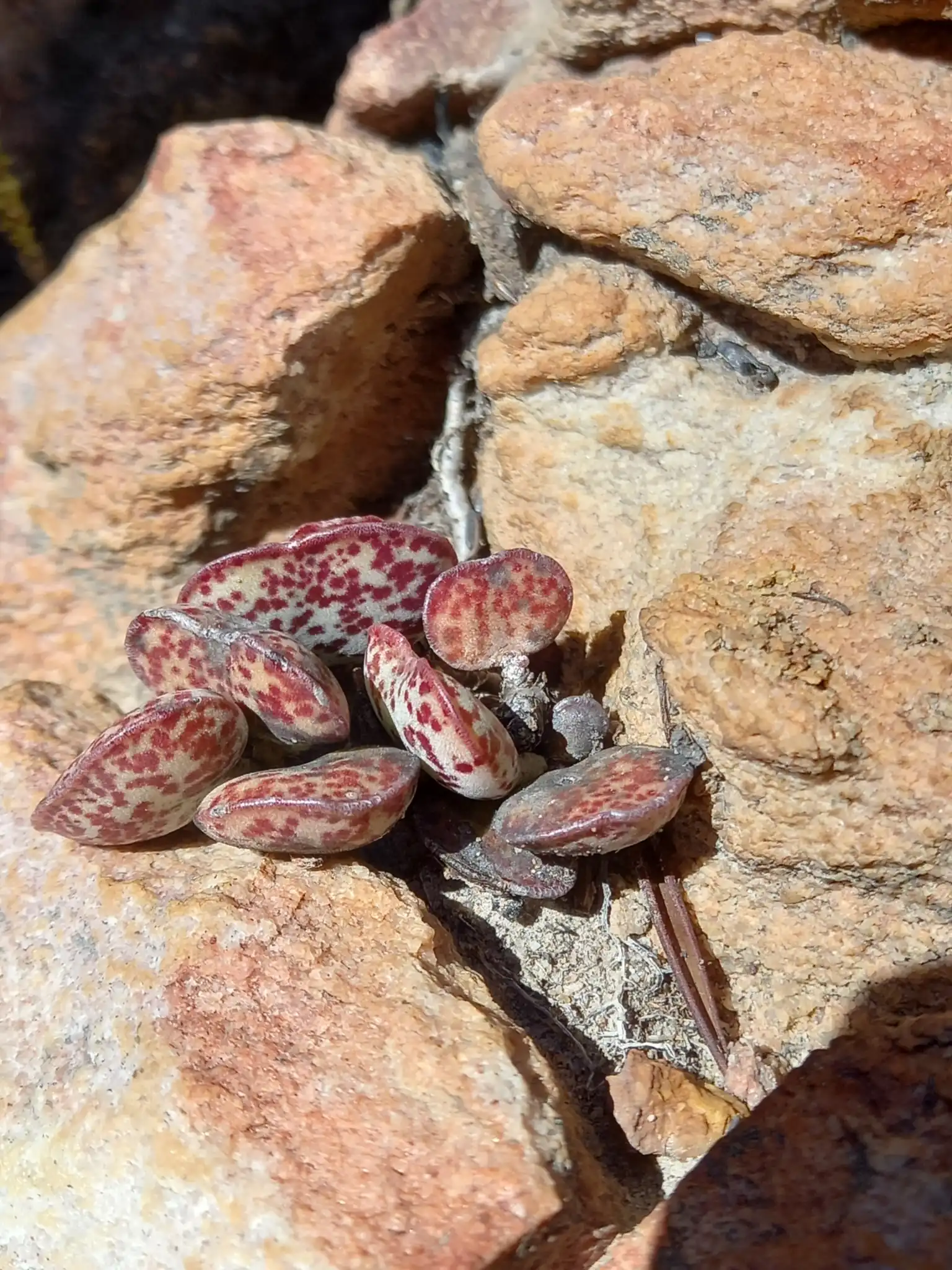
This species is distinguished by flat obovate wedge-shaped leaves to nearly three inches long with a horny margin, glossy green to scarlet in sun and marbled with chocolate-purple spots that are often absent on young growth. Summer brings an erect grey-green thyrse to fourteen inches with small tubular pale yellowish-green flowers whose recurved lobes are white to pale pink edged mauve.
Uses & Benefits:
Essentials
At a Glance
Plant Type
Cactus Succulent
Height
6"
Width
8"
Light
Full Sun, Partial Sun
Zones
9, 10
Water
Low
Humidity
Low
Lifespan
Perennial
Native To
South Africa
Toxicity
Toxic if ingested
Bloom period
Summer
In flower about 3 months of the year
Planting
How to Grow
- Plant in a small clay pot with drainage holes in 50-70% coarse grit mixed with cactus compost.
- Place in full sun to light shade with 6-8 hours bright light, acclimating gradually to prevent scorch.
- Water by soaking only when the mix is fully dry from spring to fall, keeping it completely dry in winter.
- Overwinter indoors on a sunny sill under grow lights if needed, holding above 40F with dry air and ventilation.
- Repot only when crowded in spring, handling leaves minimally because they detach easily.
Pro Tip
Pot in 50-70% mineral grit in a container with drainage holes and water only when the mix is completely dry, keeping it dry and frost-free near 45F in winter.
Keep It Thriving
Care Guide
Do
- Give 6-8 hours bright light and acclimate to full sun for best leaf color and spots.
- Use a small pot with drainage holes and sharply draining gritty mix.
- Water deeply then allow to dry fully, withholding water in winter.
- Isolate new plants and check axils for mealybugs before placing with collection.
Don't
- Do not overwater or leave in wet soil, which causes root and stem rot.
- Do not move abruptly into midday sun without acclimation.
- Do not wet leaves or crowd without ventilation.
- Do not cut into old woody stems to reshape bare plants.
Seasonal Care Calendar
| Task | Jan | Feb | Mar | Apr | May | Jun | Jul | Aug | Sep | Oct | Nov | Dec |
|---|---|---|---|---|---|---|---|---|---|---|---|---|
| Pest Check | ||||||||||||
| Plant | ||||||||||||
| Propagate | ||||||||||||
| Prune | ||||||||||||
| Winter Prep |
Watch Out For
Pests & Diseases
Common Pests
Common Diseases
In the Garden
Landscape Uses & Companions
Landscape Uses
Multiply
Propagation Methods
Good to Know
Common Questions
Calico Hearts questions
What zones can Calico Hearts grow in?
Calico Hearts is hardy in USDA Zones 9–10: in that range it survives winter in the ground. Colder than Zone 9, grow it in a container you can move to shelter for the winter, or as an annual.
When does Calico Hearts bloom?
Calico Hearts typically blooms in summer. Exact timing shifts a week or two with your zone — Sow's bloom calendar maps it to your garden.
Does Calico Hearts need full sun?
Calico Hearts does best in full sun to part shade. In hot climates, afternoon shade keeps blooms fresher longer.
Is Calico Hearts drought tolerant?
Yes — once established (usually after the first full season), Calico Hearts handles dry spells with minimal watering. Water deeply its first year to build the root system that makes that possible.
Keep exploring
Explore the genus
Hardy in your zone?
Grow Calico Hearts with confidence
See it in a design of your actual yard, get zone-matched care reminders, and track it season by season in your garden journal.