The Story
Plant Bio
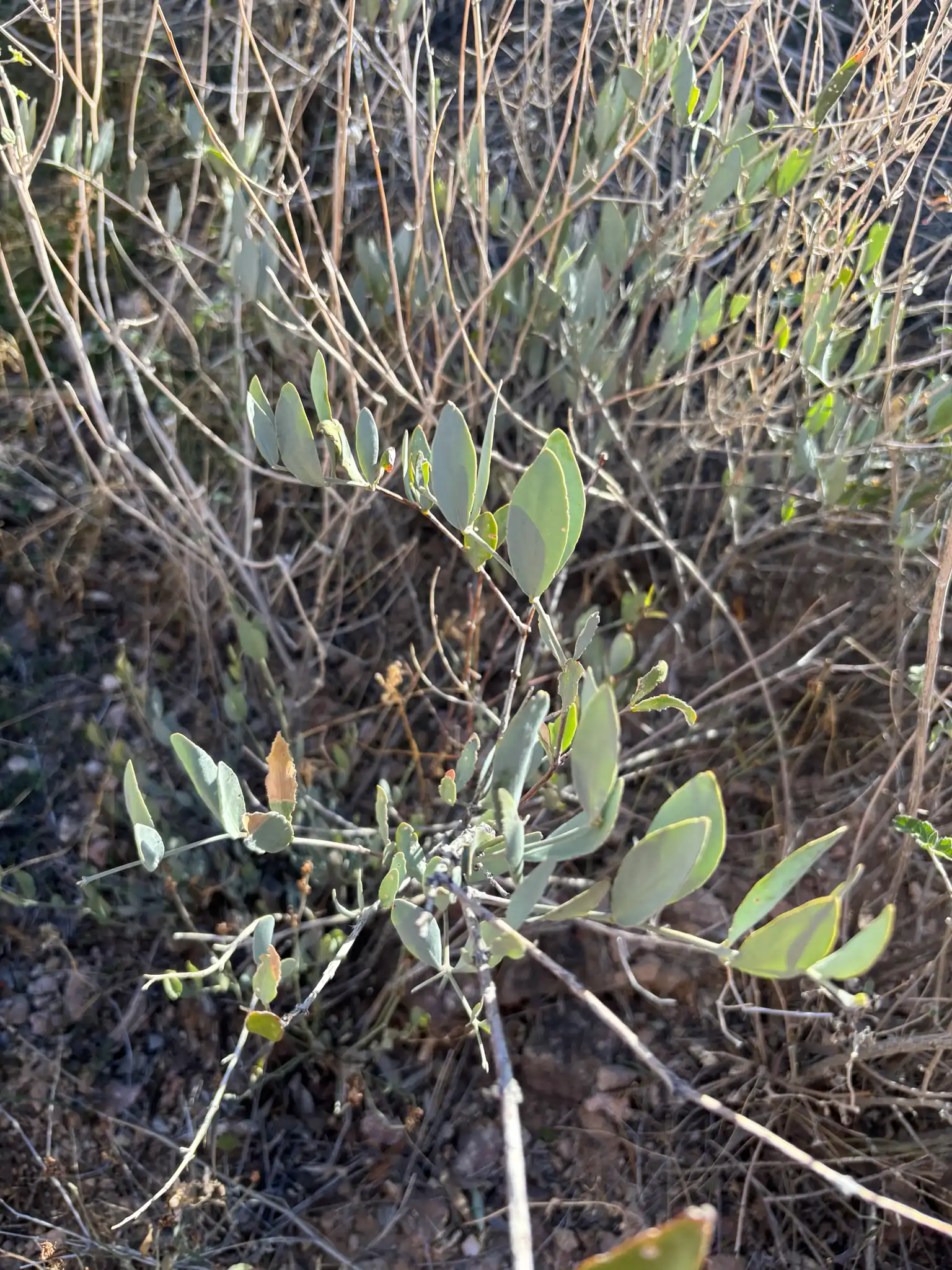
Simmondsia chinensis, commonly known as jojoba, is a dense, multi-stemmed evergreen shrub native to the arid Sonoran and Mojave deserts. It bears thick, leathery, blue-green leaves held vertically to minimize direct solar radiation and water loss during drought.
This dioecious species produces separate male and female plants, relying on wind currents rather than insects for pollination. Female plants form capsule-encased seeds that yield a unique liquid wax ester widely harvested for cosmetic and industrial use.
Uses & Benefits:
Essentials
At a Glance
Plant Type
Shrub
Height
177"
Width
118"
Light
Full Sun
Zones
8, 9, 10
Water
Low
Humidity
Low
Lifespan
Long-lived
Native To
North America
Toxicity
Seeds toxic if ingested by non-ruminants
Bloom period
Winter – Spring
In flower about 6 months of the year
Planting
How to Grow
- Select a location in full sun with gritty, fast-draining mineral soil.
- Space plants 5 to 10 feet apart to accommodate mature rounded growth.
- Water deeply at planting, then reduce frequency to mimic dry desert conditions once roots establish.
- Ensure both male and female plants are planted nearby if nut production is intended.
Pro Tip
Plant both male and female specimens within wind distance if seed formation is desired, and never cut back into old leafless wood, as stems lack dormant interior buds and will not resprout.
Keep It Thriving
Care Guide
Do
- Provide full sun exposure to maintain a dense, compact branching structure.
- Plant in coarse, well-draining soil to prevent root rot pathogens.
- Include both male and female plants in the layout for seed production.
Don't
- Do not overwater or plant in heavy clay soils that retain moisture.
- Do not prune hard into leafless woody branches.
- Do not plant in shaded locations where growth becomes sparse and leggy.
Seasonal Care Calendar
| Task | Jan | Feb | Mar | Apr | May | Jun | Jul | Aug | Sep | Oct | Nov | Dec |
|---|---|---|---|---|---|---|---|---|---|---|---|---|
| Harvest | ||||||||||||
| Pest Check | ||||||||||||
| Plant | ||||||||||||
| Propagate | ||||||||||||
| Prune |
Watch Out For
Pests & Diseases
Common Pests
Common Diseases
In the Garden
Landscape Uses & Companions
Landscape Uses
Multiply
Propagation Methods
Good to Know
Common Questions
Jojoba questions
What zones can Jojoba grow in?
Jojoba is hardy in USDA Zones 8–10: in that range it survives winter in the ground. Colder than Zone 8, grow it in a container you can move to shelter for the winter.
Is Jojoba deer resistant?
Not reliably. Deer may browse Jojoba, especially tender spring growth — plan on repellents or fencing where pressure is high.
When does Jojoba bloom?
Jojoba typically blooms from winter to spring. Exact timing shifts a week or two with your zone — Sow's bloom calendar maps it to your garden.
Does Jojoba need full sun?
Jojoba does best in full sun (6+ hours).
Is Jojoba drought tolerant?
Yes — once established (usually after the first full season), Jojoba handles dry spells with minimal watering. Water deeply its first year to build the root system that makes that possible.
Keep exploring
Explore the genus
Hardy in your zone?
Grow Jojoba with confidence
See it in a design of your actual yard, get zone-matched care reminders, and track it season by season in your garden journal.