The Story
Plant Bio
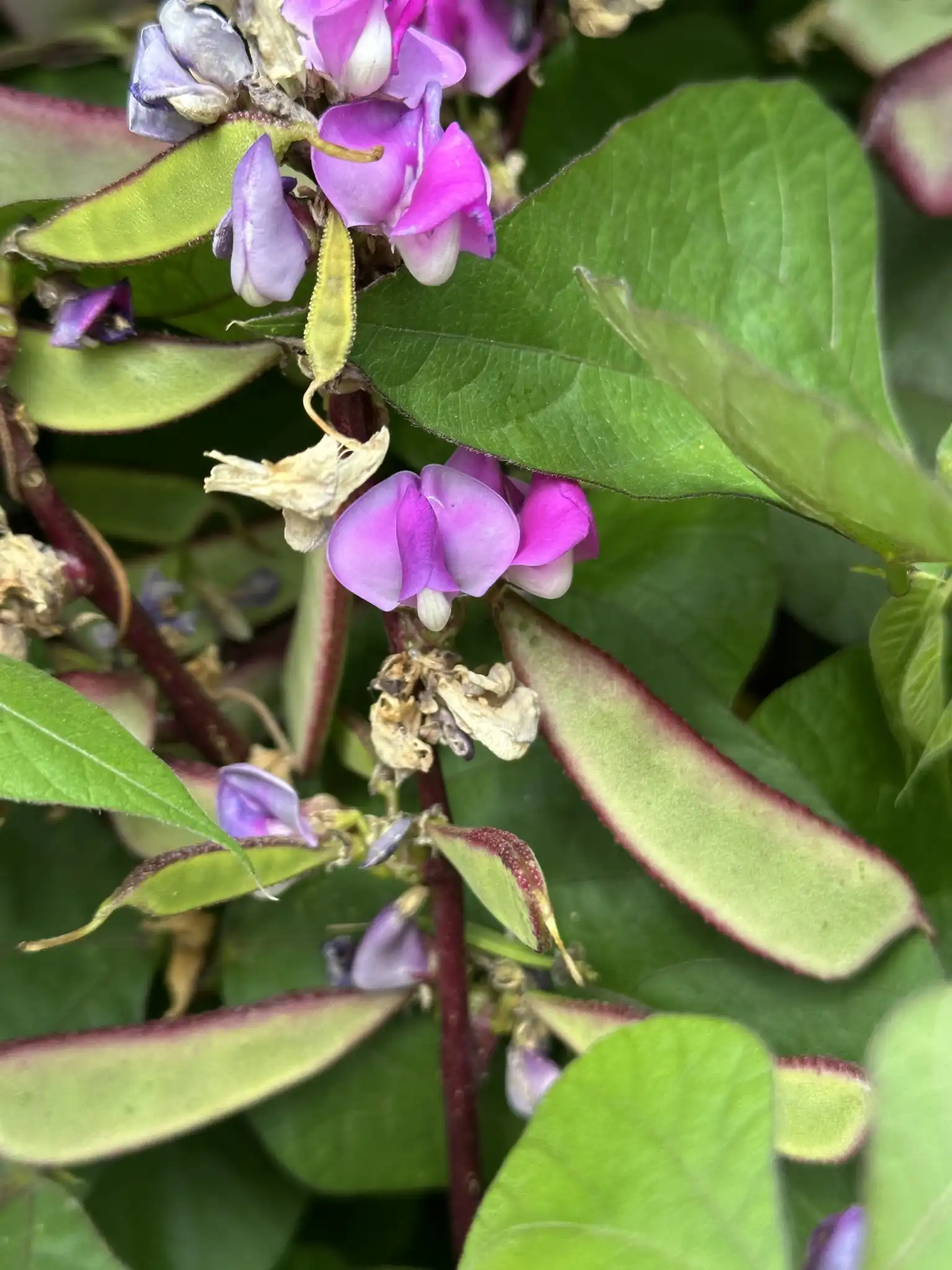
Lablab purpureus, the hyacinth bean, is a fast-growing twining herbaceous perennial from Africa grown as an annual where frost occurs, reaching ten to twenty feet on a trellis in one season. Its trifoliate leaves are purple-tinged and coarse-textured, dark green above with purple undersides, forming a dense screen through summer until frost.
Axillary racemes of violet-purple sweet-pea-like fragrant flowers open from summer to fall, followed by showy pendulous flat purple pods that extend the display. White-flowered forms exist, and daylength-sensitive pole types require tall support with room at the top to bloom and set pods before frost.
Uses & Benefits:
Essentials
At a Glance
Plant Type
Vine
Height
240"
Width
180"
Light
Full Sun, Partial Sun
Zones
9, 10
Water
Moderate
Humidity
Tolerates heat and humidity
Lifespan
Short-lived perennial grown as annual
Native To
Africa
Toxicity
Poisonous raw dry seeds
Bloom period
Summer – Fall
In flower about 6 months of the year
Planting
How to Grow
- Sow after all frost danger in full sun in moderately to well-drained sand to clay soil.
- Nick seed and soak 24 hours, then sow 1 inch deep and space 12 to 24 inches at the base of a stout trellis, fence or poles.
- Train young shoots to the support as they grow and allow room at the top for the twining stems.
- Water to establish and through dry spells; avoid waterlogged soil and overhead watering.
Pro Tip
Withhold nitrogen fertilizer to keep flowering strong, train the vine to the top of its support early, and remove spent pods to prolong bloom.
Keep It Thriving
Care Guide
Do
- Grow in full sun with a tall, sturdy trellis or fence.
- Remove spent pods to prolong flowering.
- Rotate planting location yearly to reduce nematode and soil disease buildup.
Don't
- Do not apply high-nitrogen fertilizer; it produces leaves at the expense of flowers.
- Do not eat dry mature seeds raw; they contain cyanogenic glycosides.
- Do not leave vines waterlogged or overhead-watered.
Seasonal Care Calendar
| Task | Jan | Feb | Mar | Apr | May | Jun | Jul | Aug | Sep | Oct | Nov | Dec |
|---|---|---|---|---|---|---|---|---|---|---|---|---|
| Deadhead | ||||||||||||
| Harvest | ||||||||||||
| Pest Check | ||||||||||||
| Plant | ||||||||||||
| Stake |
Watch Out For
Pests & Diseases
Common Pests
Common Diseases
In the Garden
Landscape Uses & Companions
Landscape Uses
Companion Plants
Multiply
Propagation Methods
Good to Know
Common Questions
Hyacinth Bean questions
What zones can Hyacinth Bean grow in?
Hyacinth Bean is hardy in USDA Zones 9–10: in that range it survives winter in the ground. Colder than Zone 9, grow it in a container you can move to shelter for the winter, or as an annual.
When does Hyacinth Bean bloom?
Hyacinth Bean typically blooms from summer to fall. Exact timing shifts a week or two with your zone — Sow's bloom calendar maps it to your garden.
Does Hyacinth Bean need full sun?
Hyacinth Bean does best in full sun to part shade. In hot climates, afternoon shade keeps blooms fresher longer.
Keep exploring
Explore the genus
Hardy in your zone?
Grow Hyacinth Bean with confidence
See it in a design of your actual yard, get zone-matched care reminders, and track it season by season in your garden journal.