The Story
Plant Bio
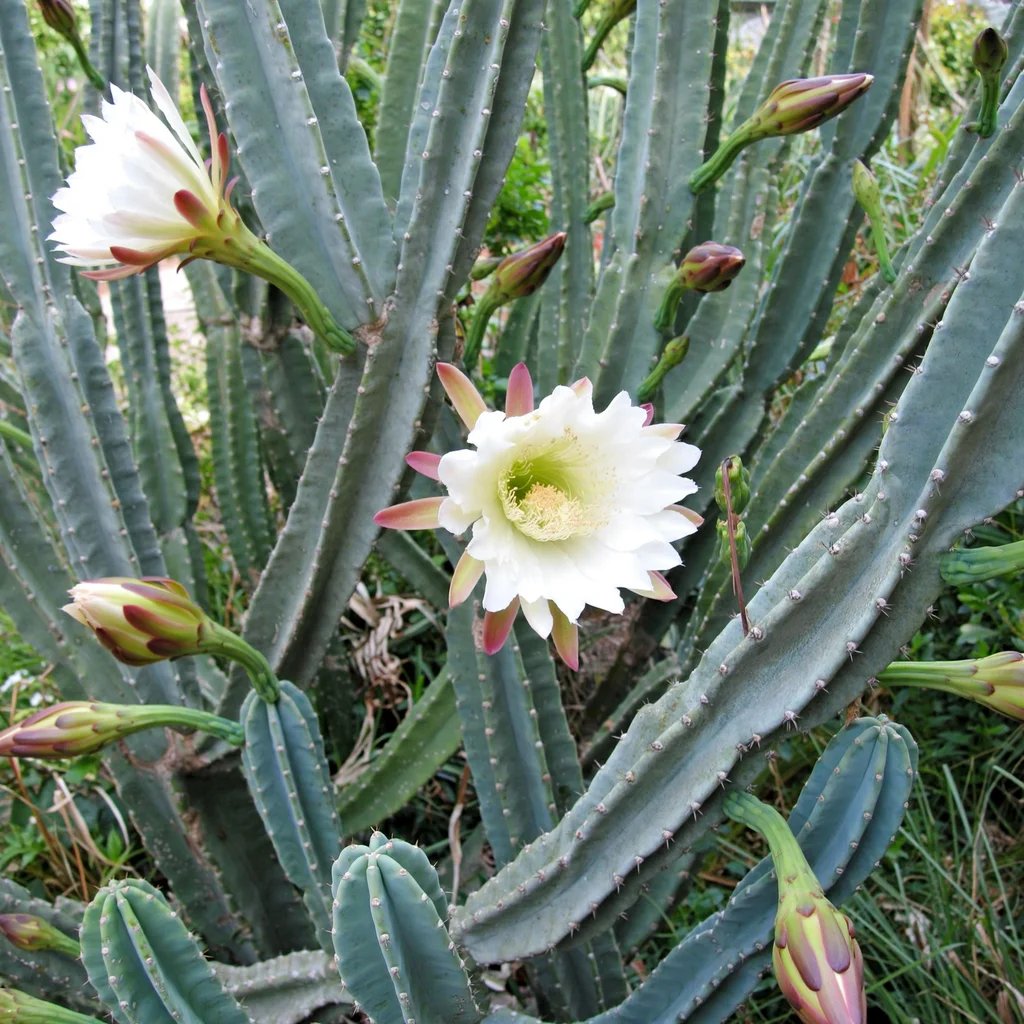
Cereus hildmannianus is a tall columnar cactus from South America that builds a distinct woody trunk and branches from the base into a candelabra of ribbed blue-green stems. Mature garden plants reach 10 to 15 feet tall with a spread to 15 feet, with 4 to 6 ribs lined with short brown to gold spines to nearly 1 inch long.
The flowers are solitary white funnels 6 to 12 inches long that open at night and collapse by day, followed by red egg-shaped fruit when pollinated. Plants are often sold as C. peruvianus, C. repandus or C. uruguayanus in the same complex, and many nursery selections are nearly spineless.
Uses & Benefits:
Essentials
At a Glance
Plant Type
Cactus Succulent
Height
180"
Width
180"
Light
Full Sun, Partial Sun
Zones
9, 10
Water
Low
Humidity
Low, prefers dry air
Lifespan
Long-lived perennial
Native To
South America: NE Argentina, Bolivia, S Brazil, Paraguay, Uruguay
Toxicity
Non-toxic to humans, cats and dogs; spines cause injury
Bloom period
Summer
In flower about 3 months of the year
Planting
How to Grow
- Plant in full sun with afternoon shade in hot inland sites in sharply draining soil.
- Set the root ball level with the soil surface and stake tall columns until anchored.
- Water deeply then allow the soil to dry completely before watering again.
- Protect below about 25F by moving containers under cover and covering stem tips on in-ground plants.
Pro Tip
Water deeply only once the soil has dried through, because prolonged wet soil rots the roots faster than drought harms the stems.
Keep It Thriving
Care Guide
Do
- Give full sun with afternoon shade in extreme heat.
- Water deeply and infrequently, letting soil dry between waterings.
- Wear heavy gloves and eye protection when handling spiny stems.
Don't
- Do not plant in poorly drained or constantly damp soil.
- Do not overwater in winter when growth slows.
- Do not prune except to remove damaged stems.
Seasonal Care Calendar
| Task | Jan | Feb | Mar | Apr | May | Jun | Jul | Aug | Sep | Oct | Nov | Dec |
|---|---|---|---|---|---|---|---|---|---|---|---|---|
| Fertilize | ||||||||||||
| Pest Check | ||||||||||||
| Plant | ||||||||||||
| Winter Prep |
Watch Out For
Pests & Diseases
Common Pests
Common Diseases
In the Garden
Landscape Uses & Companions
Landscape Uses
Multiply
Propagation Methods
Good to Know
Common Questions
Peruvian Apple Cactus questions
What zones can Peruvian Apple Cactus grow in?
Peruvian Apple Cactus is hardy in USDA Zones 9–10: in that range it survives winter in the ground. Colder than Zone 9, grow it in a container you can move to shelter for the winter, or as an annual.
When does Peruvian Apple Cactus bloom?
Peruvian Apple Cactus typically blooms in summer. Exact timing shifts a week or two with your zone — Sow's bloom calendar maps it to your garden.
Does Peruvian Apple Cactus need full sun?
Peruvian Apple Cactus does best in full sun to part shade. In hot climates, afternoon shade keeps blooms fresher longer.
Is Peruvian Apple Cactus drought tolerant?
Yes — once established (usually after the first full season), Peruvian Apple Cactus handles dry spells with minimal watering. Water deeply its first year to build the root system that makes that possible.
Keep exploring
Explore the genus
Hardy in your zone?
Grow Peruvian Apple Cactus with confidence
See it in a design of your actual yard, get zone-matched care reminders, and track it season by season in your garden journal.