The Story
Plant Bio
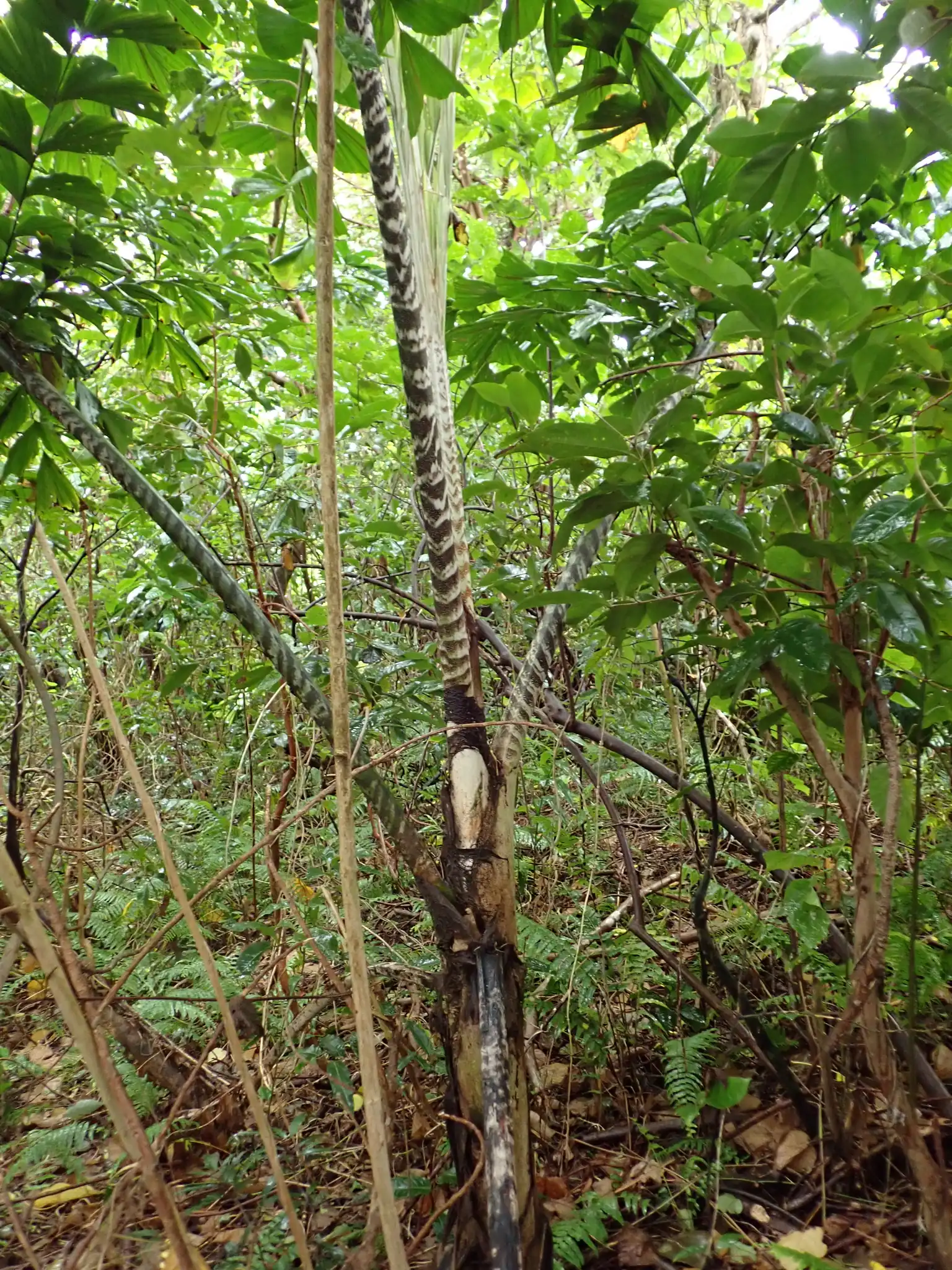
Caryota ophiopellis, the solitary snakeskin fishtail palm, is a single-stemmed understory palm from Vanuatu that reaches twenty to twenty-seven feet as grown on a trunk about eighteen inches thick. Its bipinnate fronds carry wedge-shaped fishtail leaflets in a neat arrangement, and at maturity it produces branched axillary inflorescences of cream monoecious flowers from the top downward, then fruits once and dies.
This species is distinguished by tiger-striped mottled petioles that give the snakeskin effect, combined with homogeneous endosperm in the seed that separates it from Caryota zebrina when young plants are otherwise indistinguishable. It is a slow grower for warm humid lowland gardens in filtered light and consistently moist well-drained soil, and the single stem must be removed after fruiting because the plant is strictly monocarpic.
Uses & Benefits:
Essentials
At a Glance
Plant Type
Tropical
Height
288"
Width
144"
Light
Partial Sun, Shade
Zones
10
Water
Medium
Humidity
High
Lifespan
Monocarpic; dies after flowering
Native To
Vanuatu - Tanna and Aneityum
Toxicity
Toxic - fruit pulp irritant
Bloom period
Year round
In flower about 12 months of the year
Planting
How to Grow
- Plant potted stock in spring in filtered light under high canopy where frost never occurs.
- Set the rootball level in consistently moist, well-drained soil enriched with leaf litter.
- Water to keep the root zone evenly moist through the warm season; do not let it dry hard.
- Remove only fully dead fronds; never cut into the trunk.
- Remove the whole stem at the base after it fruits and declines.
Pro Tip
Start seed-grown replacements well before maturity; the stem flowers once from the top down and then dies, so it is not a permanent canopy palm.
Keep It Thriving
Care Guide
Do
- Grow in semi-shade with shelter from full midday sun
- Keep soil evenly moist in a humid position
- Wear gloves and eye protection when handling fruit
Don't
- Do not plant where frost occurs or in exposed coastal salt wind
- Do not cut into green trunk tissue
- Do not eat the fruit pulp
Seasonal Care Calendar
| Task | Jan | Feb | Mar | Apr | May | Jun | Jul | Aug | Sep | Oct | Nov | Dec |
|---|---|---|---|---|---|---|---|---|---|---|---|---|
| Mulch | ||||||||||||
| Pest Check | ||||||||||||
| Plant | ||||||||||||
| Prune | ||||||||||||
| Winter Prep |
Watch Out For
Pests & Diseases
Common Pests
Common Diseases
In the Garden
Landscape Uses & Companions
Landscape Uses
Companion Plants
Multiply
Propagation Methods
Good to Know
Common Questions
Solitary Snakeskin Fishtail Palm questions
What zones can Solitary Snakeskin Fishtail Palm grow in?
Solitary Snakeskin Fishtail Palm is hardy in USDA Zone 10: in that range it survives winter in the ground. Colder than Zone 10, grow it in a container you can move to shelter for the winter, or as an annual.
When does Solitary Snakeskin Fishtail Palm bloom?
Solitary Snakeskin Fishtail Palm typically blooms year-round. Exact timing shifts a week or two with your zone — Sow's bloom calendar maps it to your garden.
Does Solitary Snakeskin Fishtail Palm need full sun?
Solitary Snakeskin Fishtail Palm does best in part shade.
Keep exploring
Explore the genus
Hardy in your zone?
Grow Solitary Snakeskin Fishtail Palm with confidence
See it in a design of your actual yard, get zone-matched care reminders, and track it season by season in your garden journal.