The Story
Plant Bio
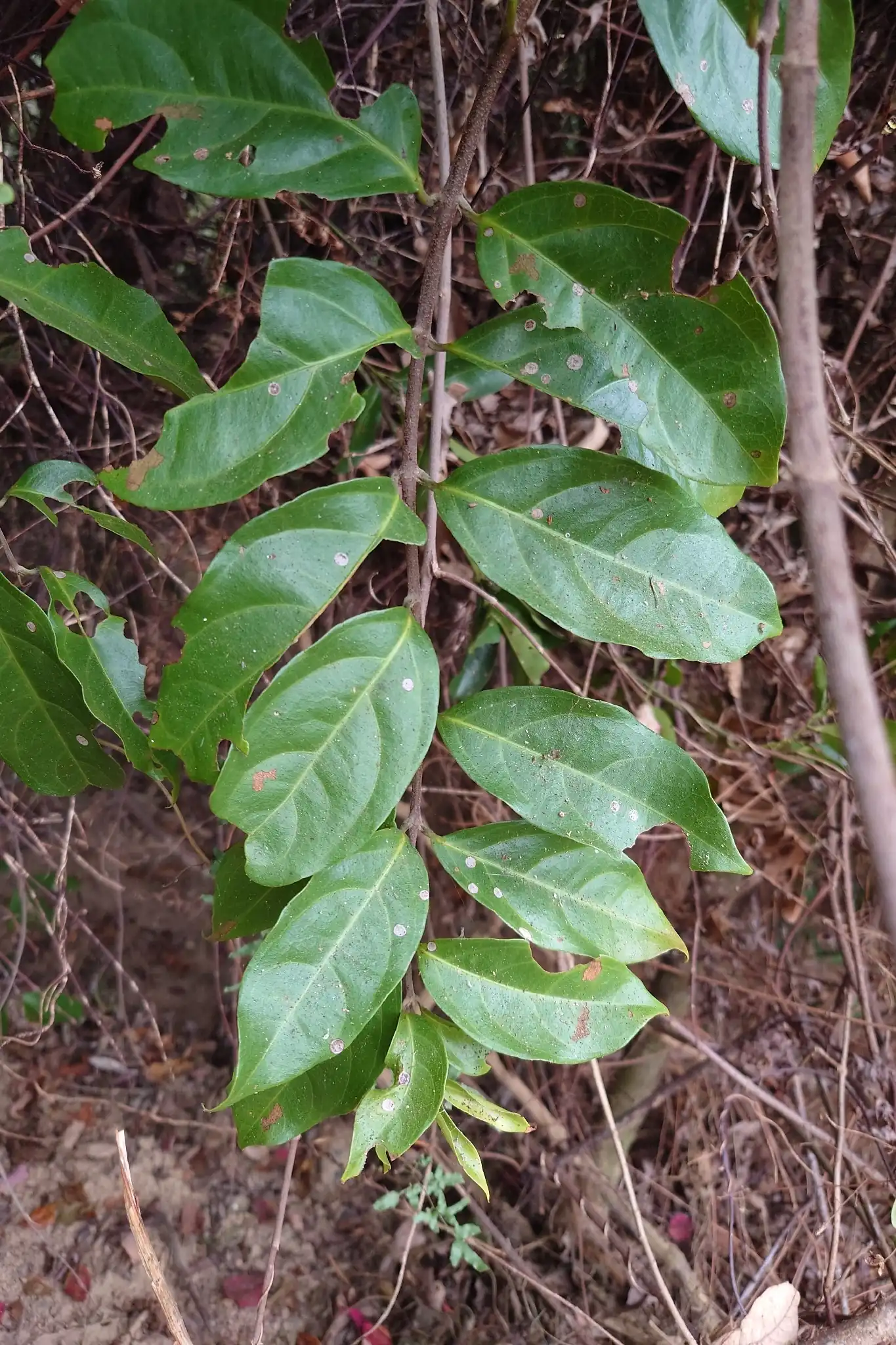
Hiptage benghalensis is an evergreen woody liana that climbs by twining stems, held as a spreading shrub five to ten feet tall with regular pruning but exceeding fifty feet unpruned. It carries opposite elliptic leaves nine to nineteen centimeters long, glossy green above and paler beneath, with bronze new growth.
The display comes in axillary and terminal racemes to eight inches long carrying ten to thirty fragrant white flowers tinged pink, each petal fringed and under an inch long with a bright yellow center. Pollinated flowers form distinct three-winged samaras one to two inches long that spin away on wind and water.
Uses & Benefits:
Essentials
At a Glance
Plant Type
Vine
Height
120"
Width
96"
Light
Full Sun, Partial Sun
Zones
9, 10
Water
Medium
Humidity
Moderate to high
Lifespan
Perennial vine
Native To
Eastern India to Southeast Asia and Philippines
Toxicity
Unknown
Bloom period
Winter – Early spring
In flower about 4 months of the year
Planting
How to Grow
- Plant in full sun to partial shade in moist, well-drained soil after danger of frost has passed.
- Set a heavy trellis, fence, or arbor at planting and tie young stems until they twine.
- Water regularly through the first year to establish a deep root system, then water during dry spells.
- Prune hard after winter flowering to control size and remove seed before it disperses.
- Protect young plants from hard freeze with frost cloth; mature wood tolerates only a brief light freeze near 30F.
Pro Tip
Cut back hard right after the winter bloom to hold it as a shrub; left uncut it builds a canopy tower that smothers trees.
Keep It Thriving
Care Guide
Do
- Plant in full sun to partial shade with regular water
- Prune after bloom to maintain a shrub form and limit seed
- Provide strong support if grown as a vine
Don't
- Do not plant near creeks or natural areas where seed can escape
- Do not let a mature vine climb unchecked into tree canopies
- Do not expose young plants to hard freeze without protection
Seasonal Care Calendar
| Task | Jan | Feb | Mar | Apr | May | Jun | Jul | Aug | Sep | Oct | Nov | Dec |
|---|---|---|---|---|---|---|---|---|---|---|---|---|
| Fertilize | ||||||||||||
| Mulch | ||||||||||||
| Pest Check | ||||||||||||
| Prune | ||||||||||||
| Winter Prep |
Watch Out For
Pests & Diseases
Common Pests
Common Diseases
In the Garden
Landscape Uses & Companions
Landscape Uses
Companion Plants
Multiply
Propagation Methods
Good to Know
Common Questions
Hiptage questions
What zones can Hiptage grow in?
Hiptage is hardy in USDA Zones 9–10: in that range it survives winter in the ground. Colder than Zone 9, grow it in a container you can move to shelter for the winter, or as an annual.
When does Hiptage bloom?
Hiptage typically blooms from early winter to early spring. Exact timing shifts a week or two with your zone — Sow's bloom calendar maps it to your garden.
Does Hiptage need full sun?
Hiptage does best in full sun to part shade. In hot climates, afternoon shade keeps blooms fresher longer.
Keep exploring
Explore the genus
Hardy in your zone?
Grow Hiptage with confidence
See it in a design of your actual yard, get zone-matched care reminders, and track it season by season in your garden journal.