The Story
Plant Bio
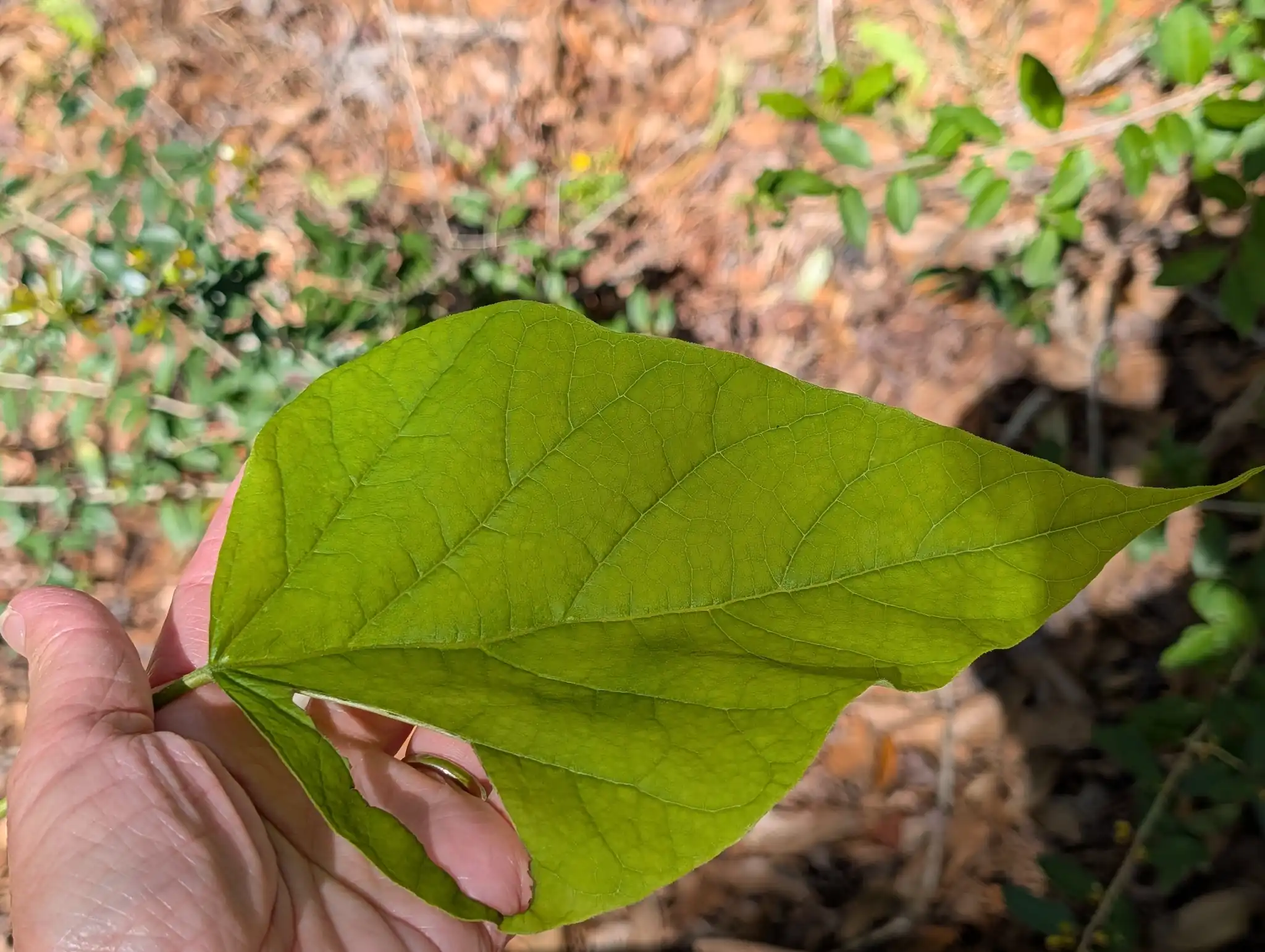
Catalpa bignonioides is a deciduous medium-sized tree native to stream banks and river bottoms across the southeastern United States. It features large, heart-shaped leaves held in opposite pairs or whorls of three that emit an unpleasant odor when bruised.
In late spring to early summer, upright panicles of bell-shaped white flowers marked with yellow streaks and purple spots bloom across the canopy. These blooms give way to elongated, narrow seed pods that persist on brittle branches into winter.
Uses & Benefits:
Essentials
At a Glance
Plant Type
Tree
Height
709"
Width
591"
Light
Full Sun, Partial Sun
Zones
5, 6, 7, 8, 9
Water
Moderate
Humidity
Moderate
Lifespan
Perennial
Native To
Southeastern United States
Toxicity
Non-toxic, minor skin irritant
Bloom period
Late spring – Early summer
In flower about 2 months of the year
Marketplace
Where to Buy
Shipping costs Year-round shipping Free shipping
Planting
How to Grow
- Select a planting site in full sun to partial shade with adequate space for a wide, irregular canopy.
- Dig a hole twice as wide as the root ball and equal to its depth, ensuring the root flare rests level with the surrounding soil.
- Backfill with native soil, firm gently, and water thoroughly to settle air pockets around the roots.
- Apply a two-inch layer of organic mulch around the base, keeping it clear of direct contact with the trunk bark.
Pro Tip
Prune minimally during late winter dormancy to remove dead wood, avoiding heavy cuts into old leafless wood.
Keep It Thriving
Care Guide
Do
- Water regularly during the first two growing seasons until the root system is established.
- Prune during winter dormancy to remove dead or brittle branches.
- Clear fallen pods and leaves in winter to maintain ground sanitation under the tree.
Don't
- Do not plant near power lines, structures, or parking areas where brittle branch drop or seed pod litter causes damage.
- Do not prune heavy framework branches into old leafless wood without active buds.
- Do not apply broad-spectrum insecticides when catalpa sphinx caterpillars are present if supporting local songbirds.
Seasonal Care Calendar
| Task | Jan | Feb | Mar | Apr | May | Jun | Jul | Aug | Sep | Oct | Nov | Dec |
|---|---|---|---|---|---|---|---|---|---|---|---|---|
| Fertilize | ||||||||||||
| Pest Check | ||||||||||||
| Propagate | ||||||||||||
| Prune |
Watch Out For
Pests & Diseases
Common Pests
Common Diseases
In the Garden
Landscape Uses & Companions
Landscape Uses
Multiply
Propagation Methods
Good to Know
Common Questions
Southern Catalpa questions
What zones can Southern Catalpa grow in?
Southern Catalpa is hardy in USDA Zones 5–9. Inside that range it survives winter in the ground; outside it, grow it as an annual or a container plant you protect.
Is Southern Catalpa deer resistant?
Not reliably. Deer may browse Southern Catalpa, especially tender spring growth — plan on repellents or fencing where pressure is high.
When does Southern Catalpa bloom?
Southern Catalpa typically blooms in late spring through early summer. Exact timing shifts a week or two with your zone — Sow's bloom calendar maps it to your garden.
Does Southern Catalpa need full sun?
Southern Catalpa does best in full sun to part shade. In hot climates, afternoon shade keeps blooms fresher longer.
Is Southern Catalpa drought tolerant?
Yes — once established (usually after the first full season), Southern Catalpa handles dry spells with minimal watering. Water deeply its first year to build the root system that makes that possible.
More Catalpa to compare
Keep exploring
Explore the genus
Hardy in your zone?
Grow Southern Catalpa with confidence
See it in a design of your actual yard, get zone-matched care reminders, and track it season by season in your garden journal.