The Story
Plant Bio
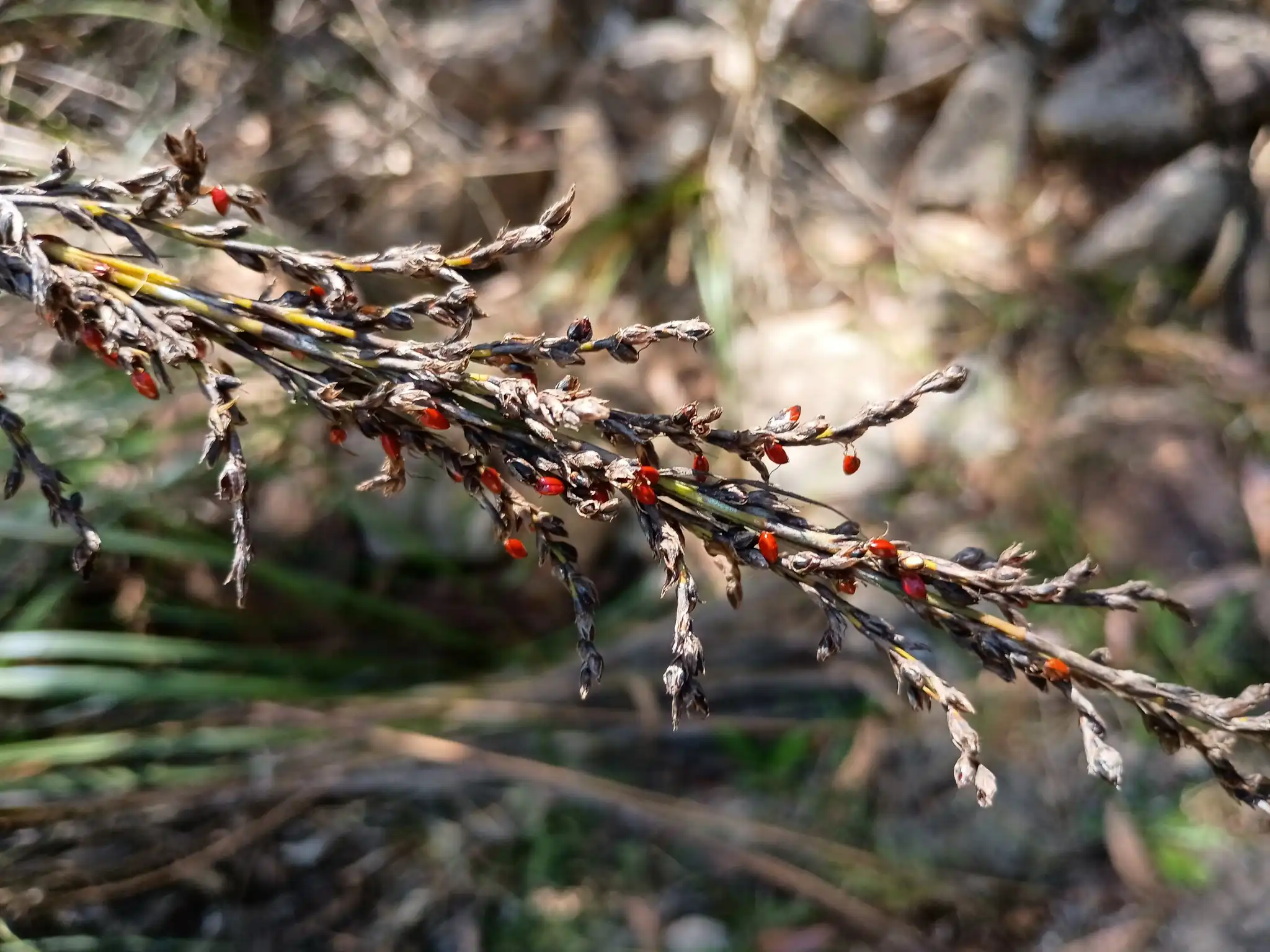
Gahnia sieberiana, commonly known as red-fruit saw-sedge, is an evergreen clumping sedge native to Australia that forms dense architectural tussocks up to ten feet tall and wide. Its arching, strap-like leaves feature microscopic, razor-sharp margins, while dark brown flower panicles give way to bright orange-red seeds.
The species stands out for its bold scale and persistent, glossy red nutlets that follow spring and summer flowering. Its sharp foliage forms a protective cover for small birds and mammals while serving as a durable structural feature in wet or coastal landscapes.
Uses & Benefits:
Essentials
At a Glance
Plant Type
Grass
Height
118"
Width
118"
Light
Full Sun, Partial Sun
Zones
8, 9, 10
Water
Moderate to Wet
Humidity
High
Lifespan
Perennial
Native To
Australia, Malesia
Toxicity
Non-Toxic (Mechanical Cut Hazard)
Bloom period
Spring – Summer
In flower about 6 months of the year
Planting
How to Grow
- Choose a site in full sun or light shade with moist, acidic to neutral soil.
- Plant the container specimen at the same crown depth as in the pot, firming the surrounding soil well.
- Water deeply and regularly during the first growing season to establish a deep root system.
- Apply a organic mulch layer around the base, keeping it clear of the central growing crown.
- Wear heavy leather gloves when handling or grooming foliage to prevent skin cuts from the razor-sharp leaf edges.
Pro Tip
Never shear the tussock flat to the ground or cut into old leafless woody stem bases, as severe pruning kills the crown; instead, wear thick leather gloves to manually pull away spent flower stalks and dead foliage.
Keep It Thriving
Care Guide
Do
- Always wear thick leather gloves and long sleeves when working near the foliage.
- Provide regular moisture during dry spells until root systems fully establish.
- Plant in locations with sub-surface water movement when installing in boggy areas.
Don't
- Do not shear or prune the foliage back into old woody stems.
- Do not plant near narrow footpaths or child play areas due to sharp leaf margins.
- Do not leave young plants in completely stagnant, anaerobic water without subsurface movement.
Seasonal Care Calendar
| Task | Jan | Feb | Mar | Apr | May | Jun | Jul | Aug | Sep | Oct | Nov | Dec |
|---|---|---|---|---|---|---|---|---|---|---|---|---|
| Divide | ||||||||||||
| Mulch | ||||||||||||
| Pest Check | ||||||||||||
| Prune |
Watch Out For
Pests & Diseases
Common Pests
Common Diseases
In the Garden
Landscape Uses & Companions
Landscape Uses
Companion Plants
Multiply
Propagation Methods
Good to Know
Common Questions
Red-Fruit Saw-Sedge questions
What zones can Red-Fruit Saw-Sedge grow in?
Red-Fruit Saw-Sedge is hardy in USDA Zones 8–10: in that range it survives winter in the ground. Colder than Zone 8, grow it in a container you can move to shelter for the winter, or as an annual.
Is Red-Fruit Saw-Sedge deer resistant?
Not reliably. Deer may browse Red-Fruit Saw-Sedge, especially tender spring growth — plan on repellents or fencing where pressure is high.
When does Red-Fruit Saw-Sedge bloom?
Red-Fruit Saw-Sedge typically blooms from spring to summer. Exact timing shifts a week or two with your zone — Sow's bloom calendar maps it to your garden.
Does Red-Fruit Saw-Sedge need full sun?
Red-Fruit Saw-Sedge does best in full sun to part shade. In hot climates, afternoon shade keeps blooms fresher longer.
Is Red-Fruit Saw-Sedge drought tolerant?
Yes — once established (usually after the first full season), Red-Fruit Saw-Sedge handles dry spells with minimal watering. Water deeply its first year to build the root system that makes that possible.
Keep exploring
Explore the genus
Hardy in your zone?
Grow Red-Fruit Saw-Sedge with confidence
See it in a design of your actual yard, get zone-matched care reminders, and track it season by season in your garden journal.