The Story
Plant Bio
Gyrocarpus americanus is a slender deciduous tree 40 to 60 feet tall in the wild, with a small crown, smooth gray to yellow-brown bark and brittle twigs that carry leaves crowded at the branch ends. The leaves are ovate to heart-shaped and three-nerved, dark green above and pale and often hairy below.
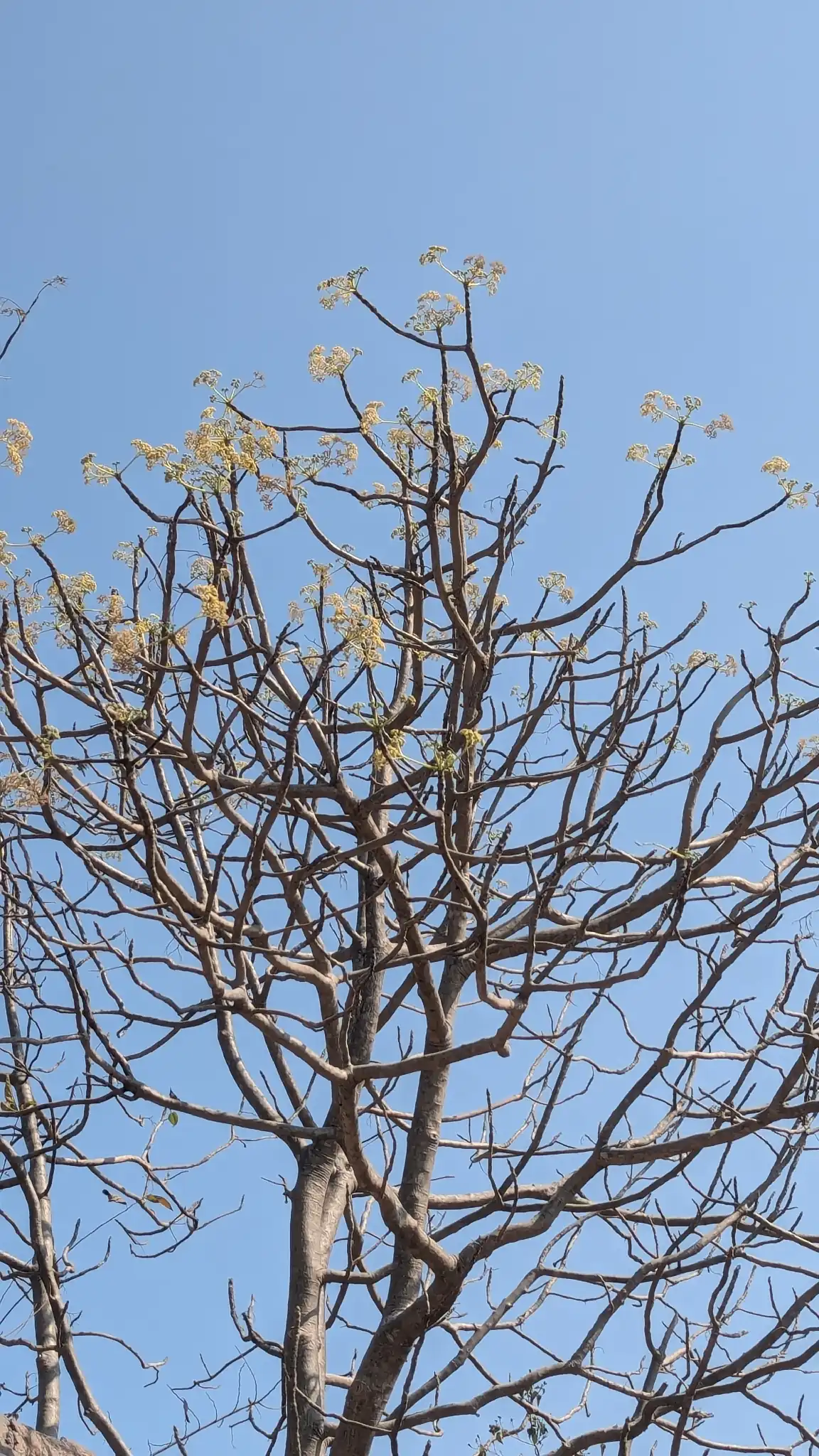
Flowers are borne leafless in much-branched terminal cymes, very small at 2 to 3 mm across, cream to yellowish-green and foul-smelling with mostly male flowers. The fruit is a woody eight-ribbed ovoid nut 1.4 to 2 cm long tipped with two thin wings 5 to 10 cm long that autorotate in wind.
Uses & Benefits:
Essentials
At a Glance
Plant Type
Tree
Height
709"
Light
Full Sun
Water
Low
Humidity
Unknown
Lifespan
Woody tree, lifespan unrecorded
Native To
Mexico to Panama, Caribbean, Africa, tropical Asia to N. Australia
Toxicity
Sap can cause blindness
Bloom period
Winter – Spring
In flower about 6 months of the year
Planting
How to Grow
- Site in full sun in a frost-free tropical position with room for a 40 to 60 foot tree
- Provide very free-draining stony or sandy loam as in rocky ridges and red sands
- Allow the small crown to develop unpruned; do not force a compact form
- Wear eye protection when handling; sap can cause blindness
Pro Tip
Give it room for a 40 to 60 foot leafless-flowering tropical tree to mature; it has no place in a small garden or where frost occurs.
Keep It Thriving
Care Guide
Do
- Allow full sun and space for a large mature crown to develop
- Handle with eye protection; keep sap away from eyes
Don't
- Do not plant in small gardens or where frost occurs
- Do not expect cool-climate hardiness or a compact habit
Seasonal Care Calendar
| Task | Jan | Feb | Mar | Apr | May | Jun | Jul | Aug | Sep | Oct | Nov | Dec |
|---|---|---|---|---|---|---|---|---|---|---|---|---|
| Mulch | ||||||||||||
| Pest Check | ||||||||||||
| Plant | ||||||||||||
| Prune | ||||||||||||
| Winter Prep |
Watch Out For
Pests & Diseases
Common Pests
Common Diseases
In the Garden
Landscape Uses & Companions
Landscape Uses
Companion Plants
Multiply
Propagation Methods
Good to Know
Common Questions
Helicopter Tree questions
When does Helicopter Tree bloom?
Helicopter Tree typically blooms from winter to spring. Exact timing shifts a week or two with your zone — Sow's bloom calendar maps it to your garden.
Does Helicopter Tree need full sun?
Helicopter Tree does best in full sun (6+ hours).
Keep exploring
Explore the genus
Grow Helicopter Tree with confidence
See it in a design of your actual yard, get zone-matched care reminders, and track it season by season in your garden journal.