The Story
Plant Bio
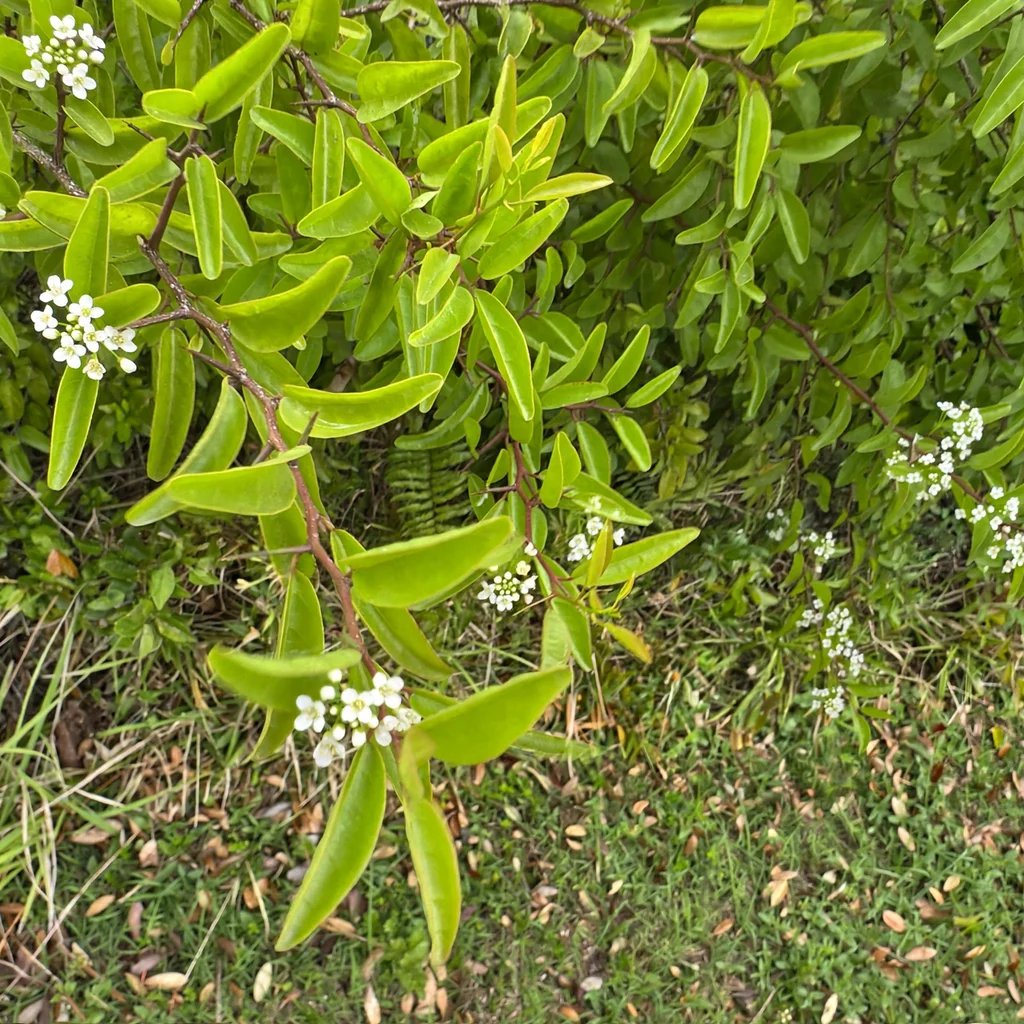
Ximenia americana is a spreading deciduous shrub to small tree 10 to 20 feet tall and as wide, with tangled vine-like branches armed with straight purple-red spines to 1 inch long. The foliage is shiny light yellowish-green, ovate to elliptic leaves 1 to 2 inches long clustered on short spur shoots that smell of almond when crushed.
This species is a facultative root parasite that forms haustoria on nearby woody roots, even on its own roots, allowing it to persist in poor sand and lime rock. Spring brings short cymes of fragrant white to yellow-green flowers with four to five bearded petals, followed by yellow plum-like drupes with edible pulp around a single purgative seed.
Uses & Benefits:
Essentials
At a Glance
Plant Type
Shrub
Height
240"
Width
240"
Light
Full Sun
Zones
9, 10
Water
Low
Humidity
Tolerant of humid subtropics
Lifespan
Long-lived woody shrub
Native To
Peninsular Florida
Toxicity
Leaves and seeds poisonous
Bloom period
Spring – Fall
In flower about 9 months of the year
Planting
How to Grow
- Set out in full sun in spring after frost danger, spacing 10 to 12 feet for the broad spiny crown.
- Plant at nursery depth in sand or sandy loam pH 5 to 7 beside established shrubs for root contact.
- Water deeply at planting then sparingly; established plants take drought and salt spray but fail in standing water.
- Mulch 2 to 3 inches with pine bark kept clear of stems.
- Cut only dead or crossing wood after fruiting, wearing heavy gloves.
Pro Tip
Site it in full sun in deep well-drained sand beside established shrubs it can tap, and leave the thorny framework alone except to cut out dead wood.
Keep It Thriving
Care Guide
Do
- Give full sun and sharp drainage in sand or lime rock
- Keep established shrubs nearby for root parasitism
- Let yellow fruit ripen fully and discard the seed
- Wear thorn-proof gloves and eye protection when pruning
Don't
- Do not plant in low ground that stays wet
- Do not cut hard into old leafless wood
- Do not eat leaves, kernels or unripe fruit
- Do not try to grow outdoors below zone 9a
Seasonal Care Calendar
| Task | Jan | Feb | Mar | Apr | May | Jun | Jul | Aug | Sep | Oct | Nov | Dec |
|---|---|---|---|---|---|---|---|---|---|---|---|---|
| Harvest | ||||||||||||
| Mulch | ||||||||||||
| Pest Check | ||||||||||||
| Plant | ||||||||||||
| Prune |
Watch Out For
Pests & Diseases
Common Pests
Common Diseases
In the Garden
Landscape Uses & Companions
Landscape Uses
Multiply
Propagation Methods
Good to Know
Common Questions
Hog Plum questions
What zones can Hog Plum grow in?
Hog Plum is hardy in USDA Zones 9–10: in that range it survives winter in the ground. Colder than Zone 9, grow it in a container you can move to shelter for the winter.
When does Hog Plum bloom?
Hog Plum typically blooms from spring to fall. Exact timing shifts a week or two with your zone — Sow's bloom calendar maps it to your garden.
Does Hog Plum need full sun?
Hog Plum does best in full sun (6+ hours).
Is Hog Plum drought tolerant?
Yes — once established (usually after the first full season), Hog Plum handles dry spells with minimal watering. Water deeply its first year to build the root system that makes that possible.
Keep exploring
Explore the genus
Hardy in your zone?
Grow Hog Plum with confidence
See it in a design of your actual yard, get zone-matched care reminders, and track it season by season in your garden journal.