The Story
Plant Bio
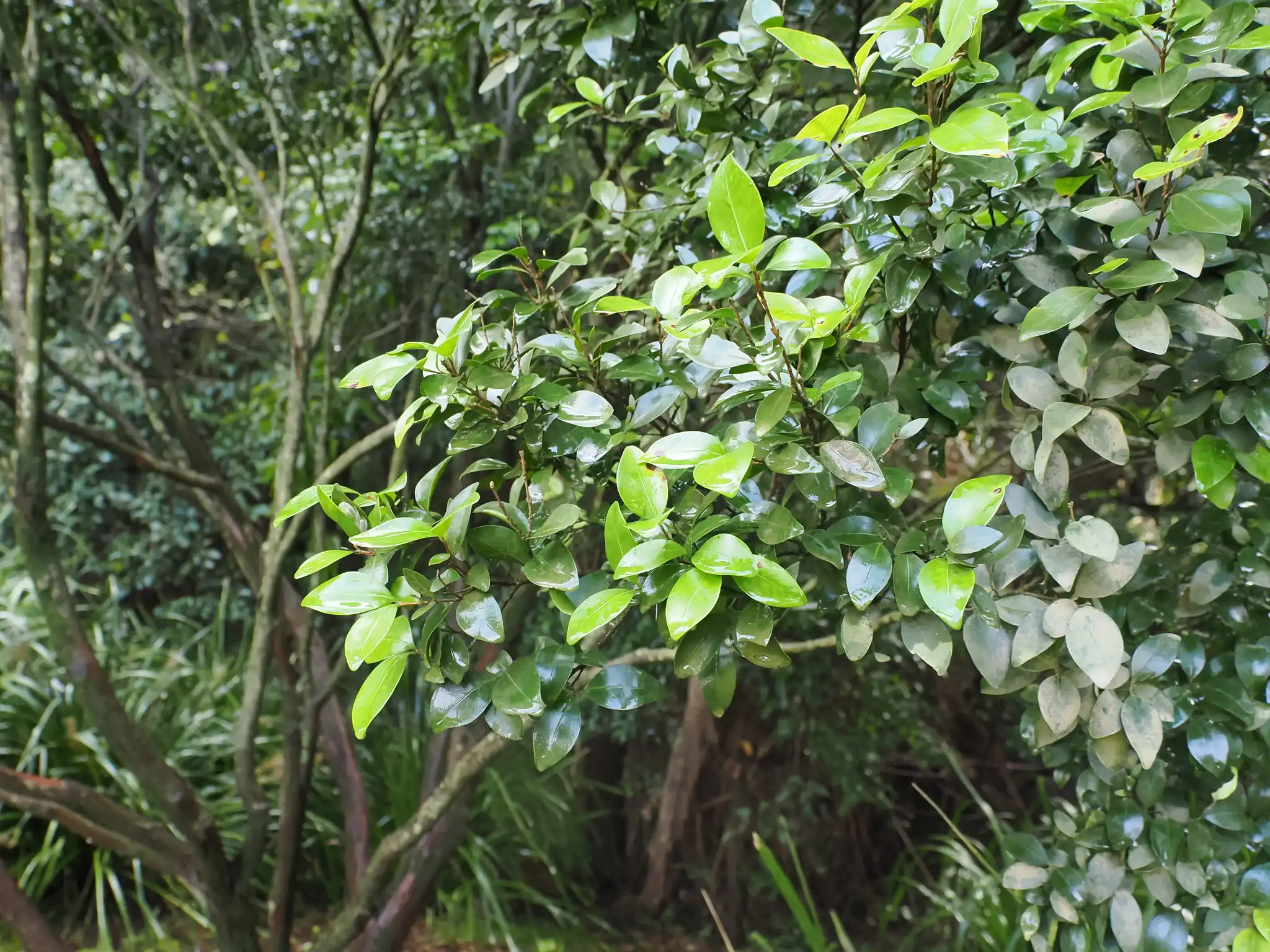
Gossia gonoclada is an evergreen small tree native to riverine rainforests, growing ten to forty feet tall with a dense, spreading canopy. Deep green, glossy leaves flush bright pink when young and emit a volatile aromatic scent when crushed, accompanied by small white four- or five-petaled spring flowers.
Young stems carry four distinct raised, winged corners that give the branchlets a square cross-section. The trunk develops pale red-brown bark that flakes off in thin scales with age.
Uses & Benefits:
Essentials
At a Glance
Plant Type
Tree
Height
472"
Width
236"
Light
Full Sun, Partial Sun
Zones
10
Water
Moderate
Humidity
High
Lifespan
Perennial
Native To
Australia
Toxicity
Non-toxic
Bloom period
Late spring
In flower about 1 month of the year
Planting
How to Grow
- Select a planting location in part shade to full sun with rich, alluvial or sandy loam soil.
- Dig a hole twice as wide as the root ball and set the crown level with the surrounding soil.
- Water thoroughly at planting and maintain consistent moisture while the root system establishes.
- Apply a two-inch layer of organic mulch around the base, keeping it clear of the direct trunk bark.
Pro Tip
Avoid cutting back into old leafless wood; canopy recovery from hard structural pruning is slow and erratic.
Keep It Thriving
Care Guide
Do
- Maintain consistent soil moisture, especially during warm dry spells.
- Provide high ambient humidity and protection from drying winds.
- Prune lightly by tip-pinching post-flowering wood to maintain canopy density.
Don't
- Do not allow soil to sit saturated or stagnantly waterlogged.
- Do not prune hard into heavy, mature wood devoid of foliage.
- Do not expose plants to freezing temperatures or frost.
Seasonal Care Calendar
| Task | Jan | Feb | Mar | Apr | May | Jun | Jul | Aug | Sep | Oct | Nov | Dec |
|---|---|---|---|---|---|---|---|---|---|---|---|---|
| Fertilize | ||||||||||||
| Mulch | ||||||||||||
| Pest Check | ||||||||||||
| Prune |
Watch Out For
Pests & Diseases
Common Pests
Common Diseases
In the Garden
Landscape Uses & Companions
Landscape Uses
Multiply
Propagation Methods
Good to Know
Common Questions
Angle-Stemmed Myrtle questions
What zones can Angle-Stemmed Myrtle grow in?
Angle-Stemmed Myrtle is hardy in USDA Zone 10: in that range it survives winter in the ground. Colder than Zone 10, winters are too cold for it to survive outdoors.
When does Angle-Stemmed Myrtle bloom?
Angle-Stemmed Myrtle typically blooms in late spring. Exact timing shifts a week or two with your zone — Sow's bloom calendar maps it to your garden.
Does Angle-Stemmed Myrtle need full sun?
Angle-Stemmed Myrtle does best in full sun to part shade. In hot climates, afternoon shade keeps blooms fresher longer.
Keep exploring
Explore the genus
Hardy in your zone?
Grow Angle-Stemmed Myrtle with confidence
See it in a design of your actual yard, get zone-matched care reminders, and track it season by season in your garden journal.