The Story
Plant Bio
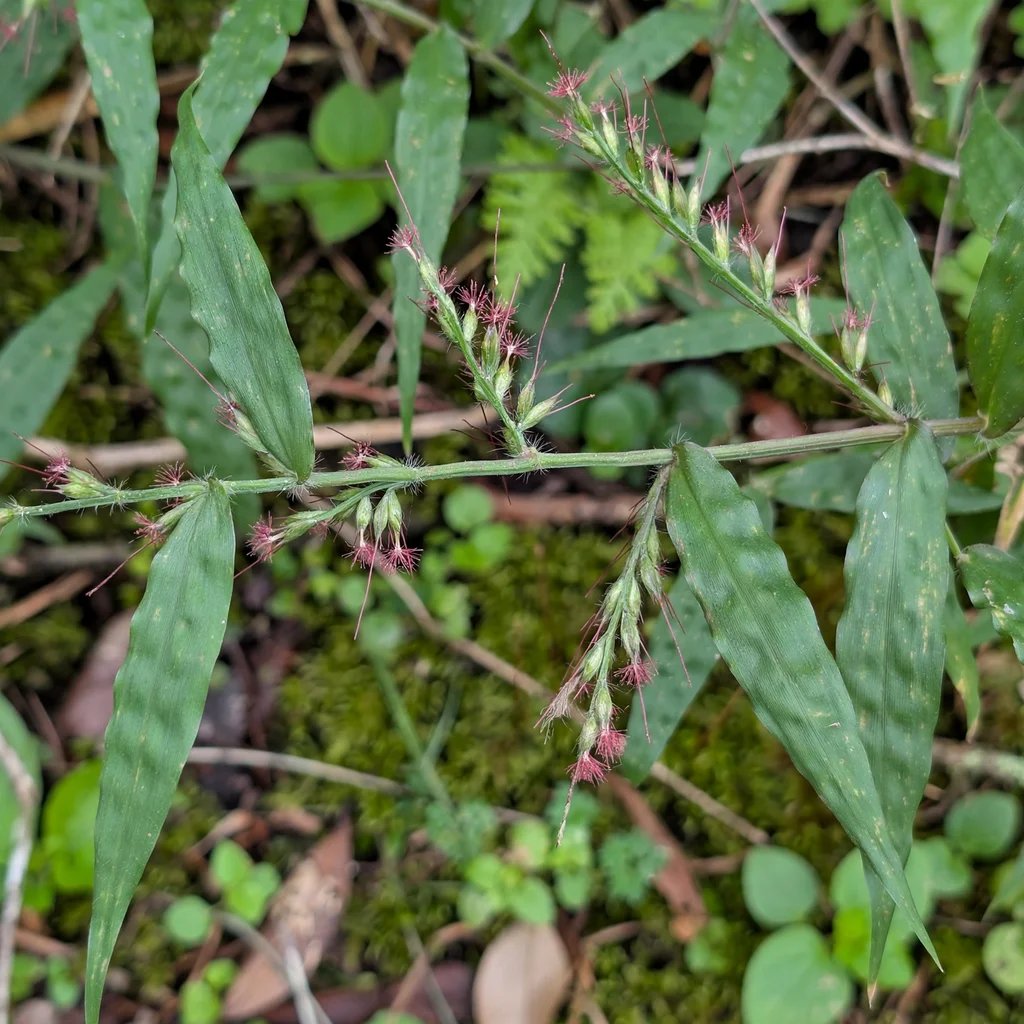
Oplismenus hirtellus is a creeping perennial grass that forms low mats by rooting freely at hairy stem nodes. The trailing culms reach three feet long, clothed in broad lance-shaped leaves held horizontally to make a woven groundcover in dense shade.
Leaves are deep green to six inches long and half an inch wide, flat or rippled at the margin with a densely hairy sheath. In summer to fall ascending stems carry narrow three to four inch spikes of tiny green spikelets tipped with sticky purple awns that catch on animal fur and clothing.
Uses & Benefits:
Essentials
At a Glance
Plant Type
Grass
Height
12"
Width
36"
Light
Partial Sun, Shade
Zones
8, 9, 10
Water
Medium
Humidity
High
Lifespan
Perennial
Native To
Pantropical, including southeastern U.S.
Toxicity
Unknown
Bloom period
Summer – Fall
In flower about 6 months of the year
Planting
How to Grow
- Plant rooted runners in spring after frost in part to full shade, spacing 12 inches apart in moist loam enriched with leaf mold and sand.
- Set crowns at soil level, water in well, and keep soil evenly moist through establishment.
- Mulch lightly with leaf mold to hold moisture and protect shallow roots.
- Shelter from hot afternoon sun and move containers indoors to a bright cool room before first frost.
Pro Tip
Leave it tall and moist in shade and never scalp it like turf; close mowing removes the leaf area it needs to feed itself and kills the patch.
Keep It Thriving
Care Guide
Do
- Keep soil evenly moist in shade
- Maintain light leaf-mold mulch
- Allow stems to root at nodes to thicken cover
Don't
- Do not mow short or scalp like turf
- Do not plant in full hot afternoon sun
- Do not expose to frost or let pots freeze
Seasonal Care Calendar
| Task | Jan | Feb | Mar | Apr | May | Jun | Jul | Aug | Sep | Oct | Nov | Dec |
|---|---|---|---|---|---|---|---|---|---|---|---|---|
| Mulch | ||||||||||||
| Pest Check | ||||||||||||
| Plant | ||||||||||||
| Prune | ||||||||||||
| Winter Prep |
Watch Out For
Pests & Diseases
Common Pests
Common Diseases
In the Garden
Landscape Uses & Companions
Landscape Uses
Companion Plants
Multiply
Propagation Methods
Good to Know
Common Questions
Basket Grass questions
What zones can Basket Grass grow in?
Basket Grass is hardy in USDA Zones 8–10: in that range it survives winter in the ground. Colder than Zone 8, grow it in a container you can move to shelter for the winter, or as an annual.
When does Basket Grass bloom?
Basket Grass typically blooms from summer to fall. Exact timing shifts a week or two with your zone — Sow's bloom calendar maps it to your garden.
Does Basket Grass need full sun?
Basket Grass does best in part shade.
Keep exploring
Explore the genus
Hardy in your zone?
Grow Basket Grass with confidence
See it in a design of your actual yard, get zone-matched care reminders, and track it season by season in your garden journal.