The Story
Plant Bio
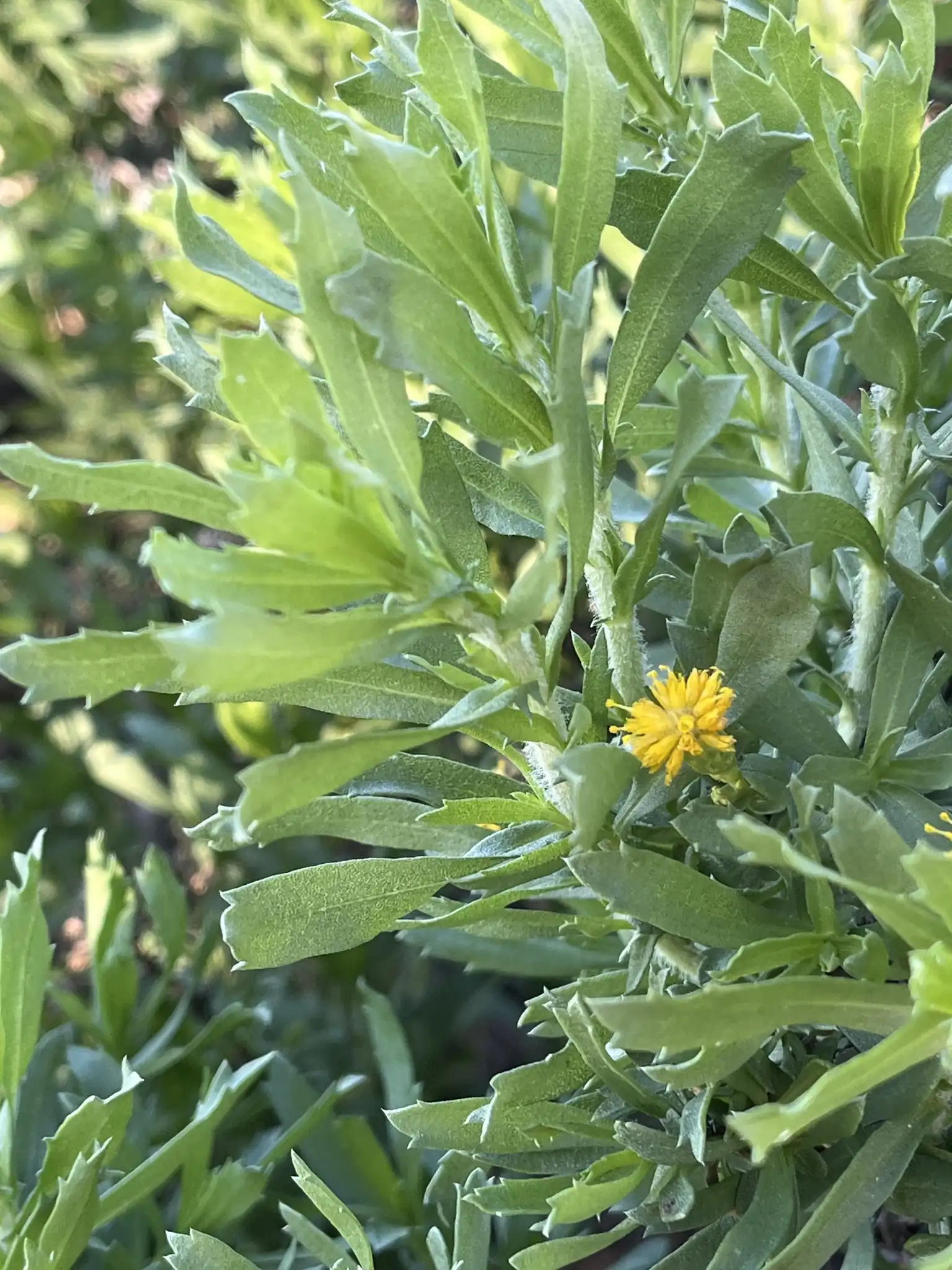
Isocoma menziesii, commonly known as Menzies' goldenbush, is an evergreen subshrub native to coastal sage scrub and chaparral habitats of California and Baja California. It forms a branching bush with gray-green foliage and produces dense, rounded terminal clusters of golden-yellow flower heads from spring into fall.
Lacking outer ray petals, the flower heads consist entirely of tubular disc florets that secrete nectar late into the dry season. The foliage features resinous glands and handles extreme drought, salt spray, and lean coastal soils with ease.
Uses & Benefits:
Essentials
At a Glance
Plant Type
Shrub
Height
48"
Width
48"
Light
Full Sun
Zones
8, 9, 10
Water
Low
Humidity
Adapted to dry coastal/Mediterranean air
Lifespan
Perennial
Native To
California, Baja California
Toxicity
Toxic to livestock if ingested in quantity
Bloom period
Spring – Fall
In flower about 9 months of the year
Planting
How to Grow
- Select a planting site in full sun with sharp, well-draining sandy or gravelly soil.
- Set nursery stock at the original pot depth, firming surrounding lean soil without adding organic amendments.
- Water sparingly during initial root establishment, allowing soil to dry completely between applications.
- Cease summer irrigation once established to prevent crown rot.
- Prune soft stem tips lightly after flowering ends in late fall to maintain density.
Pro Tip
Keep soils lean and unamended, as heavy summer watering or rich compost triggers weak growth and lethal root rot.
Keep It Thriving
Care Guide
Do
- Plant in lean, highly permeable soil under full sunlight.
- Trim soft shoot tips lightly post-blooming to maintain shape.
- Provide deep, sparse water only while establishing.
Don't
- Do not add compost or rich nitrogen fertilizers to the soil.
- Do not irrigate regularly during hot summer months.
- Do not cut back severely into old, leafless woody stems.
Seasonal Care Calendar
| Task | Jan | Feb | Mar | Apr | May | Jun | Jul | Aug | Sep | Oct | Nov | Dec |
|---|---|---|---|---|---|---|---|---|---|---|---|---|
| Pest Check | ||||||||||||
| Propagate | ||||||||||||
| Prune | ||||||||||||
| Spring Cleanup |
Watch Out For
Pests & Diseases
Common Pests
Common Diseases
In the Garden
Landscape Uses & Companions
Landscape Uses
Multiply
Propagation Methods
Good to Know
Common Questions
Menzies' Goldenbush questions
What zones can Menzies' Goldenbush grow in?
Menzies' Goldenbush is hardy in USDA Zones 8–10: in that range it survives winter in the ground. Colder than Zone 8, grow it in a container you can move to shelter for the winter.
Is Menzies' Goldenbush deer resistant?
Not reliably. Deer may browse Menzies' Goldenbush, especially tender spring growth — plan on repellents or fencing where pressure is high.
When does Menzies' Goldenbush bloom?
Menzies' Goldenbush typically blooms from spring to fall. Exact timing shifts a week or two with your zone — Sow's bloom calendar maps it to your garden.
Does Menzies' Goldenbush need full sun?
Menzies' Goldenbush does best in full sun (6+ hours).
Is Menzies' Goldenbush drought tolerant?
Yes — once established (usually after the first full season), Menzies' Goldenbush handles dry spells with minimal watering. Water deeply its first year to build the root system that makes that possible.
Keep exploring
Explore the genus
Hardy in your zone?
Grow Menzies' Goldenbush with confidence
See it in a design of your actual yard, get zone-matched care reminders, and track it season by season in your garden journal.