The Story
Plant Bio
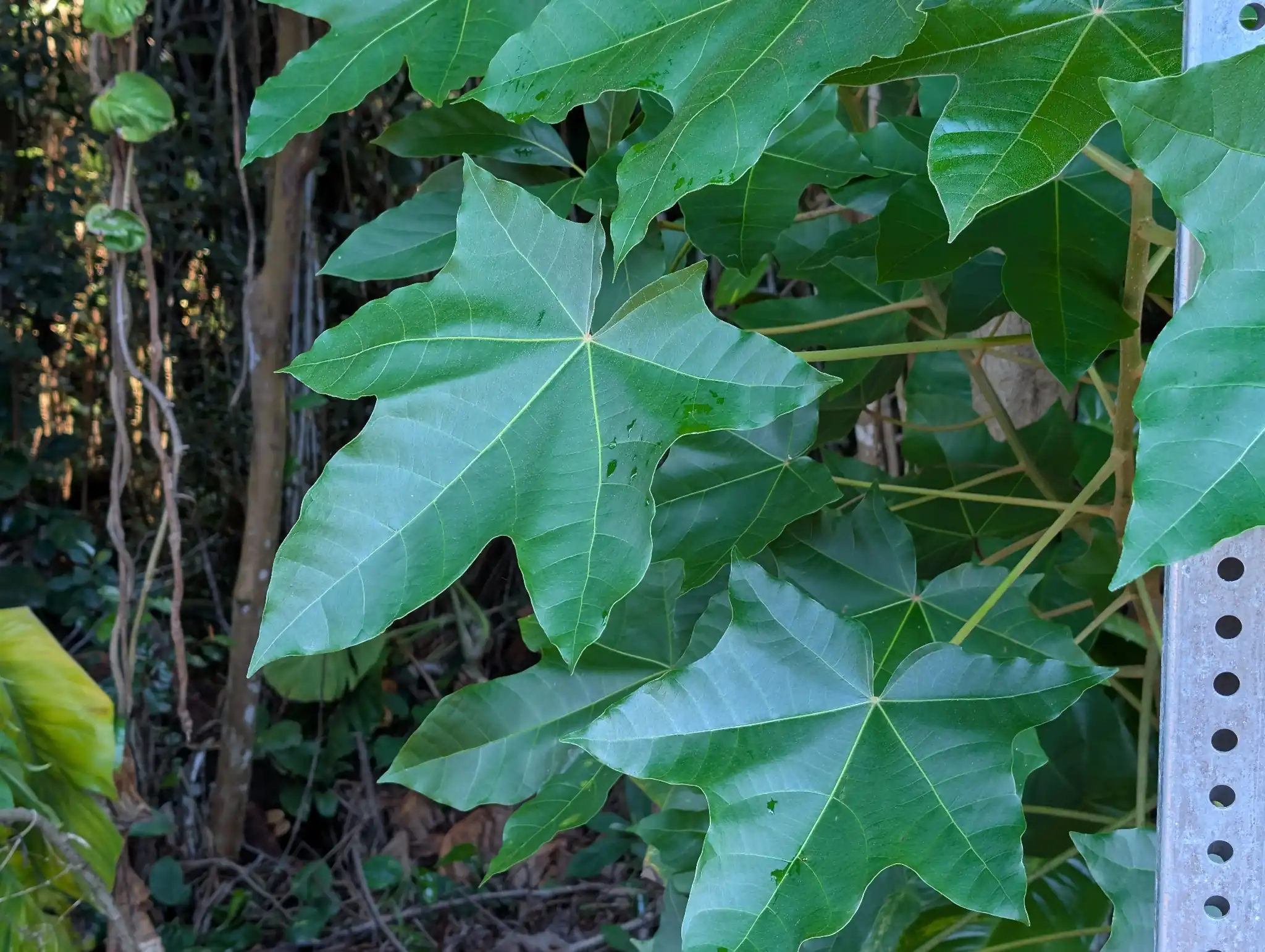
Aleurites moluccanus, commonly known as the candlenut tree, is a large, spreading evergreen tree reaching up to sixty feet tall in warm cultivated landscapes. Its dense, rounded canopy is lined with broad leaves coated in fine stellate hairs that give new foliage a powdery, silvery-white surface.
In spring and summer, terminal panicles of small creamy-white flowers bloom above the pale foliage, later producing thick-shelled globose nuts containing high concentrations of plant oils. The contrasting foliage offers a distinctive light, metallic texture among darker tropical shade trees.
Uses & Benefits:
Essentials
At a Glance
Plant Type
Tree
Height
787"
Width
590"
Light
Full Sun, Partial Sun
Zones
10
Water
Moderate
Humidity
High
Lifespan
Perennial
Native To
Tropical Asia to Western Pacific
Toxicity
Toxic if ingested; sap causes skin irritation
Bloom period
Spring – Summer
In flower about 6 months of the year
Planting
How to Grow
- Select a planting site in full sun to partial shade with deep, well-draining soil.
- Dig a hole twice as wide as the root ball and set the crown level with the surrounding grade.
- Backfill with native soil and water deeply to settle air pockets around the roots.
- Apply a three-inch layer of organic mulch around the drip line, keeping it clear of the trunk bark.
Pro Tip
Train young trees to a single leader early; cutting aggressively into mature, leafless hardwood results in weak and irregular branch recovery.
Keep It Thriving
Care Guide
Do
- Plant in light, freely draining loamy or sandy soils to prevent root rot.
- Water regularly during the first growing season until the root structure establishes.
- Wear protective gloves when handling cut branches to avoid skin irritation from milky latex sap.
Don't
- Do not allow soil to remain waterlogged or heavy with standing water.
- Do not prune severely into old, thick wood that lacks active leaves.
- Do not consume raw seeds or nuts, which contain gastrointestinal toxins.
Seasonal Care Calendar
| Task | Jan | Feb | Mar | Apr | May | Jun | Jul | Aug | Sep | Oct | Nov | Dec |
|---|---|---|---|---|---|---|---|---|---|---|---|---|
| Fertilize | ||||||||||||
| Mulch | ||||||||||||
| Pest Check | ||||||||||||
| Prune |
Watch Out For
Pests & Diseases
Common Pests
Common Diseases
In the Garden
Landscape Uses & Companions
Landscape Uses
Companion Plants
Multiply
Propagation Methods
Good to Know
Common Questions
Candlenut Tree questions
What zones can Candlenut Tree grow in?
Candlenut Tree is hardy in USDA Zone 10: in that range it survives winter in the ground. Colder than Zone 10, winters are too cold for it to survive outdoors.
Is Candlenut Tree deer resistant?
Yes — Candlenut Tree is rated deer-resistant. Deer typically pass it over, though extreme hunger can override any plant's defenses.
When does Candlenut Tree bloom?
Candlenut Tree typically blooms from spring to summer. Exact timing shifts a week or two with your zone — Sow's bloom calendar maps it to your garden.
Does Candlenut Tree need full sun?
Candlenut Tree does best in full sun to part shade. In hot climates, afternoon shade keeps blooms fresher longer.
Is Candlenut Tree drought tolerant?
Yes — once established (usually after the first full season), Candlenut Tree handles dry spells with minimal watering. Water deeply its first year to build the root system that makes that possible.
Keep exploring
Explore the genus
Hardy in your zone?
Grow Candlenut Tree with confidence
See it in a design of your actual yard, get zone-matched care reminders, and track it season by season in your garden journal.