The Story
Plant Bio
Brownea grandiceps is a slow-growing evergreen tree from South American rainforest understory, reaching 10 to 20 feet in gardens with stout branches and a low dense crown. The leaves are pinnate to 8 to 12 inches long with 8 to 12 pairs of leaflets, emerging in pendulous tassels that open pale green and pink before hardening to dark green.
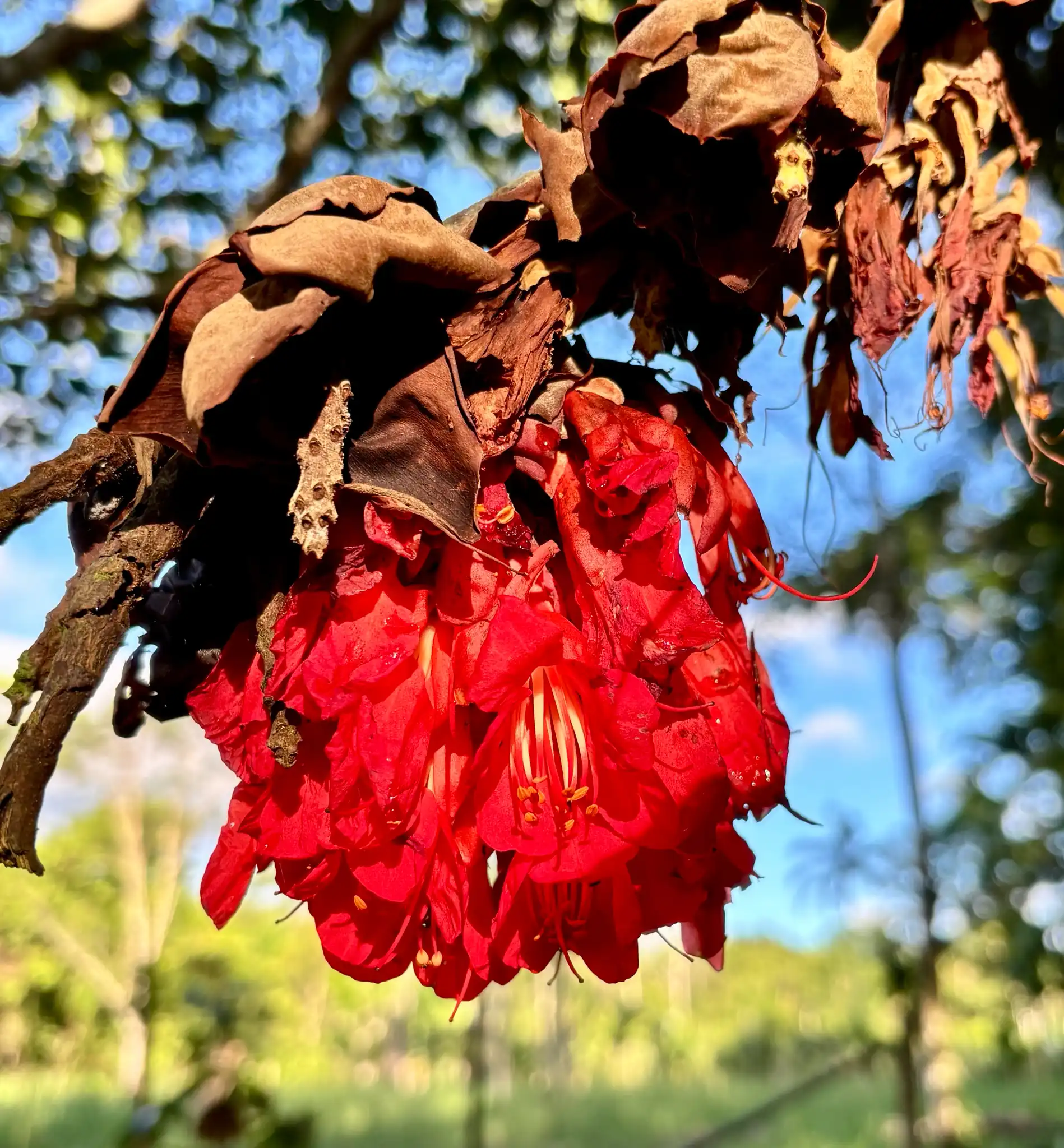
The flowers are tubular crimson with yellow-tipped stamens, borne in dense globose heads 8 to 10 inches across that hang below the foliage on old wood and trunk. New flushes of limp brown-pink leaves hang like tassels and are often mistaken for bloom, while the true flower heads produce copious nectar over a long season.
Uses & Benefits:
Essentials
At a Glance
Plant Type
Tree
Height
240"
Width
180"
Light
Full Sun, Partial Sun, Shade
Zones
10
Water
High - evenly moist
Humidity
High
Lifespan
Long-lived evergreen tree
Native To
Northern South America
Toxicity
None known
Bloom period
Early summer – Late summer
In flower about 3 months of the year
Planting
How to Grow
- Plant in a large container or in ground only in zone 10-12 in fertile organic loamy soil that stays consistently moist but drains.
- Site in partial sun to dappled shade, with shade for young plants; mature plants accept full sun if humidity and soil moisture stay high.
- Water deeply to keep the root zone evenly moist and never let young plants dry out; mulch with organic matter to hold moisture.
- Feed with balanced 10-10-10 fertilizer every few weeks during active growth.
- Keep frost-free with high humidity and warmth at 68-77F; move containers to a heated greenhouse before cold weather.
Pro Tip
Prune only to remove dead, damaged or crossing wood after flowering; shortening established stems removes flowering wood that is very slow to replace.
Keep It Thriving
Care Guide
Do
- Keep soil consistently moist and mulch to hold humidity
- Provide dappled shade and wind shelter while young
- Feed lightly through the growing season
Don't
- Do not let the root ball dry out
- Do not cut back established stems to shape the canopy
- Do not plant in waterlogged or cold exposed soil
Seasonal Care Calendar
| Task | Jan | Feb | Mar | Apr | May | Jun | Jul | Aug | Sep | Oct | Nov | Dec |
|---|---|---|---|---|---|---|---|---|---|---|---|---|
| Fertilize | ||||||||||||
| Mulch | ||||||||||||
| Pest Check | ||||||||||||
| Prune | ||||||||||||
| Winter Prep |
Watch Out For
Pests & Diseases
Common Pests
Common Diseases
In the Garden
Landscape Uses & Companions
Landscape Uses
Multiply
Propagation Methods
Good to Know
Common Questions
Rose of Venezuela questions
What zones can Rose of Venezuela grow in?
Rose of Venezuela is hardy in USDA Zone 10: in that range it survives winter in the ground. Colder than Zone 10, winters are too cold for it to survive outdoors.
When does Rose of Venezuela bloom?
Rose of Venezuela typically blooms in summer. Exact timing shifts a week or two with your zone — Sow's bloom calendar maps it to your garden.
Does Rose of Venezuela need full sun?
Rose of Venezuela does best in full sun to part shade. In hot climates, afternoon shade keeps blooms fresher longer.
Keep exploring
Explore the genus
Hardy in your zone?
Grow Rose of Venezuela with confidence
See it in a design of your actual yard, get zone-matched care reminders, and track it season by season in your garden journal.