The Story
Plant Bio
Strongylodon macrobotrys is a vigorous evergreen woody liana from Philippine rainforest, climbing 30 to 50 feet by twining stems clothed in pale green three-parted leaves. It roots in rich damp ground beside streams and ravines and pushes its foliage into full sun while the root zone stays cool and moist.
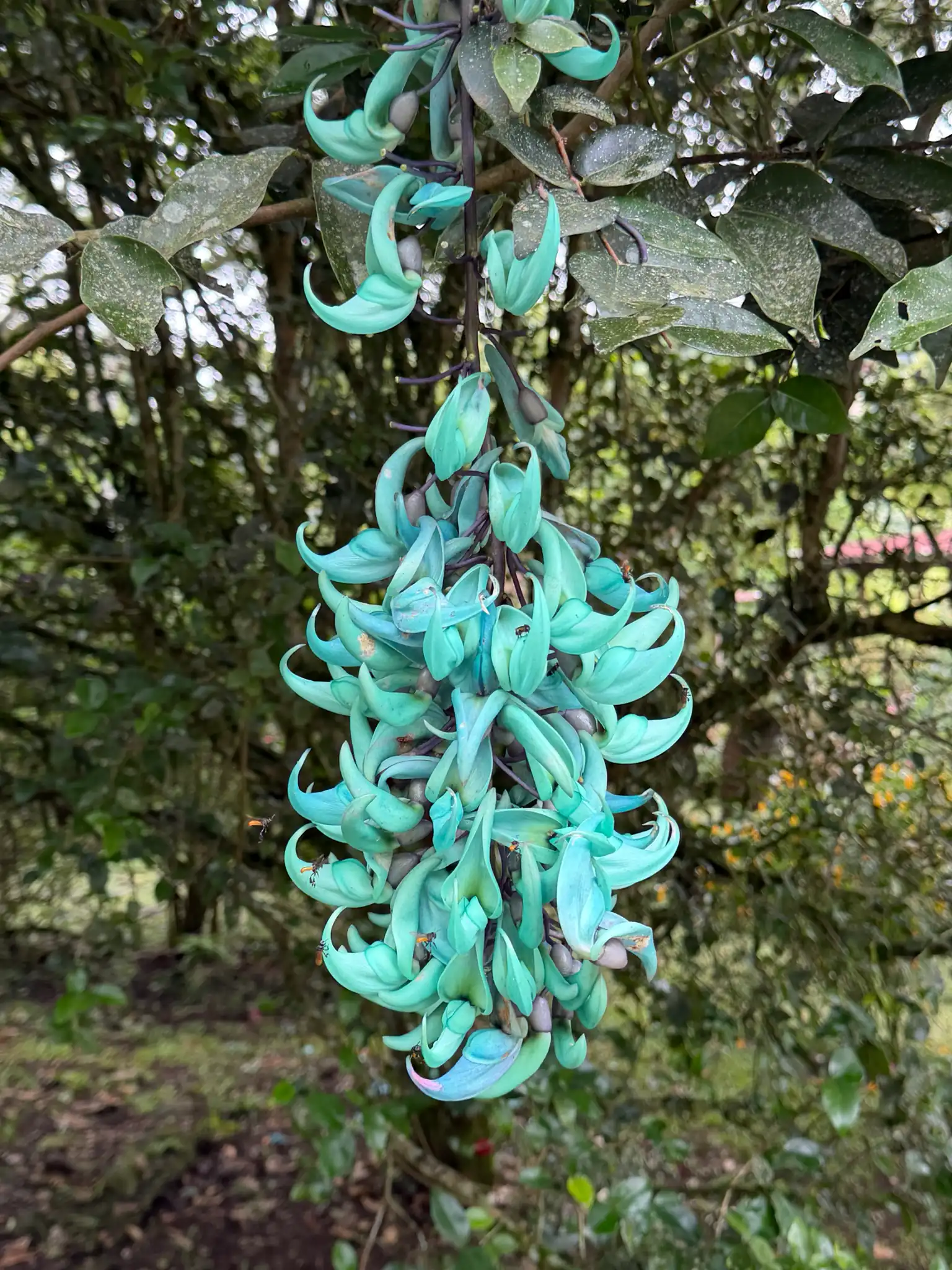
It is distinguished by pendulous trusses to a foot or more long, packed with claw-shaped pea flowers in luminous jade blue-green. Trusses form only on mature vines two or more years old, on stem wood at least 3/4 inch thick, and flowers rarely set seed in cultivation without its native bat pollinators.
Uses & Benefits:
Essentials
At a Glance
Plant Type
Vine
Height
600"
Width
180"
Light
Full Sun, Partial Sun
Zones
10
Water
High - consistently moist
Humidity
High
Lifespan
Long-lived perennial vine
Native To
Philippines
Toxicity
Considered non-toxic
Bloom period
Spring
In flower about 3 months of the year
Planting
How to Grow
- Grow outdoors in the ground only in frost-free Zone 10-12 in South Florida, Hawaii and Puerto Rico; elsewhere grow in a heated greenhouse or conservatory kept above 60F.
- Set in organically rich, fertile, well-drained soil at pH 6-7, with roots shaded and moist and leaves in full sun to part shade from midday heat.
- Provide a strong pergola, arbor or tall support at planting and tie climbing stems until they twine on their own.
- Water freely in active growth to keep soil consistently moist but never soggy, and hold high humidity around the foliage.
- Feed to promote bloom once established and prune lightly after flowering to shape.
Pro Tip
Tie new stems to the pergola and prune lightly just after bloom; keep the thick older wood that carries next season's trusses.
Keep It Thriving
Care Guide
Do
- Keep soil consistently moist and high humidity in heat
- Shade roots while leaves take sun
- Provide a strong pergola or greenhouse support from the start
- Feed with high-phosphorus 7-9-5 fertilizer in growth to promote bloom
Don't
- Do not expose to frost or temperatures below 60F
- Do not let soil stay soggy or waterlogged
- Do not hard-prune each year or remove thick flowering wood
- Do not let the root ball dry out
Seasonal Care Calendar
| Task | Jan | Feb | Mar | Apr | May | Jun | Jul | Aug | Sep | Oct | Nov | Dec |
|---|---|---|---|---|---|---|---|---|---|---|---|---|
| Fertilize | ||||||||||||
| Pest Check | ||||||||||||
| Prune | ||||||||||||
| Stake | ||||||||||||
| Winter Prep |
Watch Out For
Pests & Diseases
Common Pests
Common Diseases
In the Garden
Landscape Uses & Companions
Landscape Uses
Multiply
Propagation Methods
Good to Know
Common Questions
Jade Vine questions
What zones can Jade Vine grow in?
Jade Vine is hardy in USDA Zone 10: in that range it survives winter in the ground. Colder than Zone 10, grow it in a container you can move to shelter for the winter, or as an annual.
When does Jade Vine bloom?
Jade Vine typically blooms in spring. Exact timing shifts a week or two with your zone — Sow's bloom calendar maps it to your garden.
Does Jade Vine need full sun?
Jade Vine does best in full sun to part shade. In hot climates, afternoon shade keeps blooms fresher longer.
Keep exploring
Explore the genus
Hardy in your zone?
Grow Jade Vine with confidence
See it in a design of your actual yard, get zone-matched care reminders, and track it season by season in your garden journal.