The Story
Plant Bio
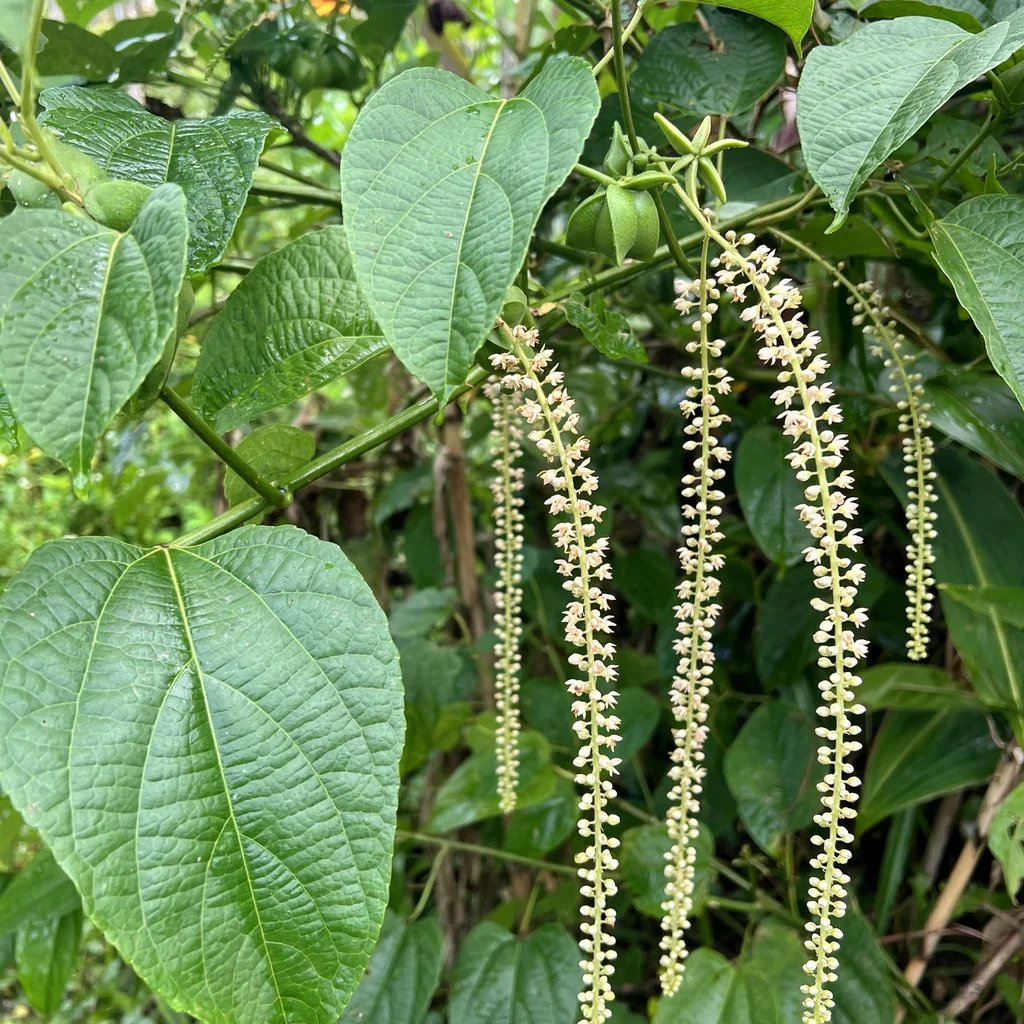
Plukenetia volubilis, the sacha inchi, is a semi-woody perennial twining vine from Andean rainforest at 900 to 1700 m that reaches about 80 inches with support. It bears large heart-shaped leaves about 4 inches wide with small trichomes and monoecious flower spikes with one to two female flowers and about sixty male flowers that swell into star-shaped fruit.
The fruit is a 1 to 2 inch star of four to seven capsules, each with a brown oval seed 0.6 to 0.8 inches long containing 35 to 60 percent oil and 27 percent protein. Flowering begins five to six months after planting with ripe fruit at eight months, then repeats continuously with harvest every three weeks where water is even and frost is absent.
Uses & Benefits:
Essentials
At a Glance
Plant Type
Vine
Height
79"
Width
118"
Light
Full Sun
Zones
10
Water
Even moisture
Humidity
High
Lifespan
Perennial vine
Native To
Andean South America
Toxicity
Toxic if ingested raw
Bloom period
Year round
In flower about 12 months of the year
Planting
How to Grow
- Plant after frost in full sun in well-drained sandy or clay loam loosened 12 to 16 inches deep with organic matter, on level ground that does not pool.
- Space 8 to 10 feet apart in rows 10 feet apart, or 5 feet apart for oil production, and set a sturdy trellis at planting.
- Water evenly to supply 850 to 1000 mm annually with irrigation in dry months, keeping soil moist but never waterlogged.
- Feed with fertilizer or manure through active growth to support continuous flowering and fruiting.
- Pick dry brown capsules from the vine every 20 to 25 days and sun-dry to split; protect all plants from freezing.
Pro Tip
Give it a sturdy trellis in full sun and frost-free, well-drained sandy or clay loam at pH 5.5 to 7.8, water evenly without pooling, and let capsules dry brown on the vine before sun-drying to split — never eat seed raw, roast it first.
Keep It Thriving
Care Guide
Do
- Do provide a strong trellis at planting and train the twining stems upward.
- Do keep soil evenly moist with irrigation in dry months and mulch with organic matter.
- Do harvest only dry brown capsules from the plant and sun-dry them to split.
Don't
- Do not eat seeds or leaves raw; they contain alkaloids, saponins, and lectins and must be roasted.
- Do not overwater or plant where water pools; excess water increases root and stem disease.
- Do not expose to freezing or sustained heat above 97F, which causes flower and fruit drop.
Seasonal Care Calendar
| Task | Jan | Feb | Mar | Apr | May | Jun | Jul | Aug | Sep | Oct | Nov | Dec |
|---|---|---|---|---|---|---|---|---|---|---|---|---|
| Fertilize | ||||||||||||
| Harvest | ||||||||||||
| Plant | ||||||||||||
| Stake | ||||||||||||
| Winter Prep |
Watch Out For
Pests & Diseases
Common Pests
Common Diseases
In the Garden
Landscape Uses & Companions
Landscape Uses
Companion Plants
Multiply
Propagation Methods
Good to Know
Common Questions
Sacha Inchi questions
What zones can Sacha Inchi grow in?
Sacha Inchi is hardy in USDA Zone 10: in that range it survives winter in the ground. Colder than Zone 10, grow it in a container you can move to shelter for the winter, or as an annual.
When does Sacha Inchi bloom?
Sacha Inchi typically blooms year-round. Exact timing shifts a week or two with your zone — Sow's bloom calendar maps it to your garden.
Does Sacha Inchi need full sun?
Sacha Inchi does best in full sun (6+ hours).
Keep exploring
Explore the genus
Hardy in your zone?
Grow Sacha Inchi with confidence
See it in a design of your actual yard, get zone-matched care reminders, and track it season by season in your garden journal.