The Story
Plant Bio
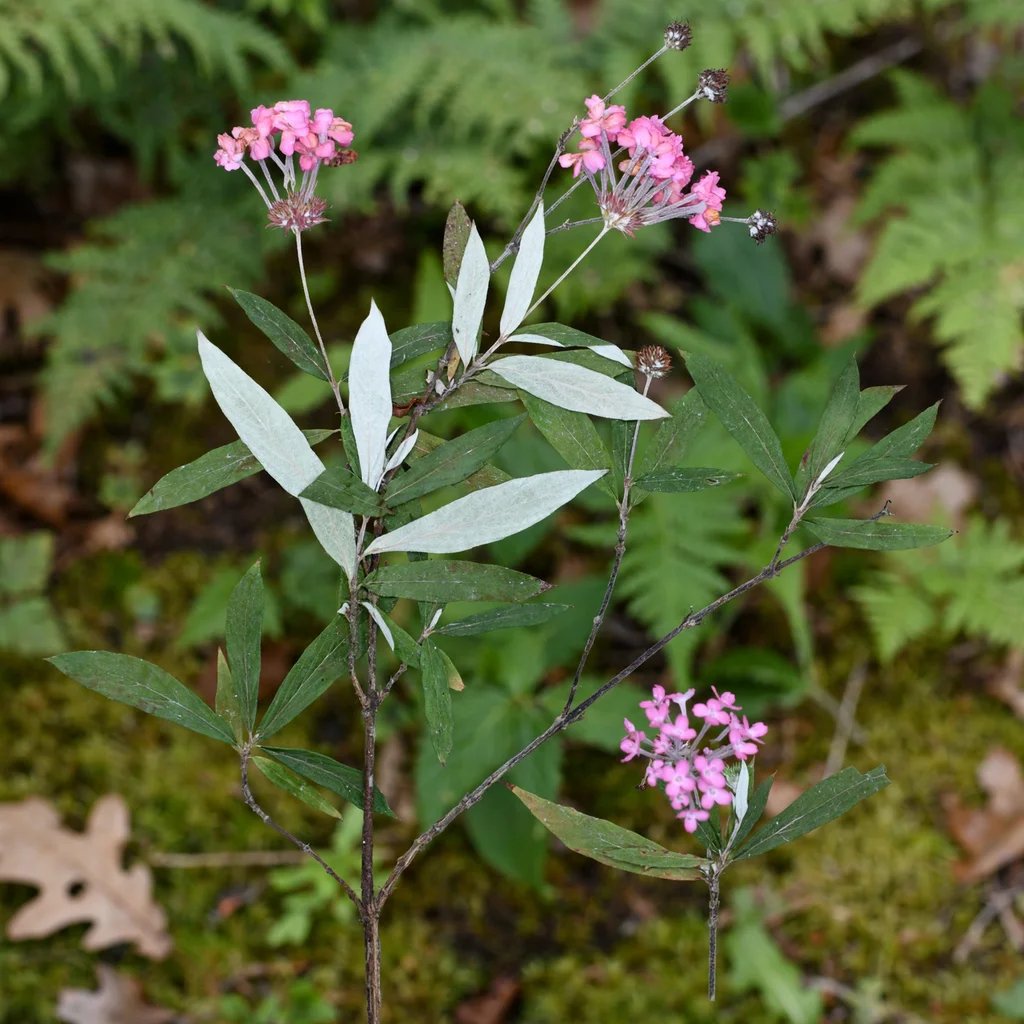
Rondeletia leucophylla is an evergreen woody shrub from Mexico to Panama that holds three to five feet in cultivation when pruned, with opposite lance-shaped leaves dark green above and white-felted beneath. The bloom is rounded terminal clusters of small tubular pink flowers with four spreading lobes and a yellow throat, fragrant by day and stronger at night.
It is distinguished by the pale tomentum that gives the leaf undersides an almost white cast and by its winter to spring peak of rose-pink clusters that continue scattered through the year. Left unpruned it builds a spreading bush that can be trained to a small multi-stem tree, while light pruning after the spring flush keeps it compact for pots and hedges.
Uses & Benefits:
Essentials
At a Glance
Plant Type
Shrub
Height
60"
Width
48"
Light
Full Sun, Partial Sun
Zones
9, 10
Water
Medium
Humidity
Average
Lifespan
Woody perennial
Native To
Mexico to Panama
Toxicity
Unknown
Bloom period
Winter – Spring
In flower about 6 months of the year
Planting
How to Grow
- Plant in full sun to light shade in average well-drained slightly acidic soil.
- Water regularly to establish, then let the top inch dry between waterings and mulch to keep roots cool.
- Protect young plants from frost and move pots under cover when nights fall below 25F.
- Prune lightly in early summer after the main flush to hold three to five feet; do not shear hard every year.
- Feed lightly with a low-nitrogen fertilizer to support bloom and take softwood cuttings to propagate.
Pro Tip
Prune lightly in early summer after the peak flush and let the top inch dry between waterings; hard annual cutbacks and constantly wet soil stop bloom and invite root rot.
Keep It Thriving
Care Guide
Do
- Plant in well-drained soil in full sun to light shade.
- Let the top inch of soil dry between waterings.
- Prune lightly after the spring flush to keep a compact shape.
Don't
- Do not overwater or leave containers standing in water.
- Do not cut back hard every year.
- Do not leave young plants exposed to frost below about 30F.
Seasonal Care Calendar
| Task | Jan | Feb | Mar | Apr | May | Jun | Jul | Aug | Sep | Oct | Nov | Dec |
|---|---|---|---|---|---|---|---|---|---|---|---|---|
| Fertilize | ||||||||||||
| Mulch | ||||||||||||
| Pest Check | ||||||||||||
| Prune | ||||||||||||
| Winter Prep |
Watch Out For
Pests & Diseases
Common Pests
Common Diseases
In the Garden
Landscape Uses & Companions
Landscape Uses
Multiply
Propagation Methods
Good to Know
Common Questions
Panama Rose questions
What zones can Panama Rose grow in?
Panama Rose is hardy in USDA Zones 9–10: in that range it survives winter in the ground. Colder than Zone 9, grow it in a container you can move to shelter for the winter.
When does Panama Rose bloom?
Panama Rose typically blooms from winter to spring. Exact timing shifts a week or two with your zone — Sow's bloom calendar maps it to your garden.
Does Panama Rose need full sun?
Panama Rose does best in full sun to part shade. In hot climates, afternoon shade keeps blooms fresher longer.
Is Panama Rose drought tolerant?
Yes — once established (usually after the first full season), Panama Rose handles dry spells with minimal watering. Water deeply its first year to build the root system that makes that possible.
Keep exploring
Explore the genus
Hardy in your zone?
Grow Panama Rose with confidence
See it in a design of your actual yard, get zone-matched care reminders, and track it season by season in your garden journal.