The Story
Plant Bio
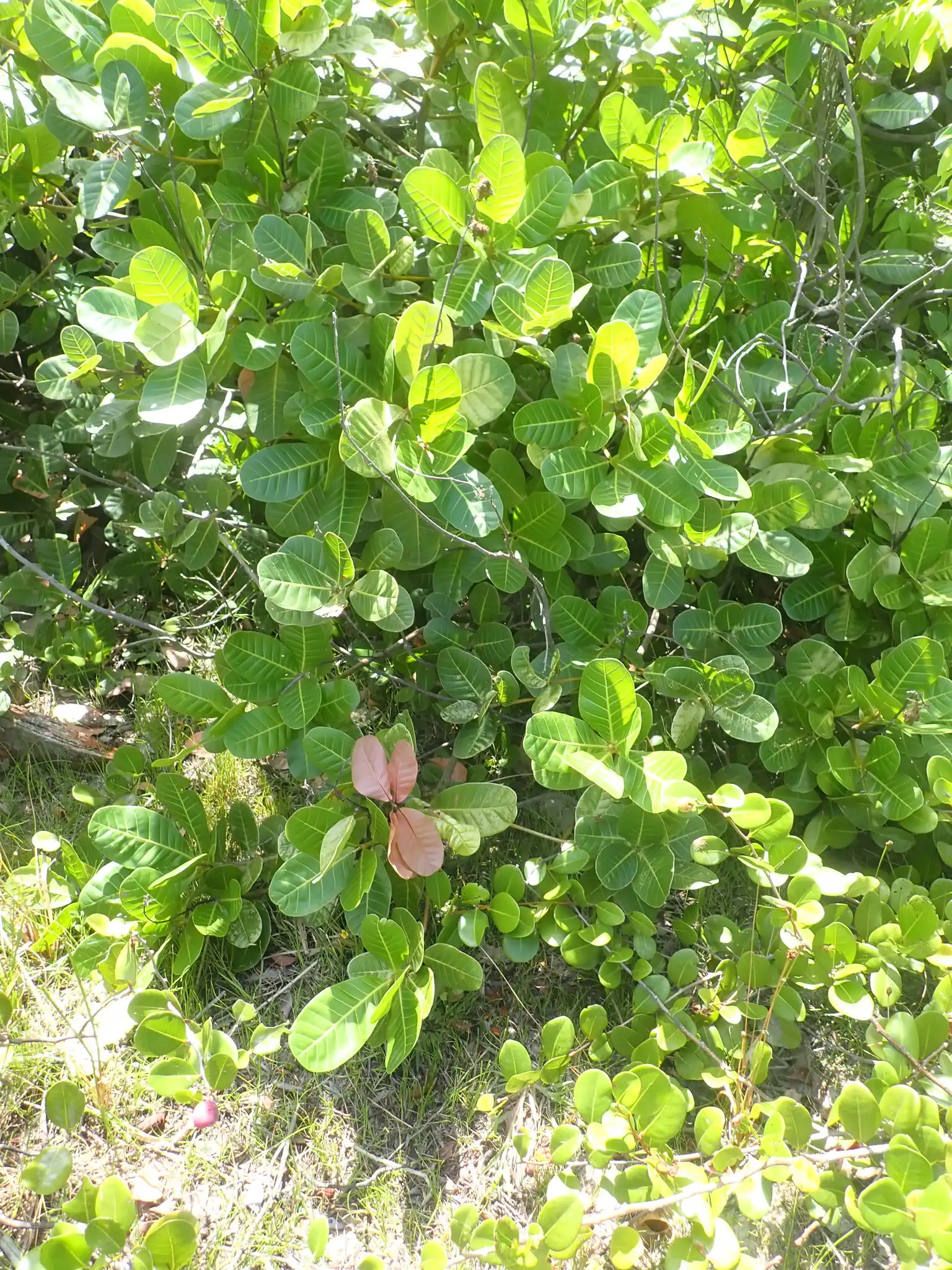
Anacardium occidentale, the cashew, is an erect evergreen tree reaching 15 to 35 feet with a dense symmetrical spreading canopy that branches very low to the ground. Leaves are simple alternate green obovate to oblong 6 to 7 inches long clustered at the stem ends with a rounded tip and prominent veins, and flowers are borne in 4- to 8-inch terminal panicles of 200 to 1600 small blooms.
This species is grown for the cashew apple and nut, but the shell oil contains powerful phenolic lipids that blister skin so home shelling is unsafe. It is frost-tender with no tolerance for freezing, demands full sun and a dry bloom period to set fruit, and develops a straggly ill-defined trunk where heat or drainage are suboptimal.
Uses & Benefits:
Essentials
At a Glance
Plant Type
Tree
Height
420"
Width
360"
Light
Full Sun
Zones
10
Water
Moderate
Humidity
65-80%
Lifespan
Long-lived
Native To
Northeastern Brazil
Toxicity
Toxic shell oil
Bloom period
Spring
In flower about 3 months of the year
Planting
How to Grow
- Plant in full sun in deep well-drained sand with pH 4.5 to 6.5; avoid limestone and low wet ground.
- Water new trees every other day for 7 to 10 days, then 1 to 2 times per week for months; water young trees weekly if dry more than 5 days.
- Fertilize young trees monthly in year one from 4 oz to 16 oz, then 3 to 4 times per year with 6-6-6-2 or 8-3-9-2.
- Keep a 2 to 4 inch mulch ring with a grass-free 2 to 5 foot zone, held 8 to 12 inches off the trunk.
- Prune to keep tops at 10 to 12 feet soon after harvest for hand picking; do not climb tall trees.
Pro Tip
Keep water off the flowers and give the canopy full sun through a dry spring; wet blooms fail from anthracnose and raw home nuts blister skin.
Keep It Thriving
Care Guide
Do
- Give the canopy full sun to flower and fruit
- Keep water off foliage, flowers, and fruit
- Maintain mulch with clearance from the trunk
- Monitor blooms for insects during dry spring
Don't
- Do not overwater mature trees in fall and winter
- Do not shell or eat home-processed nuts
- Do not plant in poorly drained or high-limestone soil without correction
- Do not handle sap, wood, or smoke without gloves
Seasonal Care Calendar
| Task | Jan | Feb | Mar | Apr | May | Jun | Jul | Aug | Sep | Oct | Nov | Dec |
|---|---|---|---|---|---|---|---|---|---|---|---|---|
| Fertilize | ||||||||||||
| Mulch | ||||||||||||
| Pest Check | ||||||||||||
| Prune | ||||||||||||
| Spray |
Watch Out For
Pests & Diseases
Common Pests
Common Diseases
In the Garden
Landscape Uses & Companions
Landscape Uses
Companion Plants
Multiply
Propagation Methods
Good to Know
Common Questions
Cashew questions
What zones can Cashew grow in?
Cashew is hardy in USDA Zone 10: in that range it survives winter in the ground. Colder than Zone 10, winters are too cold for it to survive outdoors.
When does Cashew bloom?
Cashew typically blooms in spring. Exact timing shifts a week or two with your zone — Sow's bloom calendar maps it to your garden.
Does Cashew need full sun?
Cashew does best in full sun (6+ hours).
Is Cashew drought tolerant?
Yes — once established (usually after the first full season), Cashew handles dry spells with minimal watering. Water deeply its first year to build the root system that makes that possible.
Keep exploring
Explore the genus
Hardy in your zone?
Grow Cashew with confidence
See it in a design of your actual yard, get zone-matched care reminders, and track it season by season in your garden journal.