The Story
Plant Bio
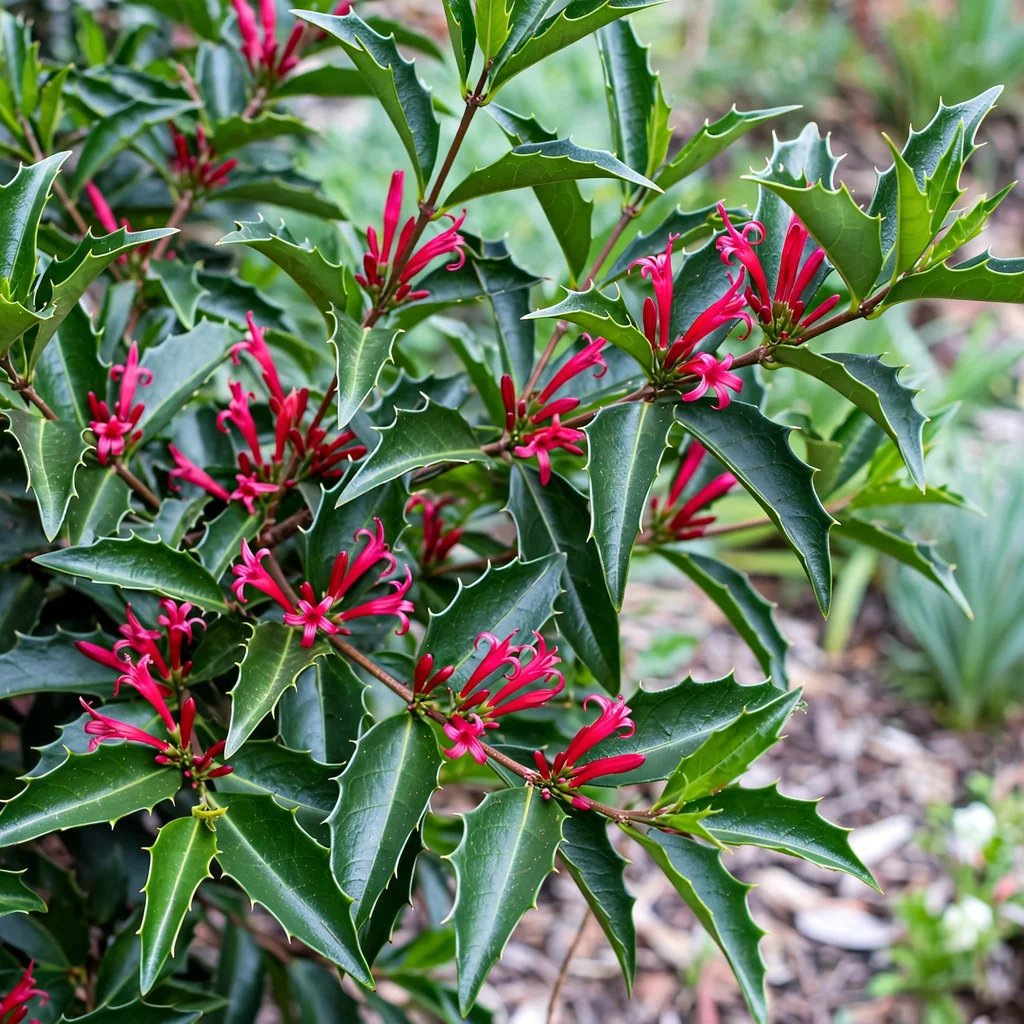
Graptophyllum ilicifolium is an upright evergreen shrub native to the dry rainforest margins of central coastal Queensland, growing ten to twenty feet tall in ideal conditions. It bears glossy, dark green leaves with prickly spined margins resembling European holly, paired with tubular scarlet-red flowers borne in short clusters.
The rigid foliage creates an effective screen or barrier, while the bright red floral tubes provide rich nectar for hummingbirds and other pollinators. It flowers most heavily in dappled sunlight, forming a dense, bushy shape when tip-pruned following its bloom period.
Uses & Benefits:
Essentials
At a Glance
Plant Type
Shrub
Height
236"
Width
157"
Light
Full Sun, Partial Sun, Shade
Zones
10
Water
Moderate
Humidity
Moderate to high
Lifespan
Perennial
Native To
Australia (Queensland)
Toxicity
Non-toxic
Bloom period
Spring – Early summer
In flower about 4 months of the year
Planting
How to Grow
- Select a planting site or container spot receiving dappled shade or gentle morning sun.
- Prepare humus-rich, sandy or loamy soil with high drainage capability to prevent root stagnation.
- Plant at the exact depth of the nursery container and water thoroughly to settle roots.
- Apply a light layer of organic mulch around the base, keeping it clear of the main stem.
- Water regularly during active spring growth, allowing the top inch of soil to dry slightly between waterings.
Pro Tip
Prune lightly behind spent flowers immediately after spring blooming; cutting back into old bare wood prevents latent bud development and leaves permanent empty gaps.
Keep It Thriving
Care Guide
Do
- Provide dappled shade to protect foliage from sun-scald during high heat.
- Use well-draining potting soil or sandy loam to prevent root rot pathogens.
- Tip-prune young stems after flowering to encourage dense branching.
Don't
- Do not allow roots to sit in soggy, saturated soil or heavy clay.
- Do not prune hard into thick, leafless inner wood where buds cannot regenerate.
- Do not leave container plants outdoors when temperatures approach freezing.
Seasonal Care Calendar
| Task | Jan | Feb | Mar | Apr | May | Jun | Jul | Aug | Sep | Oct | Nov | Dec |
|---|---|---|---|---|---|---|---|---|---|---|---|---|
| Fertilize | ||||||||||||
| Pest Check | ||||||||||||
| Prune | ||||||||||||
| Winter Prep |
Watch Out For
Pests & Diseases
Common Pests
Common Diseases
In the Garden
Landscape Uses & Companions
Landscape Uses
Companion Plants
Multiply
Propagation Methods
Good to Know
Common Questions
Mount Blackwood Holly questions
What zones can Mount Blackwood Holly grow in?
Mount Blackwood Holly is hardy in USDA Zone 10: in that range it survives winter in the ground. Colder than Zone 10, grow it in a container you can move to shelter for the winter.
When does Mount Blackwood Holly bloom?
Mount Blackwood Holly typically blooms from early spring to early summer. Exact timing shifts a week or two with your zone — Sow's bloom calendar maps it to your garden.
Does Mount Blackwood Holly need full sun?
Mount Blackwood Holly does best in full sun to part shade. In hot climates, afternoon shade keeps blooms fresher longer.
Is Mount Blackwood Holly drought tolerant?
Yes — once established (usually after the first full season), Mount Blackwood Holly handles dry spells with minimal watering. Water deeply its first year to build the root system that makes that possible.
More Graptophyllum to compare
Keep exploring
Explore the genus
Hardy in your zone?
Grow Mount Blackwood Holly with confidence
See it in a design of your actual yard, get zone-matched care reminders, and track it season by season in your garden journal.