The Story
Plant Bio
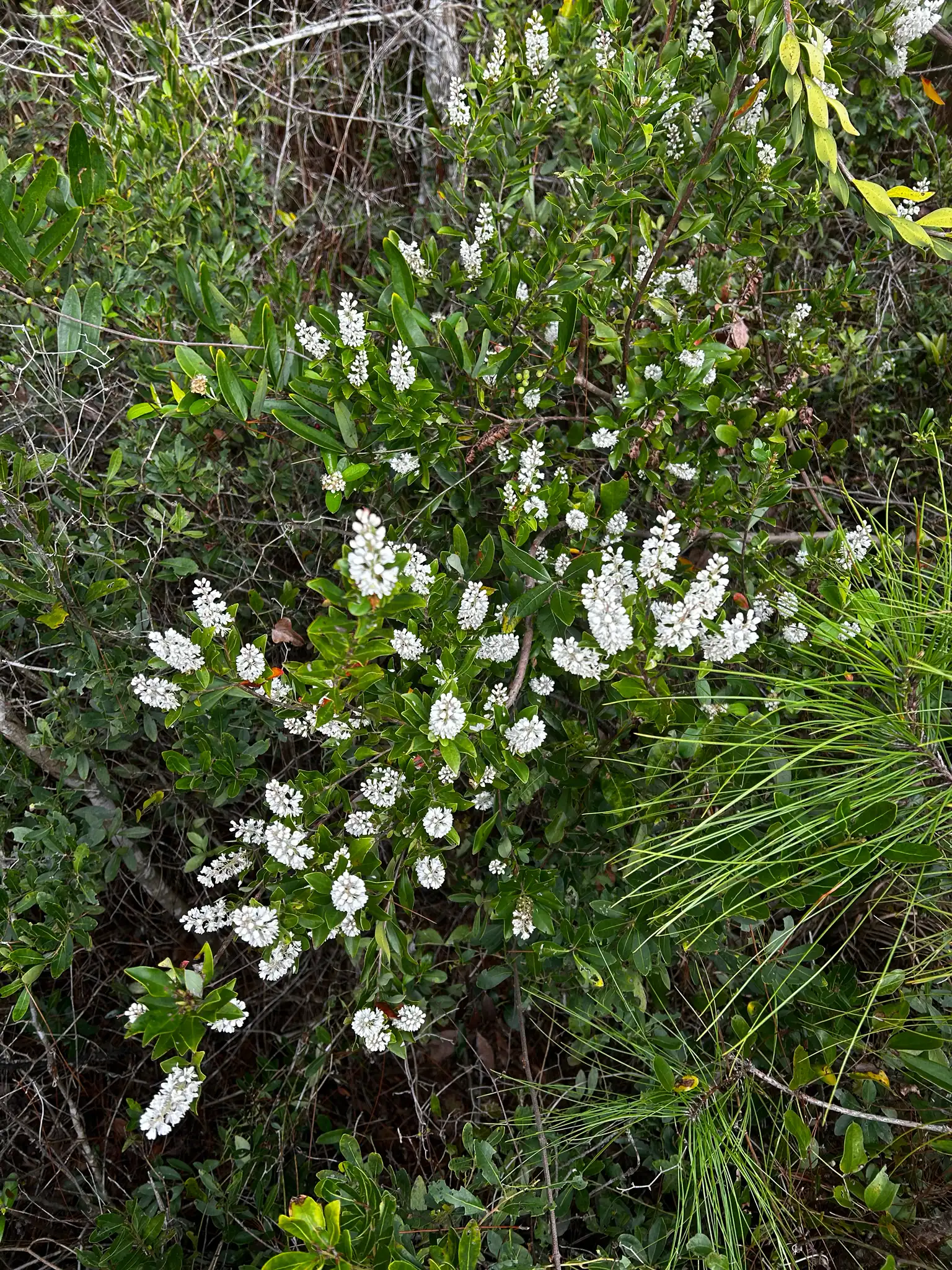
Cliftonia monophylla is an evergreen shrub to small tree of the southeastern coastal plain, forming crooked multi-stemmed thickets to about 18 feet with an open irregular crown. The leaves are thick, dark and glossy and held year-round, on roots that require damp sandy peat free of lime, mud and salt.
In late winter to spring it carries upright 2- to 4-inch racemes of fragrant white to pinkish five-petaled flowers at the branch tips. It is a major early nectar and pollen source that builds honeybee colonies and bumblebee queens in February and March, and it spreads by suckers to form colonies if left unconfined.
Uses & Benefits:
Essentials
At a Glance
Plant Type
Shrub
Height
216"
Width
120"
Light
Full Sun, Partial Sun
Zones
7, 8, 9, 10
Water
Moist to wet
Humidity
High
Lifespan
Woody perennial, decades
Native To
Southeastern USA
Toxicity
Non-toxic
Bloom period
Early spring – Late spring
In flower about 3 months of the year
Planting
How to Grow
- Set in full sun to partial shade in a swamp edge, bay or rain garden with moist acid sand or peat.
- Acidify and loosen the planting area with peat and leafmould, with no lime, fertilizer salts or deicing runoff.
- Plant container saplings at nursery depth in spring after hard frost, then water in deeply.
- Mulch 2 to 3 inches with pine straw or leafmould, keeping mulch off the stems.
- Water to keep soil evenly moist through the first two summers; established plants tolerate brief drying.
Pro Tip
Keep it free of root competition and mulched with leafmould to hold acid moisture; it fails in alkaline, salty or crowded plantings despite having no serious pests.
Keep It Thriving
Care Guide
Do
- Test soil and keep pH below 7.0 with peat and leafmould amendments.
- Mulch to conserve moisture and suppress competing weeds and grasses.
- Remove suckers promptly if a single-stem form is wanted.
Don't
- Do not plant in chalky, limed, salty or compacted mud soils.
- Do not cut back hard into old bare wood or shear the crown.
- Do not let grasses or aggressive shrubs crowd the root zone.
Seasonal Care Calendar
| Task | Jan | Feb | Mar | Apr | May | Jun | Jul | Aug | Sep | Oct | Nov | Dec |
|---|---|---|---|---|---|---|---|---|---|---|---|---|
| Mulch | ||||||||||||
| Pest Check | ||||||||||||
| Plant | ||||||||||||
| Prune |
Watch Out For
Pests & Diseases
Common Pests
Common Diseases
In the Garden
Landscape Uses & Companions
Landscape Uses
Multiply
Propagation Methods
Good to Know
Common Questions
Buckwheat Tree questions
What zones can Buckwheat Tree grow in?
Buckwheat Tree is hardy in USDA Zones 7–10: in that range it survives winter in the ground. Colder than Zone 7, grow it in a container you can move to shelter for the winter.
Is Buckwheat Tree deer resistant?
Not reliably. Deer may browse Buckwheat Tree, especially tender spring growth — plan on repellents or fencing where pressure is high.
When does Buckwheat Tree bloom?
Buckwheat Tree typically blooms in spring. Exact timing shifts a week or two with your zone — Sow's bloom calendar maps it to your garden.
Does Buckwheat Tree need full sun?
Buckwheat Tree does best in full sun to part shade. In hot climates, afternoon shade keeps blooms fresher longer.
Keep exploring
Explore the genus
Hardy in your zone?
Grow Buckwheat Tree with confidence
See it in a design of your actual yard, get zone-matched care reminders, and track it season by season in your garden journal.