The Story
Plant Bio
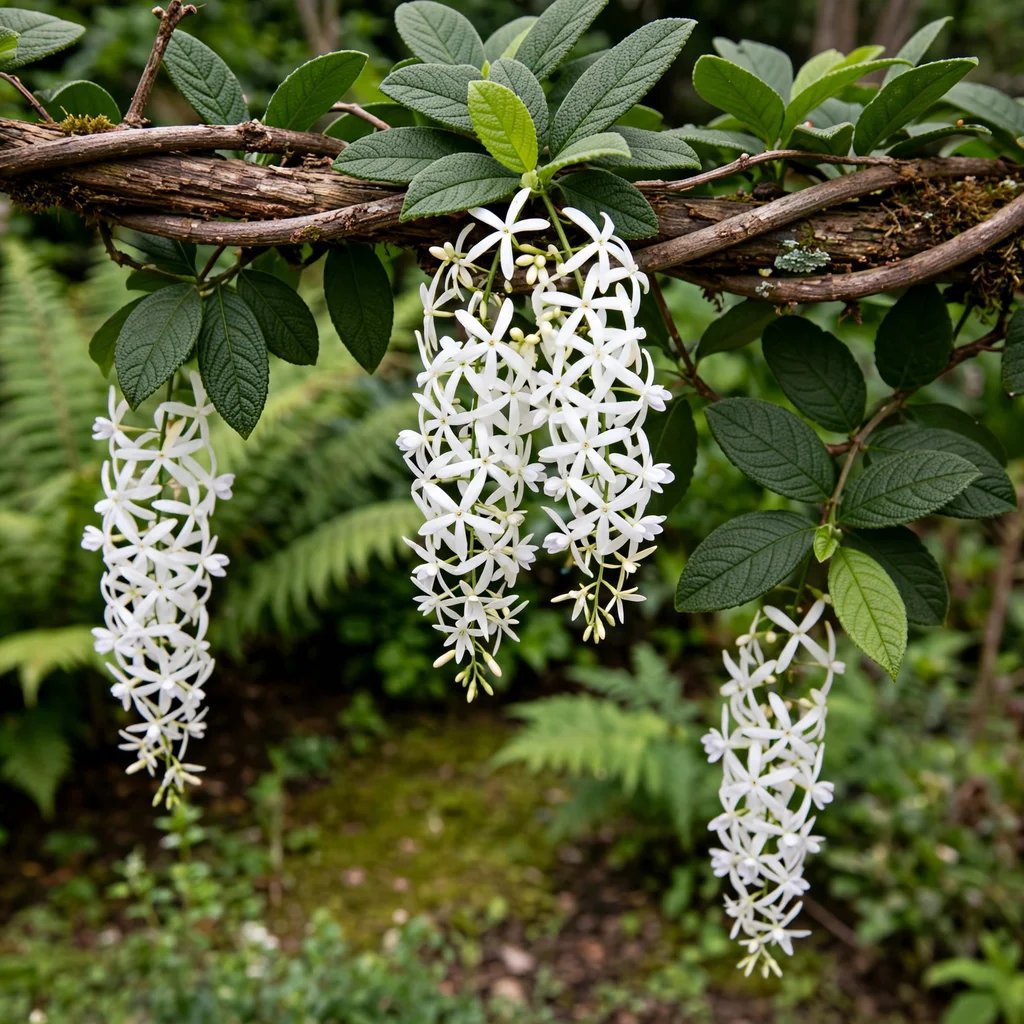
Petrea pubescens, sold as Petrea glandulosa, is a fast-growing woody vine from South American forest reaching 30 to 40 feet unpruned, with stiff green leaves rough as sandpaper to the touch. Flowers are borne in long drooping racemes over a foot long, where the show comes from persistent calyces that hold color for weeks after the true flowers drop.
'Alba' is the white-flowered nursery form sold as White Queen's Wreath, bearing pinwheel star-shaped flowers in white to off-white instead of purple. It climbs by twining stems that need a sturdy fence or trellis, and can be trained as a shrub or small tree where space is limited.
Uses & Benefits:
Essentials
At a Glance
Plant Type
Vine
Height
480"
Width
144"
Light
Full Sun, Partial Sun
Zones
9, 10
Water
Moderate to low once established
Humidity
High
Lifespan
Woody perennial vine
Native To
South America
Toxicity
Unknown
Bloom period
Spring – Fall
In flower about 9 months of the year
Planting
How to Grow
- Plant in full sun after last frost in well-drained soil with room for a sturdy trellis or fence.
- Water frequently to establish, then water infrequently; keep lawn grass away from roots and avoid waterlogging.
- Protect young plants from frost below 30F; move containers indoors in cold zones.
- Prune lightly after the spring flush to control size; provide strong support as stems twine and lengthen.
- Expect 2-3 years to first flower; leaves return after first heavy bloom drops foliage.
Pro Tip
Give it a strong trellis from the start and prune lightly after flowering; the first heavy bloom often drops its leaves, which return without intervention.
Keep It Thriving
Care Guide
Do
- Give full sun for best bloom, with partial shade tolerated
- Provide a sturdy trellis, fence or arbor
- Water deeply to establish, then reduce
Don't
- Do not over-prune or cut hard into old wood
- Do not waterlog soil or plant where water stands
- Do not expect frost hardiness below 30F without protection
Seasonal Care Calendar
| Task | Jan | Feb | Mar | Apr | May | Jun | Jul | Aug | Sep | Oct | Nov | Dec |
|---|---|---|---|---|---|---|---|---|---|---|---|---|
| Fertilize | ||||||||||||
| Pest Check | ||||||||||||
| Plant | ||||||||||||
| Prune | ||||||||||||
| Winter Prep |
Watch Out For
Pests & Diseases
Common Pests
Common Diseases
In the Garden
Landscape Uses & Companions
Landscape Uses
Multiply
Propagation Methods
Good to Know
Common Questions
White Queen's Wreath questions
What zones can White Queen's Wreath grow in?
White Queen's Wreath is hardy in USDA Zones 9–10: in that range it survives winter in the ground. Colder than Zone 9, grow it in a container you can move to shelter for the winter, or as an annual.
When does White Queen's Wreath bloom?
White Queen's Wreath typically blooms from spring to fall. Exact timing shifts a week or two with your zone — Sow's bloom calendar maps it to your garden.
Does White Queen's Wreath need full sun?
White Queen's Wreath does best in full sun to part shade. In hot climates, afternoon shade keeps blooms fresher longer.
Is White Queen's Wreath drought tolerant?
Yes — once established (usually after the first full season), White Queen's Wreath handles dry spells with minimal watering. Water deeply its first year to build the root system that makes that possible.
More Petrea to compare
Keep exploring
Explore the genus
Hardy in your zone?
Grow White Queen's Wreath with confidence
See it in a design of your actual yard, get zone-matched care reminders, and track it season by season in your garden journal.