The Story
Plant Bio
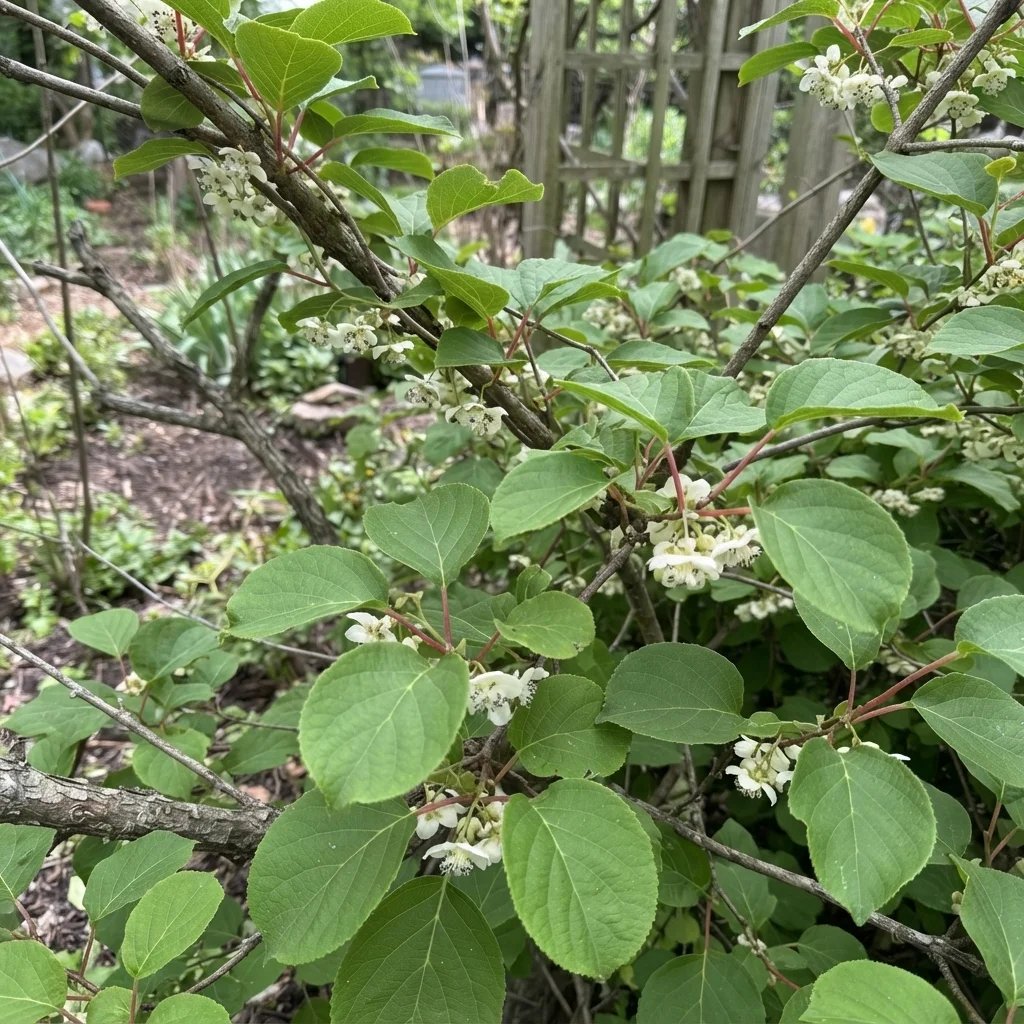
Actinidia arguta, the hardy kiwi, is a vigorous deciduous twining liana from Japan, Korea, northern China and the Russian Far East that reaches 40 feet in cultivation and requires a substantial trellis. White fragrant blooms open in spring and develop into smooth-skinned grape-sized fruit from late summer into fall.
It survives to -30F in winter yet pushes frost-tender spring shoots, so a late frost that kills the flowers means no crop that year. Fruit forms on current-season shoots from one-year-old canes and bears at 5 to 9 years at 50 to 100 pounds per mature female when one same-bloom male is planted for every six females.
Uses & Benefits:
Essentials
At a Glance
Plant Type
Vine
Height
472"
Width
24"
Zones
4, 5, 6, 7, 8, 9
Water
Medium
Humidity
Unknown
Lifespan
Long-lived woody vine
Native To
Japan, Korea, Northern China, Russian Far East
Toxicity
Unknown
Bloom period
Spring
In flower about 3 months of the year
Planting
How to Grow
- Set plants 10 feet apart on a stout trellis or arbor, covering the roots just to the crown and watering well at planting.
- Train one or two permanent trunks and tie vigorous new canes to wires, allowing 5 to 6 feet of growth in a single season.
- Withhold fertilizer the first year, then apply 2 oz of 10-10-10 in spring of year two and add 2 oz per year to a maximum of 8 oz.
- Dormant-prune December to March, removing suckers, watersprouts and crowded wood and spacing fruiting canes 8 to 12 inches apart.
- Summer-prune several times to 4 to 6 leaves beyond the last flower and harvest fruit from August to October.
Pro Tip
Dormant-prune from December to March to remove 70 percent of wood and space fruiting canes 8 to 12 inches apart, then summer-prune to 4 to 6 leaves beyond the last flower.
Keep It Thriving
Care Guide
Do
- Provide one same-bloom male for pollination unless planting self-fertile Issai
- Irrigate as needed through establishment and dry spells
- Monitor fruit closely as it ripens for insect damage
Don't
- Do not fertilize at planting or over-fertilize, as salts burn the roots
- Do not leave vines unsupported or unpruned, as wood tangles and shades fruit
- Do not expect a crop after spring frost burns the flowers
Seasonal Care Calendar
| Task | Jan | Feb | Mar | Apr | May | Jun | Jul | Aug | Sep | Oct | Nov | Dec |
|---|---|---|---|---|---|---|---|---|---|---|---|---|
| Fertilize | ||||||||||||
| Harvest | ||||||||||||
| Pest Check | ||||||||||||
| Plant | ||||||||||||
| Prune |
Watch Out For
Pests & Diseases
Common Pests
Common Diseases
In the Garden
Landscape Uses & Companions
Landscape Uses
Multiply
Propagation Methods
Good to Know
Common Questions
Hardy Kiwi questions
What zones can Hardy Kiwi grow in?
Hardy Kiwi is hardy in USDA Zones 4–9: in that range it survives winter in the ground. Warmer than Zone 9, winter isn't the problem: it prefers colder winters, and summer heat can shorten its life.
When does Hardy Kiwi bloom?
Hardy Kiwi typically blooms in spring. Exact timing shifts a week or two with your zone — Sow's bloom calendar maps it to your garden.
More Actinidia to compare
Keep exploring
Explore the genus
Grow Hardy Kiwi with confidence
See it in a design of your actual yard, get zone-matched care reminders, and track it season by season in your garden journal.