The Story
Plant Bio
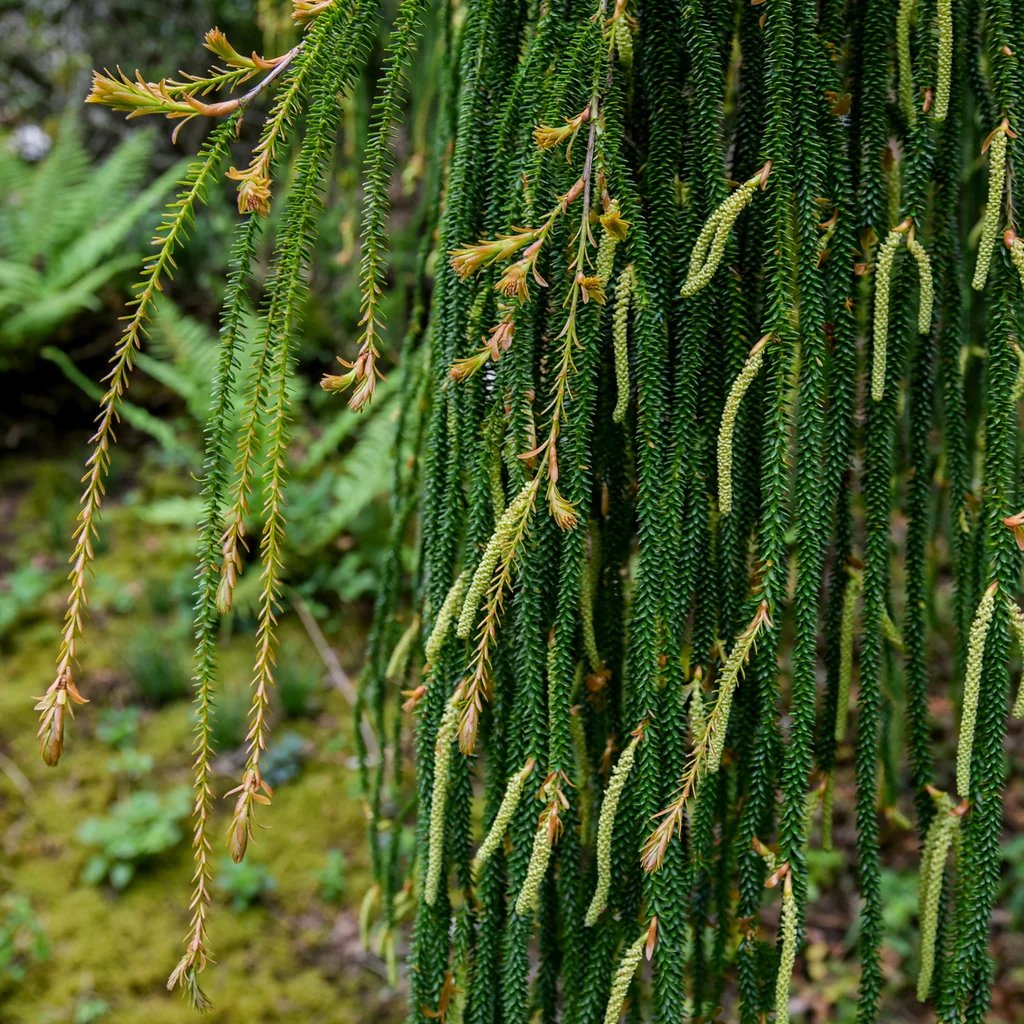
Dacrydium cupressinum, commonly known as rimu, is a large evergreen southern conifer native to the moist temperate rainforests of New Zealand. In youth, it forms a pyramidal tree with distinctively weeping, pendulous branchlets clad in small, spirally arranged scale-like leaves.
New foliage emerges in bright light green or bronze tones before aging to deep forest green on gracefully cascading shoots. Male and female reproductive structures occur on separate trees, producing tiny, solitary cones that hold negligible ornamental value.
Uses & Benefits:
Essentials
At a Glance
Plant Type
Tree
Height
394"
Width
591"
Light
Full Sun, Partial Sun
Zones
8, 9, 10
Water
High
Humidity
Moderate to high
Lifespan
Perennial
Native To
New Zealand
Toxicity
Non-toxic
Bloom period
Spring
In flower about 3 months of the year
Planting
How to Grow
- Select a sheltered site in full sun to partial shade with rich, well-draining organic loam and protection from hot, drying winds.
- Dig a planting hole twice as wide as the root ball and equal in depth, ensuring the root crown rests flush with the surrounding soil line.
- Backfill with native soil mixed with organic matter, firming gently around the base to eliminate air pockets.
- Water deeply immediately after planting and apply a 2- to 3-inch layer of organic mulch around the root zone, keeping it clear of the main trunk.
- Water regularly to maintain uniform soil moisture, taking care never to let the soil dry out completely.
Pro Tip
Maintain consistent sub-surface soil moisture in a well-draining organic loam, as allowing the root zone to dry out causes rapid foliage dieback.
Keep It Thriving
Care Guide
Do
- Provide shelter from hot, desiccating summer winds.
- Maintain continuous soil moisture with deep, regular watering.
- Mulch around the base to retain soil moisture and keep roots cool.
Don't
- Do not cut back into old, leafless brown wood, as it will not resprout.
- Do not allow the soil to dry out completely during dry spells.
- Do not plant in heavy, poorly draining clay soils prone to waterlogging.
Seasonal Care Calendar
| Task | Jan | Feb | Mar | Apr | May | Jun | Jul | Aug | Sep | Oct | Nov | Dec |
|---|---|---|---|---|---|---|---|---|---|---|---|---|
| Fertilize | ||||||||||||
| Mulch | ||||||||||||
| Pest Check | ||||||||||||
| Prune | ||||||||||||
| Winter Prep |
Watch Out For
Pests & Diseases
Common Pests
Common Diseases
In the Garden
Landscape Uses & Companions
Landscape Uses
Companion Plants
Multiply
Propagation Methods
Good to Know
Common Questions
Rimu questions
What zones can Rimu grow in?
Rimu is hardy in USDA Zones 8–10: in that range it survives winter in the ground. Colder than Zone 8, winters are too cold for it to survive outdoors.
When does Rimu bloom?
Rimu typically blooms in spring. Exact timing shifts a week or two with your zone — Sow's bloom calendar maps it to your garden.
Does Rimu need full sun?
Rimu does best in full sun to part shade. In hot climates, afternoon shade keeps blooms fresher longer.
Keep exploring
Explore the genus
Hardy in your zone?
Grow Rimu with confidence
See it in a design of your actual yard, get zone-matched care reminders, and track it season by season in your garden journal.