The Story
Plant Bio
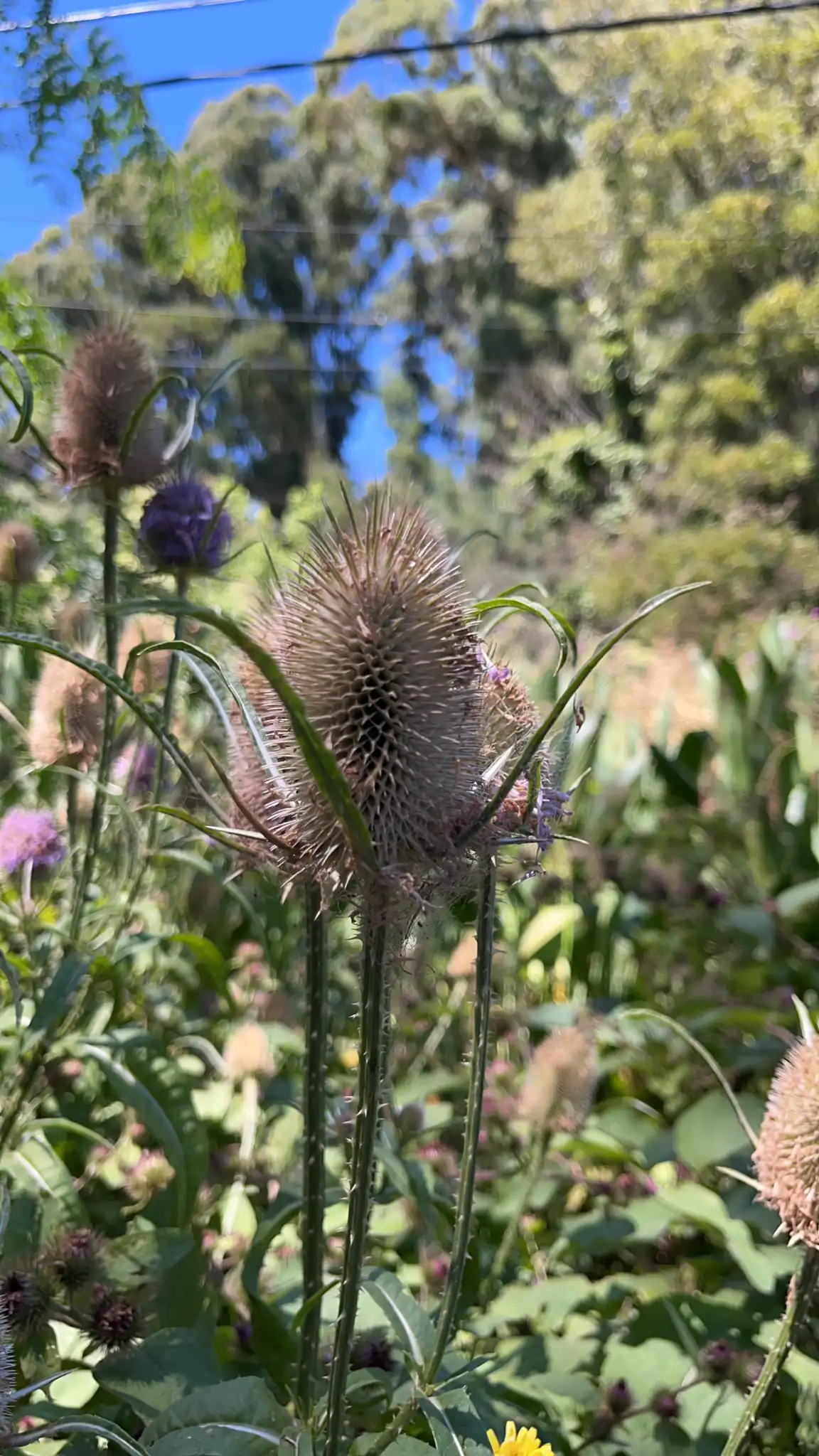
Dipsacus fullonum is a stout biennial herb native to Europe and North Africa that forms a flat basal rosette of spiny leaves during its first year. In its second season, it shoots up tall, rigid flowering stalks topped with dense, cone-shaped spiny seed heads subtended by long upwardly curving bracts.
The paired stem leaves merge at the node to form cup-like reservoirs that trap rainwater, earning the plant the common name Venus' basin. Its small pale purple flowers bloom in horizontal bands across the central cone and mature into persistent, rigid seed heads that provide food for granivorous birds.
Uses & Benefits:
Essentials
At a Glance
Plant Type
Perennial
Height
79"
Width
24"
Light
Full Sun, Partial Sun
Zones
4, 5, 6, 7, 8, 9
Water
Low
Humidity
Moderate
Lifespan
Biennial
Native To
Europe, Caucasus, Northwest Africa
Toxicity
Non-toxic (spiny/skin irritant)
Bloom period
Summer – Early fall
In flower about 4 months of the year
Planting
How to Grow
- Sow seed in early spring on well-drained soil exposed to full sun.
- Keep soil moderately moist until the first-year basal rosettes become established.
- Withhold fertilizer completely, as elevated nutrient levels promote excessive weed spread.
- Cut down flowering stalks before seed cones dry and scatter to maintain boundary control.
Pro Tip
Remove flower heads manually before seeds set, as a single plant produces thousands of self-seeding propagules that escape easily into wild habitats.
Keep It Thriving
Care Guide
Do
- Wear heavy leather gloves when handling stems to avoid painful puncture injuries from rigid prickles.
- Ensure soil drainage is thorough to protect taproots from wet rot during winter dormancy.
- Cut spent flower stalks back to ground level before seeds mature.
Don't
- Never apply nitrogen fertilizer, which encourages aggressive expansion and dense weed thickets.
- Do not allow seed heads to remain on the plant into winter near natural waterways or pastures.
- Do not plant in saturated soils prone to prolonged waterlogging.
Seasonal Care Calendar
| Task | Jan | Feb | Mar | Apr | May | Jun | Jul | Aug | Sep | Oct | Nov | Dec |
|---|---|---|---|---|---|---|---|---|---|---|---|---|
| Deadhead | ||||||||||||
| Pest Check | ||||||||||||
| Prune | ||||||||||||
| Spring Cleanup |
Watch Out For
Pests & Diseases
Common Pests
Common Diseases
In the Garden
Landscape Uses & Companions
Landscape Uses
Multiply
Propagation Methods
Good to Know
Common Questions
Common Teasel questions
What zones can Common Teasel grow in?
Common Teasel is hardy in USDA Zones 4–9: in that range it survives winter in the ground. Warmer than Zone 9, winter isn't the problem: it prefers colder winters, and summer heat can shorten its life.
Is Common Teasel deer resistant?
Yes — Common Teasel is rated deer-resistant. Deer typically pass it over, though extreme hunger can override any plant's defenses.
When does Common Teasel bloom?
Common Teasel typically blooms from early summer to early fall. Exact timing shifts a week or two with your zone — Sow's bloom calendar maps it to your garden.
Does Common Teasel need full sun?
Common Teasel does best in full sun to part shade. In hot climates, afternoon shade keeps blooms fresher longer.
Is Common Teasel drought tolerant?
Yes — once established (usually after the first full season), Common Teasel handles dry spells with minimal watering. Water deeply its first year to build the root system that makes that possible.
Keep exploring
Explore the genus
Grow Common Teasel with confidence
See it in a design of your actual yard, get zone-matched care reminders, and track it season by season in your garden journal.