The Story
Plant Bio
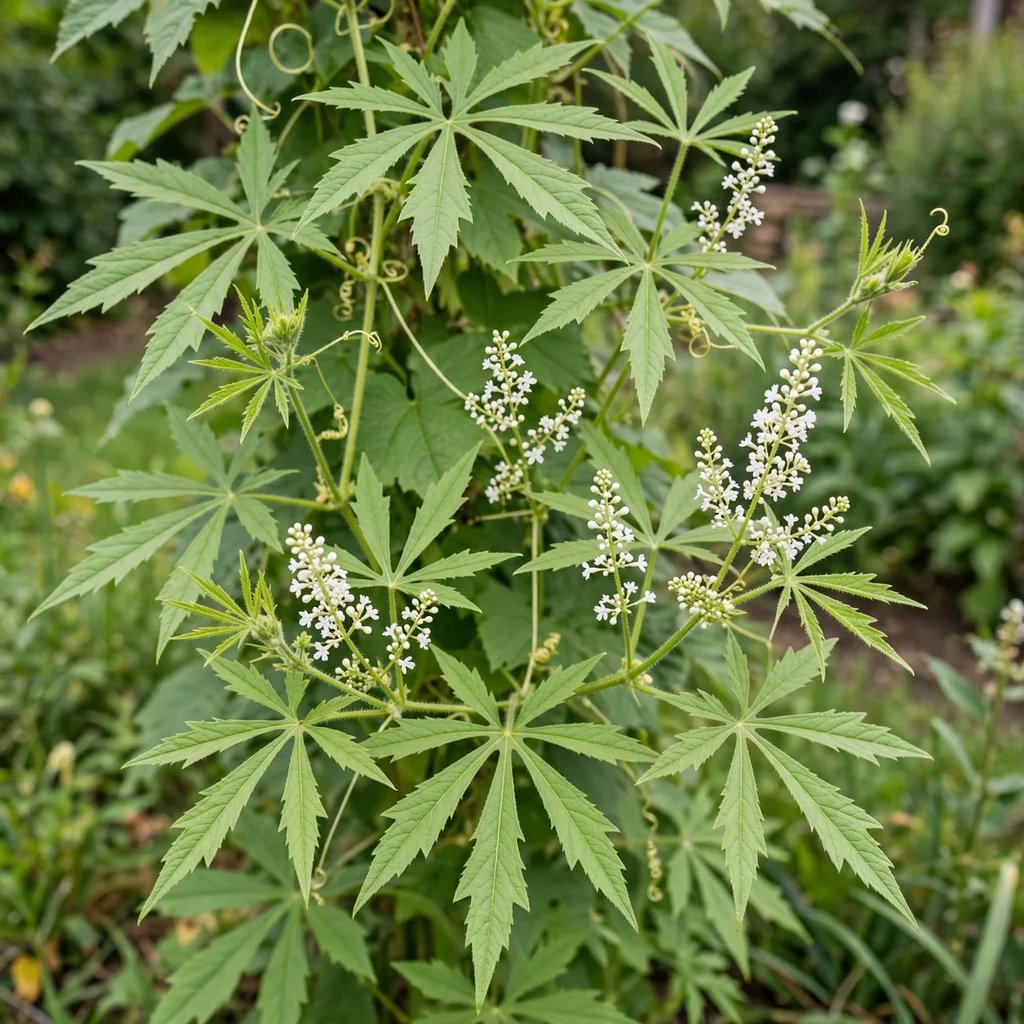
Echinocystis lobata is a fast-growing herbaceous annual vine native to North America that climbs up to thirty feet using three-forked coiling tendrils. Its thin, light green foliage features three to seven palmately arranged lobes and produces erect panicles of small, fragrant white flowers through summer and early fall.
The plant produces swollen, spiny seed pods that discharge four large seeds via hydrostatic pressure when fully mature. Although often mistaken for a perennial due to its massive seasonal growth, it functions strictly as a tender annual that completes its lifecycle before dying back after the first hard fall frost.
Uses & Benefits:
Essentials
At a Glance
Plant Type
Vine
Height
354"
Width
118"
Light
Full Sun, Partial Sun
Zones
4, 5, 6, 7, 8, 9, 10
Water
High
Humidity
Moderate to High
Lifespan
Annual
Native To
North America
Toxicity
Toxic if ingested
Bloom period
Summer – Autumn
In flower about 6 months of the year
Planting
How to Grow
- Cold stratify seeds in moist sand at refrigeration temperatures for 60 days prior to spring planting.
- Sow stratified seeds direct into moist, rich soil in full sun or partial shade after the last spring frost.
- Provide a sturdy trellis, fence, or arbor immediately to support the fast-coiling tendrils as seedlings emerge.
- Maintain consistent soil moisture throughout summer, watering deeply during dry spells.
Pro Tip
Remove developing spiny fruit before they ripen and burst to control rampant self-seeding across adjacent borders.
Keep It Thriving
Care Guide
Do
- Plant in fertile, moisture-retentive soils near wetland margins or damp garden areas.
- Erect climbing supports at planting time so tendrils catch immediately.
- Harvest or pluck green spiny seed capsules early if self-seeding is undesirable.
Don't
- Do not allow soil to dry out completely, as foliage wilts rapidly under water stress.
- Do not consume the fruits or seeds, which are extremely bitter and inedible.
- Do not cut back late into the season expecting winter survival; plants die completely with the first hard frost.
Seasonal Care Calendar
| Task | Jan | Feb | Mar | Apr | May | Jun | Jul | Aug | Sep | Oct | Nov | Dec |
|---|---|---|---|---|---|---|---|---|---|---|---|---|
| Pest Check | ||||||||||||
| Plant | ||||||||||||
| Prune | ||||||||||||
| Stake |
Watch Out For
Pests & Diseases
Common Pests
Common Diseases
In the Garden
Landscape Uses & Companions
Landscape Uses
Multiply
Propagation Methods
Good to Know
Common Questions
Wild Cucumber questions
What zones can Wild Cucumber grow in?
Wild Cucumber is an annual: it grows, flowers and sets seed in one season, so winter cold doesn't limit where it grows. Gardeners in any zone can grow it by planting at the right time, usually after the last spring frost.
When does Wild Cucumber bloom?
Wild Cucumber typically blooms from summer to fall. Exact timing shifts a week or two with your zone — Sow's bloom calendar maps it to your garden.
Does Wild Cucumber need full sun?
Wild Cucumber does best in full sun to part shade. In hot climates, afternoon shade keeps blooms fresher longer.
Keep exploring
Explore the genus
Grow Wild Cucumber with confidence
See it in a design of your actual yard, get zone-matched care reminders, and track it season by season in your garden journal.