The Story
Plant Bio
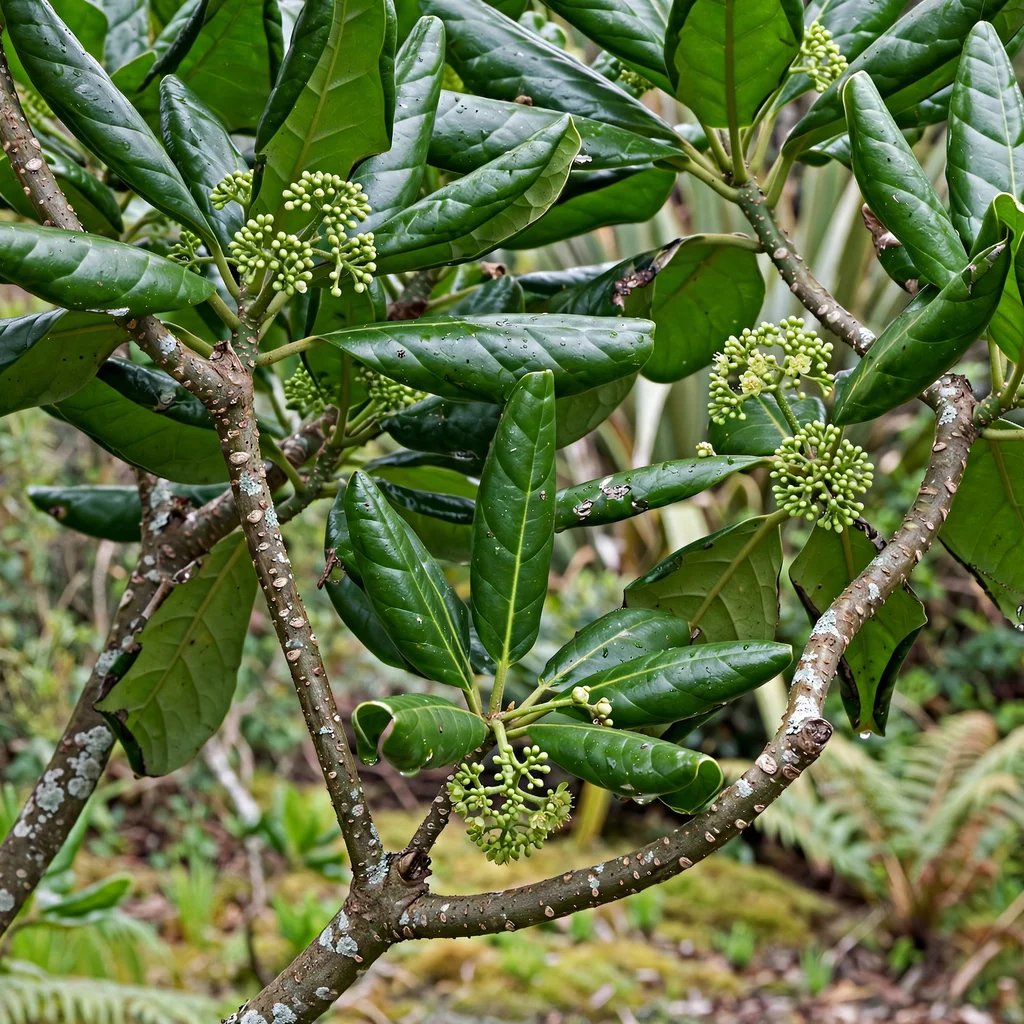
Pennantia baylisiana is a multi-trunked evergreen small tree with broad, leathery leaves and a dense spreading crown. Native to maritime cliff environments, it bears large oblong foliage with glossy upper surfaces and distinct hairy pocket-domatia underneath.
Small greenish-white flowers develop directly on older stems in dense clusters during spring, followed by small fleshy fruits. All cultivated specimens stem from a single wild female tree discovered on Great Island in 1945.
Uses & Benefits:
Essentials
At a Glance
Plant Type
Tree
Height
256"
Width
157"
Light
Full Sun, Partial Sun
Zones
9, 10
Water
Low to Moderate
Humidity
High
Lifespan
Perennial
Native To
Three Kings Islands (New Zealand)
Toxicity
Non-toxic
Bloom period
Spring – Late spring
In flower about 3 months of the year
Planting
How to Grow
- Select a sheltered site in full sun to partial shade with well-draining soil protected from hard freezes.
- Dig a planting hole twice as wide as the container and incorporate coarse sand or gravel into heavy soils.
- Set the root ball level with the surrounding soil grade and backfill without over-compacting.
- Water thoroughly to settle soil around the roots and apply a shallow mulch layer, keeping mulch off the trunk.
Pro Tip
Prune only lightly to shape after flowering; cutting heavily into old, leafless wood results in poor epicormic growth and slow recovery.
Keep It Thriving
Care Guide
Do
- Plant in light, freely draining soils to eliminate waterlogging around the root collar.
- Protect young trees from freezing temperatures using winter covers or container shelter.
- Water regularly during warm summer periods until the root system establishes.
Don't
- Do not prune back into mature bare branches without leafy shoots.
- Do not apply heavy doses of high-nitrogen fertilizer.
- Do not allow soil around the base to stay waterlogged during winter.
Seasonal Care Calendar
| Task | Jan | Feb | Mar | Apr | May | Jun | Jul | Aug | Sep | Oct | Nov | Dec |
|---|---|---|---|---|---|---|---|---|---|---|---|---|
| Fertilize | ||||||||||||
| Pest Check | ||||||||||||
| Prune | ||||||||||||
| Winter Prep |
Watch Out For
Pests & Diseases
Common Pests
Common Diseases
In the Garden
Landscape Uses & Companions
Landscape Uses
Multiply
Propagation Methods
Good to Know
Common Questions
Three Kings Kaikōmako questions
What zones can Three Kings Kaikōmako grow in?
Three Kings Kaikōmako is hardy in USDA Zones 9–10: in that range it survives winter in the ground. Colder than Zone 9, winters are too cold for it to survive outdoors.
Is Three Kings Kaikōmako deer resistant?
Not reliably. Deer may browse Three Kings Kaikōmako, especially tender spring growth — plan on repellents or fencing where pressure is high.
When does Three Kings Kaikōmako bloom?
Three Kings Kaikōmako typically blooms in spring. Exact timing shifts a week or two with your zone — Sow's bloom calendar maps it to your garden.
Does Three Kings Kaikōmako need full sun?
Three Kings Kaikōmako does best in full sun to part shade. In hot climates, afternoon shade keeps blooms fresher longer.
Is Three Kings Kaikōmako drought tolerant?
Yes — once established (usually after the first full season), Three Kings Kaikōmako handles dry spells with minimal watering. Water deeply its first year to build the root system that makes that possible.
More Pennantia to compare
Keep exploring
Explore the genus
Hardy in your zone?
Grow Three Kings Kaikōmako with confidence
See it in a design of your actual yard, get zone-matched care reminders, and track it season by season in your garden journal.