The Story
Plant Bio
Selenicereus anthonyanus is a perennial epiphytic cactus from the lowland rainforests of southern Mexico, where it climbs trees or trails with clustered arching stems. It stores water in succulent tissue yet requires regular moisture and humidity during growth, not the dry rest of a desert cactus.
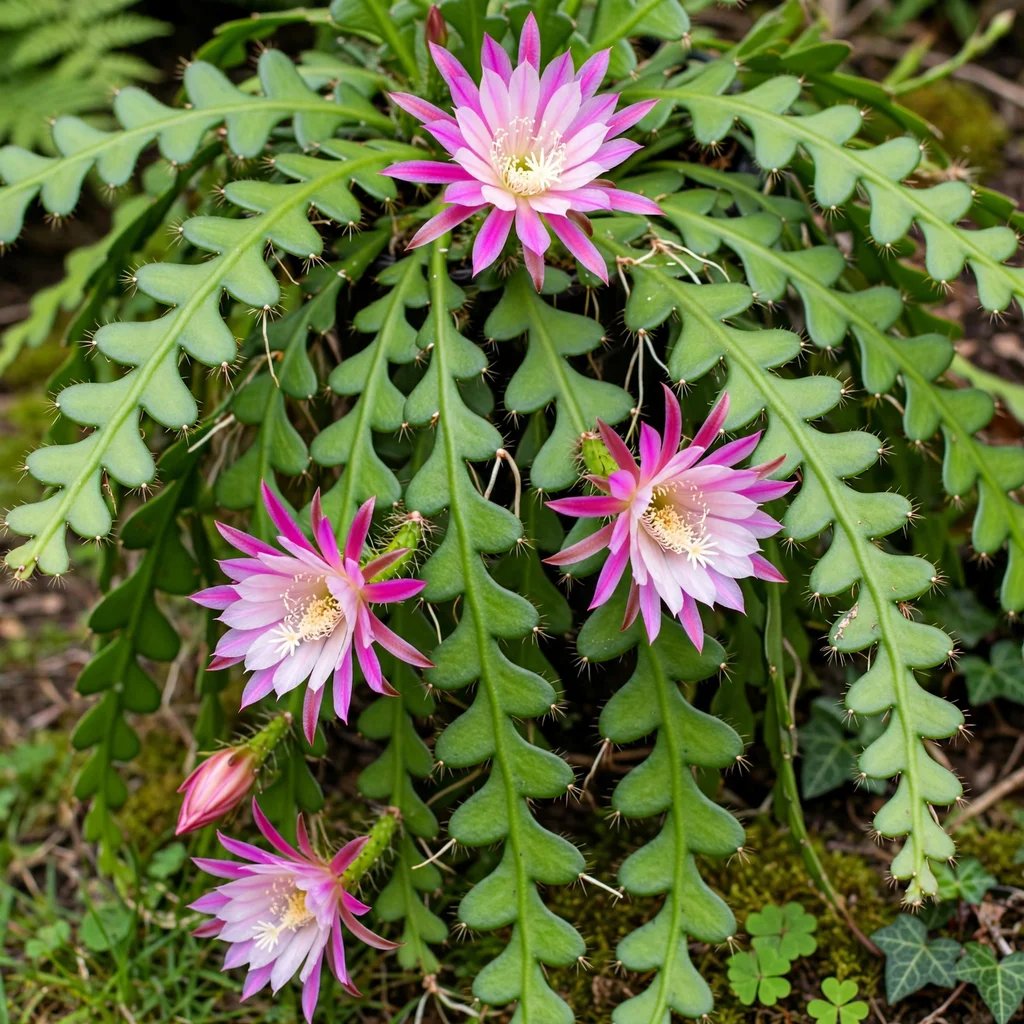
What sets it apart is the flattened bright green stem deeply lobed on alternate sides into a precise zigzag like a fishbone, edged with tiny translucent bristles and small aerial roots. Mature, slightly root-bound plants open large sweetly fragrant night flowers to 17 cm across, violet-rose outside and white within, in spring to early summer.
Uses & Benefits:
Essentials
At a Glance
Plant Type
Cactus Succulent
Height
35"
Width
47"
Light
Partial Sun, Shade
Zones
10
Water
Medium
Humidity
Moderate to high
Lifespan
Perennial
Native To
Southern Mexico
Toxicity
Non-toxic
Bloom period
Spring – Early summer
In flower about 4 months of the year
Planting
How to Grow
- Grow indoors or on a shaded patio in bright indirect light to partial shade, protected from hot midday sun.
- Pot in a porous, highly organic epiphytic mix of peat moss, perlite, and bark with pH 6.1-7.5 and exceptional drainage.
- Water thoroughly during spring and summer when the top inch of mix dries, then reduce watering in winter while never letting stems shrivel for long.
- Maintain moderate to high humidity and temperatures above 40F; bring containers indoors well before frost and keep winter soil on the dry side.
- Feed sparingly with dilute balanced orchid or cactus liquid fertilizer once a month only during active growth.
Pro Tip
Keep it slightly root-bound in a chunky bark-based mix in bright indirect light; excess pot space and heavy soil grow stems at the expense of flowers.
Keep It Thriving
Care Guide
Do
- Do grow in a hanging basket or slatted orchid pot where arching stems can trail or climb.
- Do allow the top of the mix to dry between waterings while maintaining humidity around the plant.
- Do keep slightly root-bound to encourage nocturnal flowering.
Don't
- Don't plant in heavy garden soil or leave in standing water; soggy mix causes stem and root rot.
- Don't treat it like a desert cactus by starving it of water and humidity during summer growth.
- Don't overwater or over-fertilize in winter when growth slows.
Seasonal Care Calendar
| Task | Jan | Feb | Mar | Apr | May | Jun | Jul | Aug | Sep | Oct | Nov | Dec |
|---|---|---|---|---|---|---|---|---|---|---|---|---|
| Fertilize | ||||||||||||
| Pest Check | ||||||||||||
| Propagate | ||||||||||||
| Prune | ||||||||||||
| Winter Prep |
Watch Out For
Pests & Diseases
Common Pests
Common Diseases
In the Garden
Landscape Uses & Companions
Landscape Uses
Multiply
Propagation Methods
Good to Know
Common Questions
Fishbone Cactus questions
What zones can Fishbone Cactus grow in?
Fishbone Cactus is hardy in USDA Zone 10: in that range it survives winter in the ground. Colder than Zone 10, grow it in a container you can move to shelter for the winter, or as an annual.
When does Fishbone Cactus bloom?
Fishbone Cactus typically blooms from early spring to early summer. Exact timing shifts a week or two with your zone — Sow's bloom calendar maps it to your garden.
Does Fishbone Cactus need full sun?
Fishbone Cactus does best in part shade.
Is Fishbone Cactus drought tolerant?
Yes — once established (usually after the first full season), Fishbone Cactus handles dry spells with minimal watering. Water deeply its first year to build the root system that makes that possible.
Keep exploring
Explore the genus
Hardy in your zone?
Grow Fishbone Cactus with confidence
See it in a design of your actual yard, get zone-matched care reminders, and track it season by season in your garden journal.