
The Story
Plant Bio
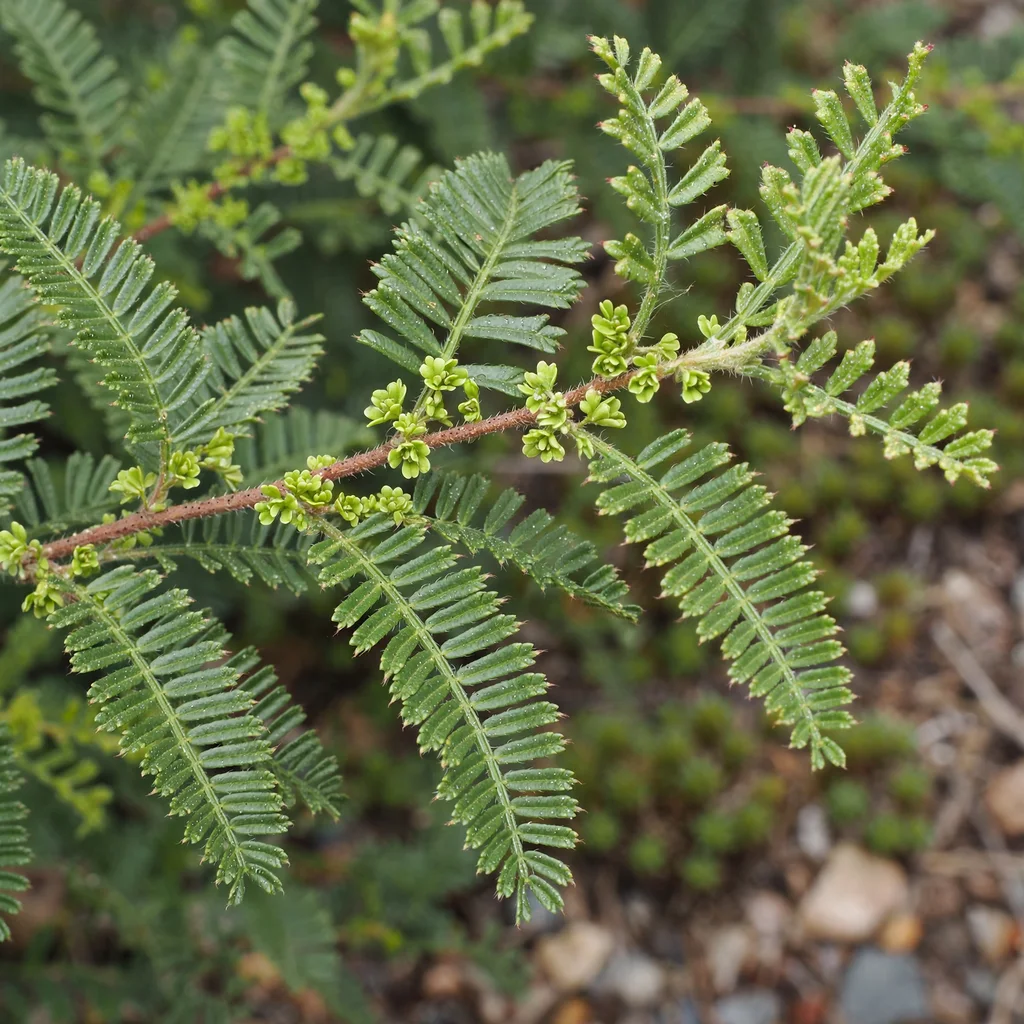
Dodonaea adenophora, a Western Australian hop bush, is a dioecious evergreen shrub reaching five to six feet in cultivation, with erect to spreading stems and reddish branches. Its leaves are imparipinnate with four to six small sticky resinous leaflets, and its small single or paired flowers are followed by broad four-winged capsules that redden at maturity.
This species is grown for its reddish four-winged capsules rather than its flowers, which are small and without showy petals. It is dioecious, so fruit forms only on female plants when a male grows nearby, and its sticky pinnate foliage with reddish stems separates it from entire-leaved hop bushes.
Uses & Benefits:
Essentials
At a Glance
Plant Type
Shrub
Height
72"
Width
60"
Light
Full Sun, Partial Sun
Zones
9, 10
Water
Low
Humidity
Low
Lifespan
Long-lived shrub
Native To
Western Australia
Toxicity
Unknown
Bloom period
Winter – Spring
In flower about 6 months of the year
Planting
How to Grow
- Choose full sun with open air and sandy loam to granitic sand that drains fast after rain.
- Plant at nursery depth in spring after frost, spacing 3 to 5 feet for a screen.
- Water deeply at planting, then taper to occasional deep soakings once established.
- Tip-prune lightly after capsules fade to keep the canopy dense.
Pro Tip
Site in sharply drained soil in full sun and remember a lone plant may never fruit, since male and female flowers grow on separate plants.
Keep It Thriving
Care Guide
Do
- Plant in full sun for best capsule color and dense growth.
- Provide sharp drainage on a slope or raised mound.
- Tip-prune to shape after flowering.
Don't
- Do not plant in heavy clay or ground that stays wet in winter.
- Do not cut hard back into old bare wood.
- Do not expect winged pods from a single isolated plant.
Seasonal Care Calendar
| Task | Jan | Feb | Mar | Apr | May | Jun | Jul | Aug | Sep | Oct | Nov | Dec |
|---|---|---|---|---|---|---|---|---|---|---|---|---|
| Mulch | ||||||||||||
| Plant | ||||||||||||
| Prune | ||||||||||||
| Winter Prep |
Watch Out For
Pests & Diseases
Common Pests
Common Diseases
In the Garden
Landscape Uses & Companions
Landscape Uses
Multiply
Propagation Methods
Good to Know
Common Questions
Hop Bush questions
What zones can Hop Bush grow in?
Hop Bush is hardy in USDA Zones 9–10: in that range it survives winter in the ground. Colder than Zone 9, grow it in a container you can move to shelter for the winter.
When does Hop Bush bloom?
Hop Bush typically blooms from winter to spring. Exact timing shifts a week or two with your zone — Sow's bloom calendar maps it to your garden.
Does Hop Bush need full sun?
Hop Bush does best in full sun to part shade. In hot climates, afternoon shade keeps blooms fresher longer.
Is Hop Bush drought tolerant?
Yes — once established (usually after the first full season), Hop Bush handles dry spells with minimal watering. Water deeply its first year to build the root system that makes that possible.
More Dodonaea to compare
Keep exploring
Explore the genus
Hardy in your zone?
Grow Hop Bush with confidence
See it in a design of your actual yard, get zone-matched care reminders, and track it season by season in your garden journal.