The Story
Plant Bio
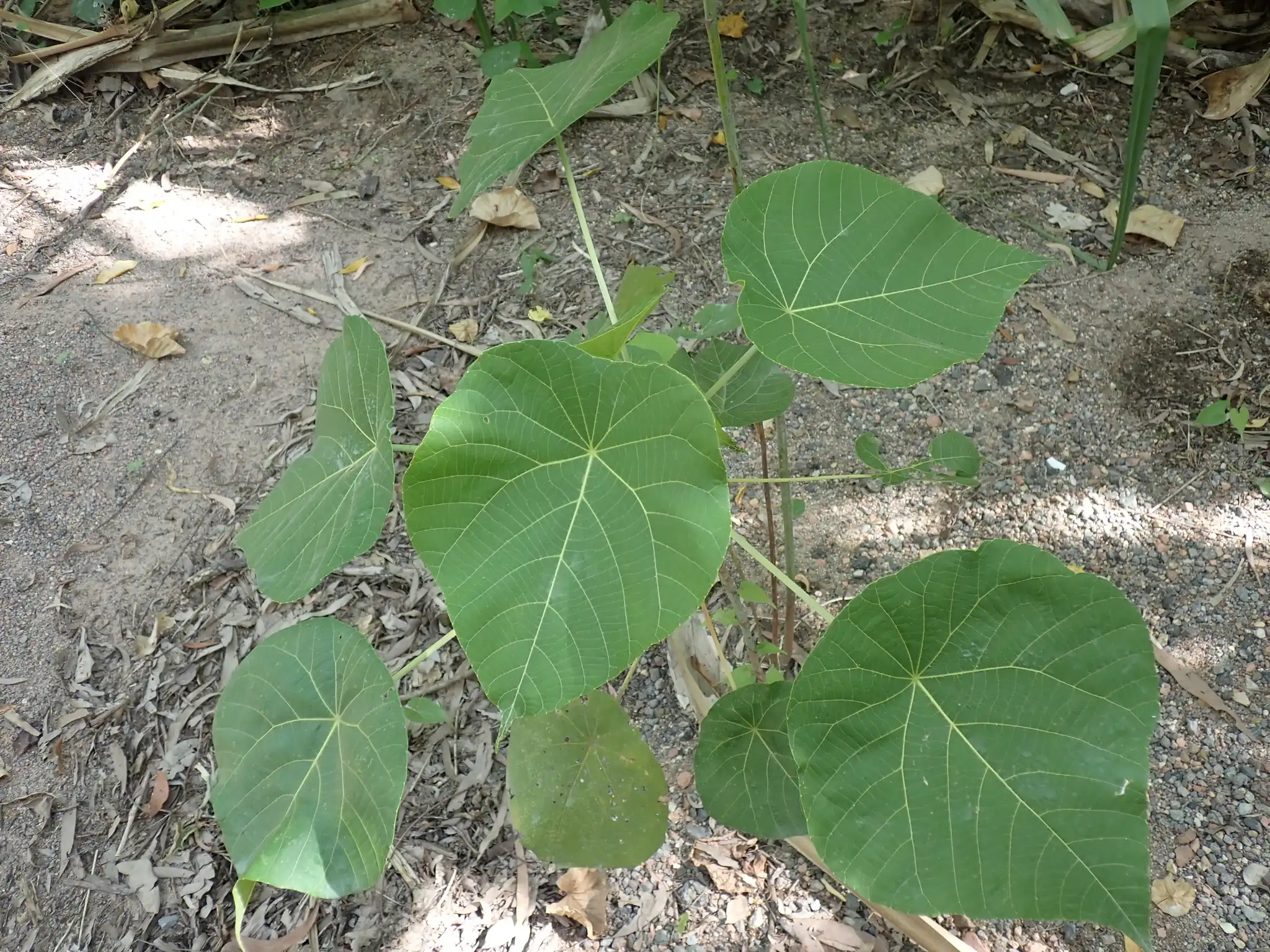
Macaranga tanarius is a fast-growing, evergreen tropical pioneer tree reaching twenty to thirty feet in height with broad canopy coverage. It is distinguished by large, peltate circular leaves with prominent radiating veins, emerging with a bronze-red tint before turning glossy deep green.
The leaf undersides feature yellow glands that secrete resinous compounds attractive to generalist insects. Small greenish-yellow flowers appear in clustered panicles along the upper leaf axils throughout spring and summer.
Uses & Benefits:
Essentials
At a Glance
Plant Type
Tree
Height
360"
Width
240"
Light
Full Sun, Partial Sun
Zones
10
Water
Moderate
Humidity
High
Lifespan
Perennial
Native To
Asia, Australia, Western Pacific
Toxicity
Sap may cause skin irritation
Bloom period
Spring – Summer
In flower about 6 months of the year
Planting
How to Grow
- Select a planting site in full sun or light shade with well-draining sandy loam.
- Dig a hole twice as wide as the root ball and set the plant at its original container depth.
- Backfill with native soil, press firm, and water deeply to settle air pockets.
- Apply a two-inch layer of organic mulch around the base, keeping it off the stem.
Pro Tip
Avoid heavy pruning into bare, mature wood, as old branches lack latent buds and respond poorly.
Keep It Thriving
Care Guide
Do
- Water regularly during active growth to maintain consistent soil moisture.
- Provide protection from freezing temperatures and strong frost events.
- Space adequately to allow room for rapid vertical and lateral growth.
Don't
- Do not allow roots to sit in chronically waterlogged or poorly draining soil.
- Do not cut back into hard, leafless woody trunk tissue.
- Do not skip moisture monitoring during extended warm, dry spells.
Seasonal Care Calendar
| Task | Jan | Feb | Mar | Apr | May | Jun | Jul | Aug | Sep | Oct | Nov | Dec |
|---|---|---|---|---|---|---|---|---|---|---|---|---|
| Fertilize | ||||||||||||
| Mulch | ||||||||||||
| Pest Check | ||||||||||||
| Prune |
Watch Out For
Pests & Diseases
Common Pests
Common Diseases
In the Garden
Landscape Uses & Companions
Landscape Uses
Companion Plants
Multiply
Propagation Methods
Good to Know
Common Questions
Parasol Leaf Tree questions
What zones can Parasol Leaf Tree grow in?
Parasol Leaf Tree is hardy in USDA Zone 10: in that range it survives winter in the ground. Colder than Zone 10, winters are too cold for it to survive outdoors.
When does Parasol Leaf Tree bloom?
Parasol Leaf Tree typically blooms from spring to summer. Exact timing shifts a week or two with your zone — Sow's bloom calendar maps it to your garden.
Does Parasol Leaf Tree need full sun?
Parasol Leaf Tree does best in full sun to part shade. In hot climates, afternoon shade keeps blooms fresher longer.
More Macaranga to compare
Keep exploring
Explore the genus
Hardy in your zone?
Grow Parasol Leaf Tree with confidence
See it in a design of your actual yard, get zone-matched care reminders, and track it season by season in your garden journal.