The Story
Plant Bio
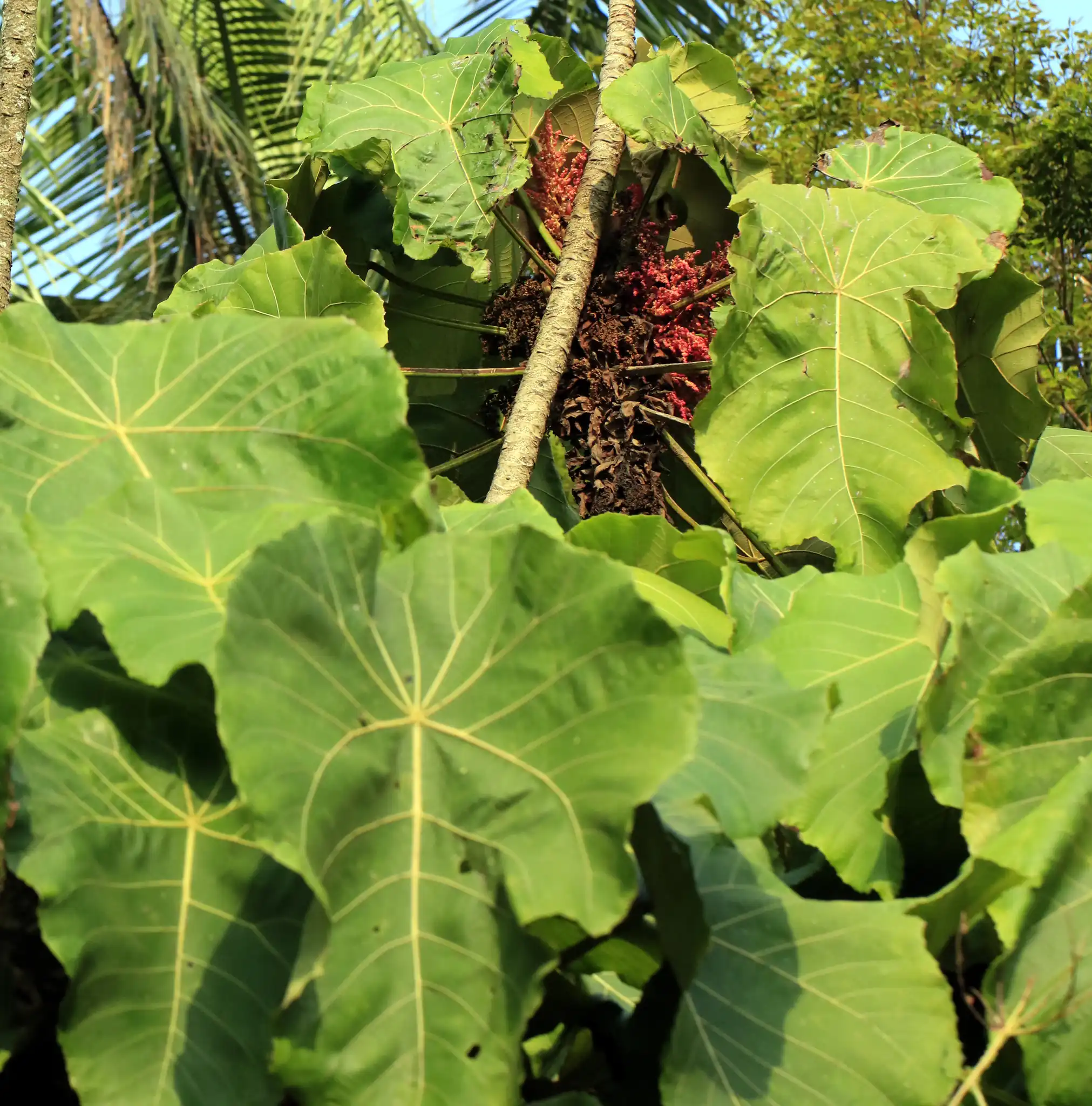
Macaranga grandifolia is an evergreen dioecious tree from humid lowland and montane forest in the Philippines and northern Sulawesi, reaching 10 to 20 feet in cultivation in frost-free climates with an erect, little-branched frame. Leaves are huge, peltate and oval-rounded to 40 inches long, tough and cardboard-like, green with reddish veins and new growth flushed red.
It is grown for leaf size rather than flowers, each nasturtium-like blade spanning 24 to 40 inches across on a stout stalk. Male plants pack tiny red flowers into dense coral-like heads with lanceolate bracts, while female plants set 8- to 10-millimeter two-valved capsules tipped with two spine-like points.
Uses & Benefits:
Essentials
At a Glance
Plant Type
Tree
Height
240"
Width
144"
Light
Full Sun, Partial Sun
Zones
9, 10
Water
Moderate
Humidity
High
Lifespan
Long-lived
Native To
Philippines and northern Sulawesi
Toxicity
Unknown
Planting
How to Grow
- Plant in full sun to partial shade in well-draining soil enriched with compost, setting the top of the rootball slightly above grade.
- Mulch 2 to 3 inches deep, keeping mulch off the trunk, and water regularly until established, letting the top dry before watering again.
- Feed at planting with slow-release fertilizer and withhold fertilizer in late fall and winter.
- Prune lightly to control size and remove damaged leaves, avoiding hard cuts into old bare stems.
- Protect young plants from frost with cloth or by moving pots indoors; mature plants tolerate only brief exposure near 30F.
Pro Tip
Give it room, heat and full sun to partial shade in well-draining soil, set the top of the rootball slightly above grade, and protect young plants from cold; only mature wood tolerates a brief dip to 30F.
Keep It Thriving
Care Guide
Do
- Plant high with the rootball top above grade in well-draining soil
- Water regularly until established, then when the top dries
- Mulch while keeping mulch off the trunk
Don't
- Do not plant deep or overwater in poorly drained soil
- Do not fertilize in late fall and winter
- Do not expose young plants to freezing temperatures
Seasonal Care Calendar
| Task | Jan | Feb | Mar | Apr | May | Jun | Jul | Aug | Sep | Oct | Nov | Dec |
|---|---|---|---|---|---|---|---|---|---|---|---|---|
| Fertilize | ||||||||||||
| Mulch | ||||||||||||
| Plant | ||||||||||||
| Prune | ||||||||||||
| Winter Prep |
Watch Out For
Pests & Diseases
Common Pests
Common Diseases
In the Garden
Landscape Uses & Companions
Landscape Uses
Multiply
Propagation Methods
Good to Know
Common Questions
Elephant Ear Tree questions
What zones can Elephant Ear Tree grow in?
Elephant Ear Tree is hardy in USDA Zones 9–10: in that range it survives winter in the ground. Colder than Zone 9, winters are too cold for it to survive outdoors.
Does Elephant Ear Tree need full sun?
Elephant Ear Tree does best in full sun to part shade. In hot climates, afternoon shade keeps blooms fresher longer.
More Macaranga to compare
Keep exploring
Explore the genus
Hardy in your zone?
Grow Elephant Ear Tree with confidence
See it in a design of your actual yard, get zone-matched care reminders, and track it season by season in your garden journal.