The Story
Plant Bio
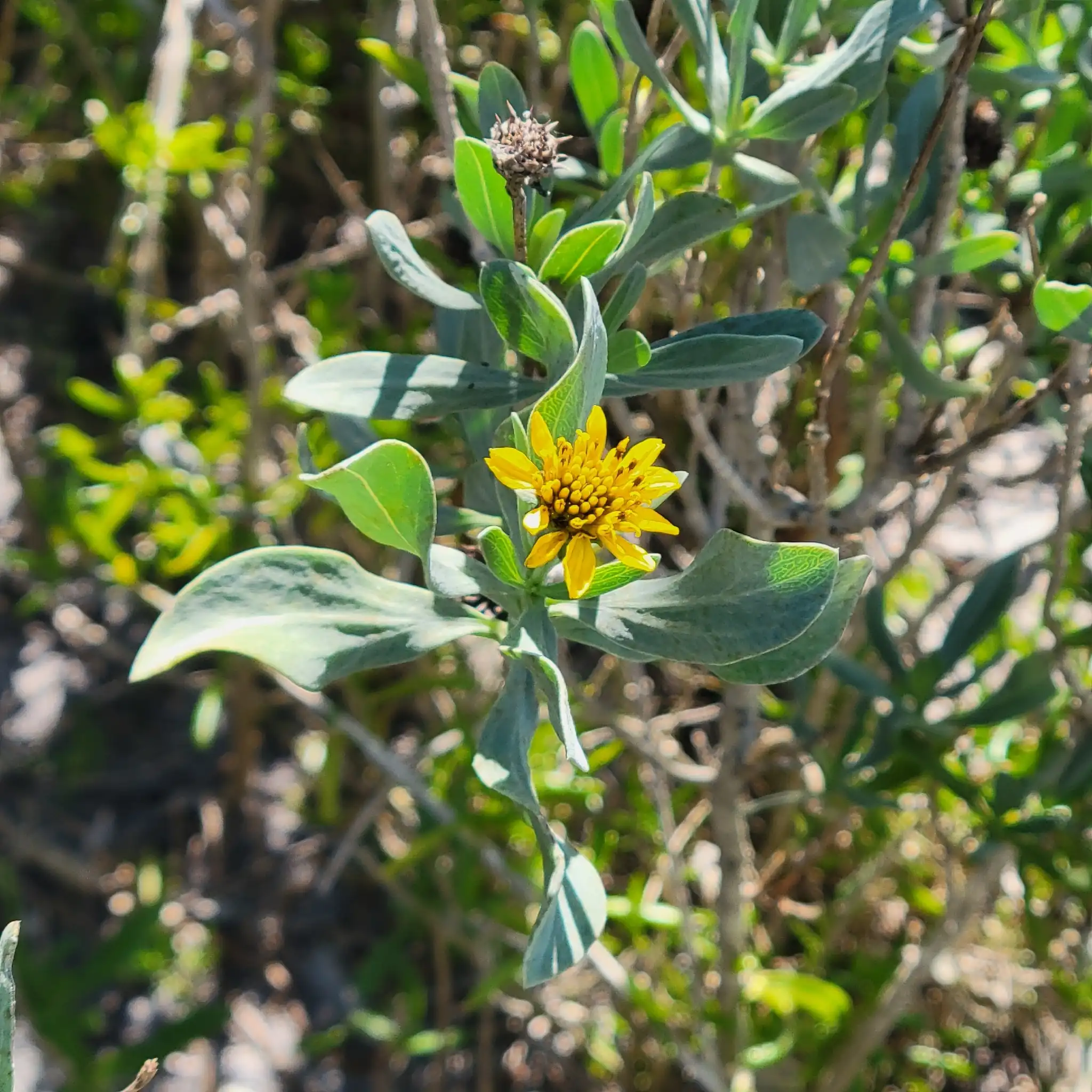
Borrichia frutescens is a rhizomatous, colony-forming perennial of Atlantic and Gulf salt marshes, growing two to four feet tall with upright to sprawling stems. The leaves are thick, oval and gray-green to silvery from dense hairs on both surfaces, and the solitary heads carry 15 to 30 short yellow rays around a yellow-orange disk.
It tolerates salt spray and brief saltwater flooding, rooting in wet brackish sand and mud where few other shrubs persist. It is separated from Borrichia arborescens of southern Florida by its lower, spreading habit and densely pubescent leaves, and it spreads by rhizomes to form broad patches if given room.
Uses & Benefits:
Essentials
At a Glance
Plant Type
Shrub
Height
36"
Width
60"
Light
Full Sun
Zones
8, 9, 10
Water
Low
Humidity
High
Lifespan
Perennial
Native To
Atlantic and Gulf Coasts, USA to Yucatan
Toxicity
Unknown
Bloom period
Spring – Summer
In flower about 6 months of the year
Planting
How to Grow
- Plant in full sun in sandy or loamy soil that drains but stays moist to brackish.
- Space 30 to 60 inches apart to allow rhizome spread into a colony.
- Water in well, then water during the first season until roots run.
- Mulch lightly with sand or pine straw, keeping mulch off the crowns.
- Leave established clumps unfertilized and unirrigated except in extended drought.
Pro Tip
Give it full sun, lean saline sand and room to spread, and cut back lightly only after flowering rather than shearing it hard each year.
Keep It Thriving
Care Guide
Do
- Do give it full sun and air movement.
- Do allow room for rhizome spread.
- Do collect seed when heads turn brown if you want more plants.
Don't
- Do not plant in rich inland clay that stays dry.
- Do not shear hard every year into old wood.
- Do not overwater or fertilize to force growth.
Seasonal Care Calendar
| Task | Jan | Feb | Mar | Apr | May | Jun | Jul | Aug | Sep | Oct | Nov | Dec |
|---|---|---|---|---|---|---|---|---|---|---|---|---|
| Deadhead | ||||||||||||
| Pest Check | ||||||||||||
| Plant | ||||||||||||
| Prune |
Watch Out For
Pests & Diseases
Common Pests
Common Diseases
In the Garden
Landscape Uses & Companions
Landscape Uses
Multiply
Propagation Methods
Good to Know
Common Questions
Sea Oxeye questions
What zones can Sea Oxeye grow in?
Sea Oxeye is hardy in USDA Zones 8–10: in that range it survives winter in the ground. Colder than Zone 8, grow it in a container you can move to shelter for the winter.
When does Sea Oxeye bloom?
Sea Oxeye typically blooms from spring to summer. Exact timing shifts a week or two with your zone — Sow's bloom calendar maps it to your garden.
Does Sea Oxeye need full sun?
Sea Oxeye does best in full sun (6+ hours).
Is Sea Oxeye drought tolerant?
Yes — once established (usually after the first full season), Sea Oxeye handles dry spells with minimal watering. Water deeply its first year to build the root system that makes that possible.
Keep exploring
Explore the genus
Hardy in your zone?
Grow Sea Oxeye with confidence
See it in a design of your actual yard, get zone-matched care reminders, and track it season by season in your garden journal.