The Story
Plant Bio
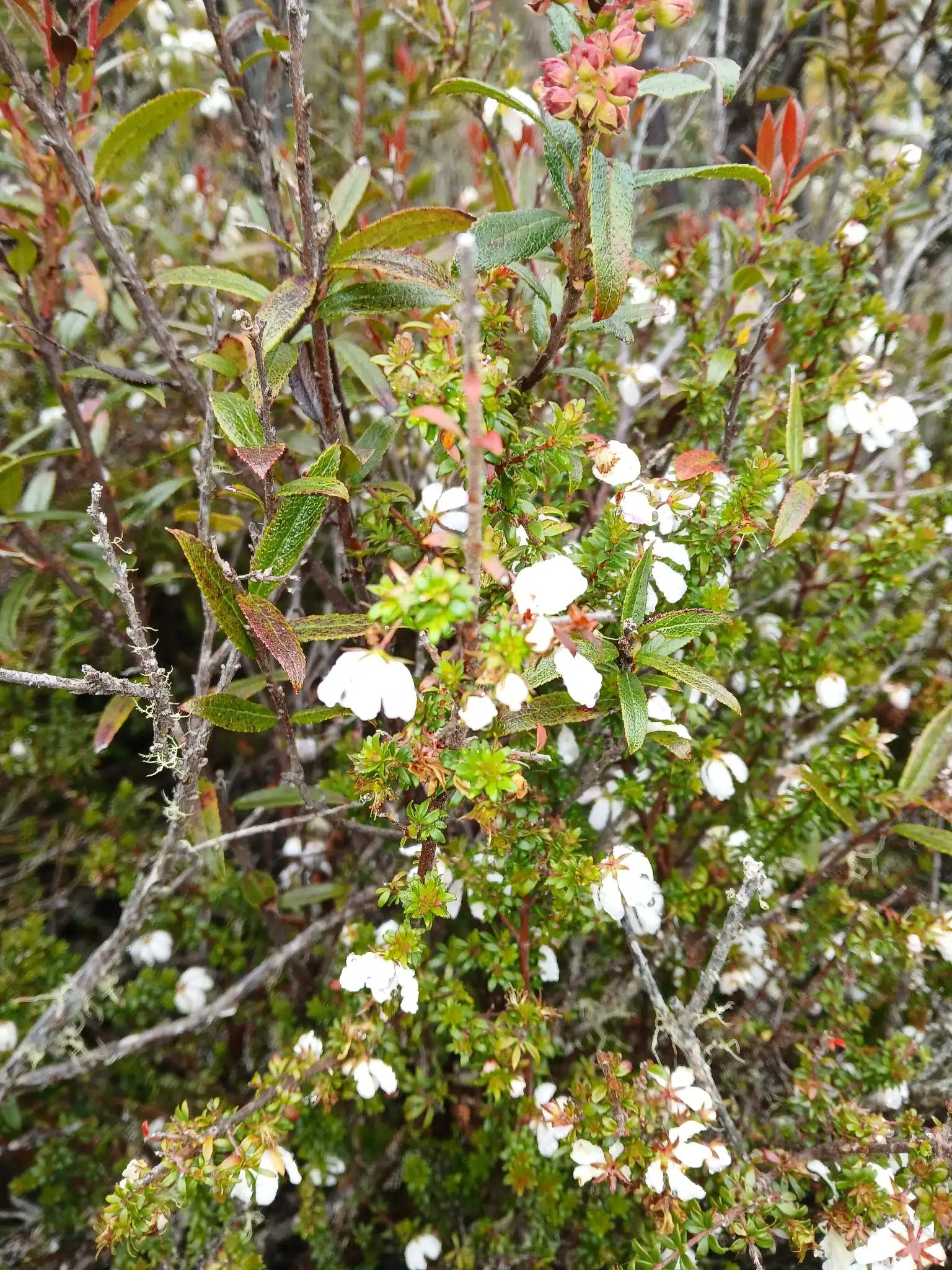
Bauera rubioides is an evergreen Australian shrub growing up to six feet tall with fine, interlacing wiry stems and trifoliolate leaves that appear as whorls along the branches. From spring through summer, it bears solitary, saucer-shaped flowers ranging from white to deep pink with pale cream stamens.
The species adapts its growth form to sun exposure, remaining low and scrambling in shaded understories while forming dense, tangled thickets in full sun. Its slender new shoots emerge with a soft, fine-haired texture that keeps the outer foliage looking fresh.
Uses & Benefits:
Essentials
At a Glance
Plant Type
Shrub
Height
79"
Width
79"
Light
Full Sun, Partial Sun
Zones
8, 9, 10
Water
High
Humidity
Moderate to High
Lifespan
Perennial
Native To
Eastern Australia and Tasmania
Toxicity
Non-toxic
Bloom period
Spring – Summer
In flower about 6 months of the year
Planting
How to Grow
- Select a planting site in full sun to partial shade with acidic to neutral, lime-free soil.
- Incorporate organic matter into sandy or light loamy soils to enhance moisture retention while maintaining subsurface drainage.
- Water deeply upon planting and keep the root zone continuously moist, preventing the soil from drying out completely.
- Apply a light top-dressing of low-phosphorus fertilizer in early spring to encourage dense stem development.
Pro Tip
Lightly trim tip growth immediately after flowering, and never cut back into old, leafless woody stems, as hard pruning causes irreversible branch dieback.
Keep It Thriving
Care Guide
Do
- Keep the root zone consistently moist throughout the year.
- Provide afternoon shade in hot inland microclimates.
- Feed sparingly in spring with a low-phosphorus fertilizer formulation.
- Tip-prune outer stems right after bloom flushes to maintain density.
Don't
- Do not prune back into bare, old woody stems.
- Do not plant in alkaline or chalky soils.
- Do not allow the root zone to dry out completely during summer heat.
- Do not apply heavy doses of high-phosphorus fertilizers.
Seasonal Care Calendar
| Task | Jan | Feb | Mar | Apr | May | Jun | Jul | Aug | Sep | Oct | Nov | Dec |
|---|---|---|---|---|---|---|---|---|---|---|---|---|
| Fertilize | ||||||||||||
| Mulch | ||||||||||||
| Pest Check | ||||||||||||
| Prune |
Watch Out For
Pests & Diseases
Common Pests
Common Diseases
In the Garden
Landscape Uses & Companions
Landscape Uses
Companion Plants
Multiply
Propagation Methods
Good to Know
Common Questions
Dog Rose questions
What zones can Dog Rose grow in?
Dog Rose is hardy in USDA Zones 8–10: in that range it survives winter in the ground. Colder than Zone 8, grow it in a container you can move to shelter for the winter.
When does Dog Rose bloom?
Dog Rose typically blooms from spring to summer. Exact timing shifts a week or two with your zone — Sow's bloom calendar maps it to your garden.
Does Dog Rose need full sun?
Dog Rose does best in full sun to part shade. In hot climates, afternoon shade keeps blooms fresher longer.
Keep exploring
Explore the genus
Hardy in your zone?
Grow Dog Rose with confidence
See it in a design of your actual yard, get zone-matched care reminders, and track it season by season in your garden journal.