The Story
Plant Bio
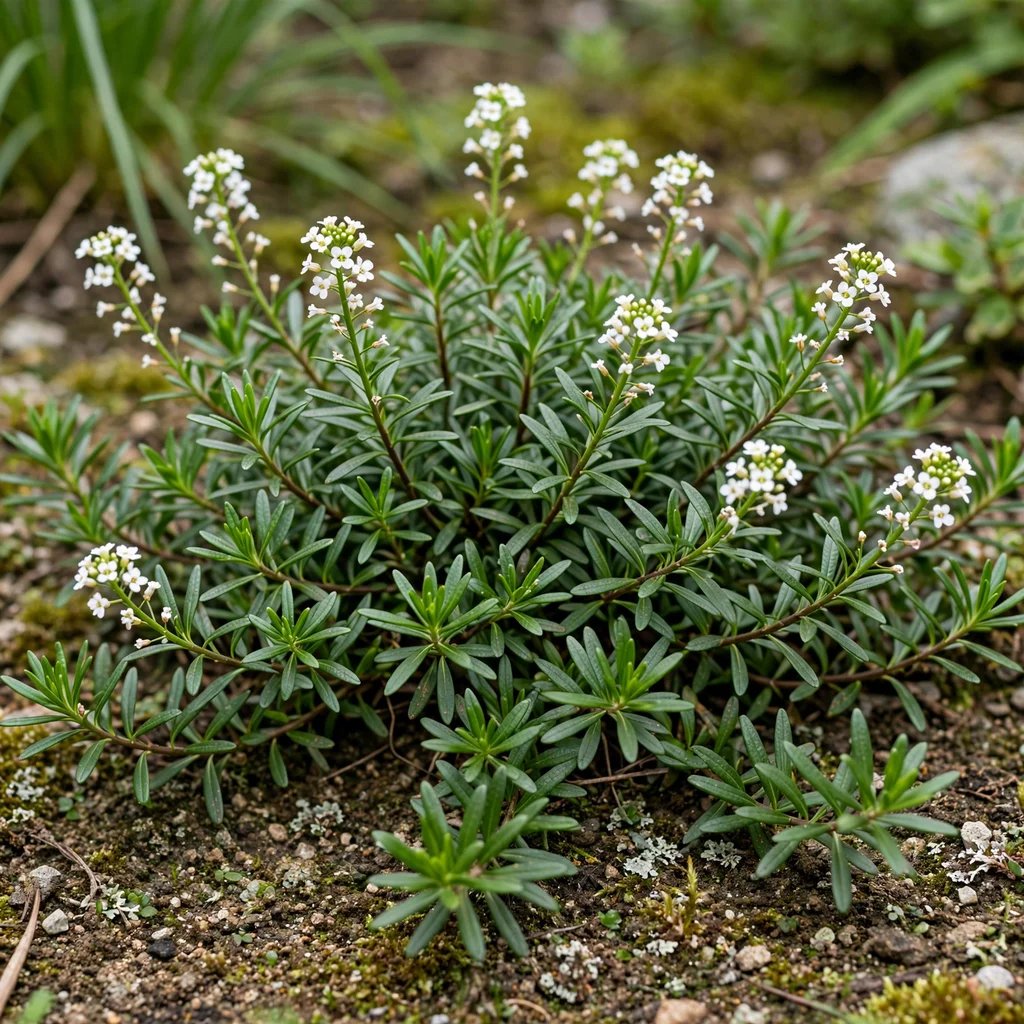
Veronica linifolia, still sold as Parahebe linifolia, is an evergreen subshrub from New Zealand's South Island that forms a low flattened mound woody only at the base. In cultivation it reaches 6 to 10 inches tall by about a foot wide, with small linear glossy green leaves and procumbent lower stems that root where they touch gritty soil.
The leaves are narrow-oblong, 10 to 30 mm long by 1.5 to 3.5 mm wide, entire with a ciliate margin and rounded tip, glossy above and pale dull beneath. Flowers are borne in unbranched 1- to 8-flowered racemes on slender 8 to 40 mm pedicels, each white corolla 12 to 17 mm across with a yellow throat and magenta-purple nectar guides.
Uses & Benefits:
Essentials
At a Glance
Plant Type
Shrub
Height
10"
Width
12"
Light
Full Sun, Partial Sun
Zones
7, 8, 9, 10
Water
Medium
Humidity
Low
Lifespan
Perennial
Native To
New Zealand - South Island
Toxicity
Unknown
Bloom period
Late spring – Fall
In flower about 7 months of the year
Planting
How to Grow
- Choose full sun to part shade with afternoon shade in hot summers.
- Dig gritty humus-rich soil that drains fast; set the crown level, not buried.
- Water to settle, then keep evenly moist but never soggy; keep drier in winter.
- Top-dress with gravel grit to keep procumbent stems off wet soil.
- Clip spent flower stems to encourage rebloom through fall.
Pro Tip
Plant it high in sharp gritty mix and withhold summer overhead water; crowns that sit wet in heat rot while roots that dry out completely stall.
Keep It Thriving
Care Guide
Do
- Plant in sharply drained rock-garden soil enriched with humus
- Give afternoon shade in hot climates
- Use rooted lower pieces to replace aging mounds
Don't
- Don't let the root zone dry out completely
- Don't overwater or mist overhead in humid heat
- Don't cut back into leafless woody base
Seasonal Care Calendar
| Task | Jan | Feb | Mar | Apr | May | Jun | Jul | Aug | Sep | Oct | Nov | Dec |
|---|---|---|---|---|---|---|---|---|---|---|---|---|
| Deadhead | ||||||||||||
| Pest Check | ||||||||||||
| Plant | ||||||||||||
| Propagate | ||||||||||||
| Prune |
Watch Out For
Pests & Diseases
Common Pests
Common Diseases
In the Garden
Landscape Uses & Companions
Landscape Uses
Companion Plants
Multiply
Propagation Methods
Good to Know
Common Questions
White Parahebe questions
What zones can White Parahebe grow in?
White Parahebe is hardy in USDA Zones 7–10: in that range it survives winter in the ground. Colder than Zone 7, grow it in a container you can move to shelter for the winter.
When does White Parahebe bloom?
White Parahebe typically blooms from late spring to late fall. Exact timing shifts a week or two with your zone — Sow's bloom calendar maps it to your garden.
Does White Parahebe need full sun?
White Parahebe does best in full sun to part shade. In hot climates, afternoon shade keeps blooms fresher longer.
More Parahebe to compare
Keep exploring
Explore the genus
Hardy in your zone?
Grow White Parahebe with confidence
See it in a design of your actual yard, get zone-matched care reminders, and track it season by season in your garden journal.