The Story
Plant Bio
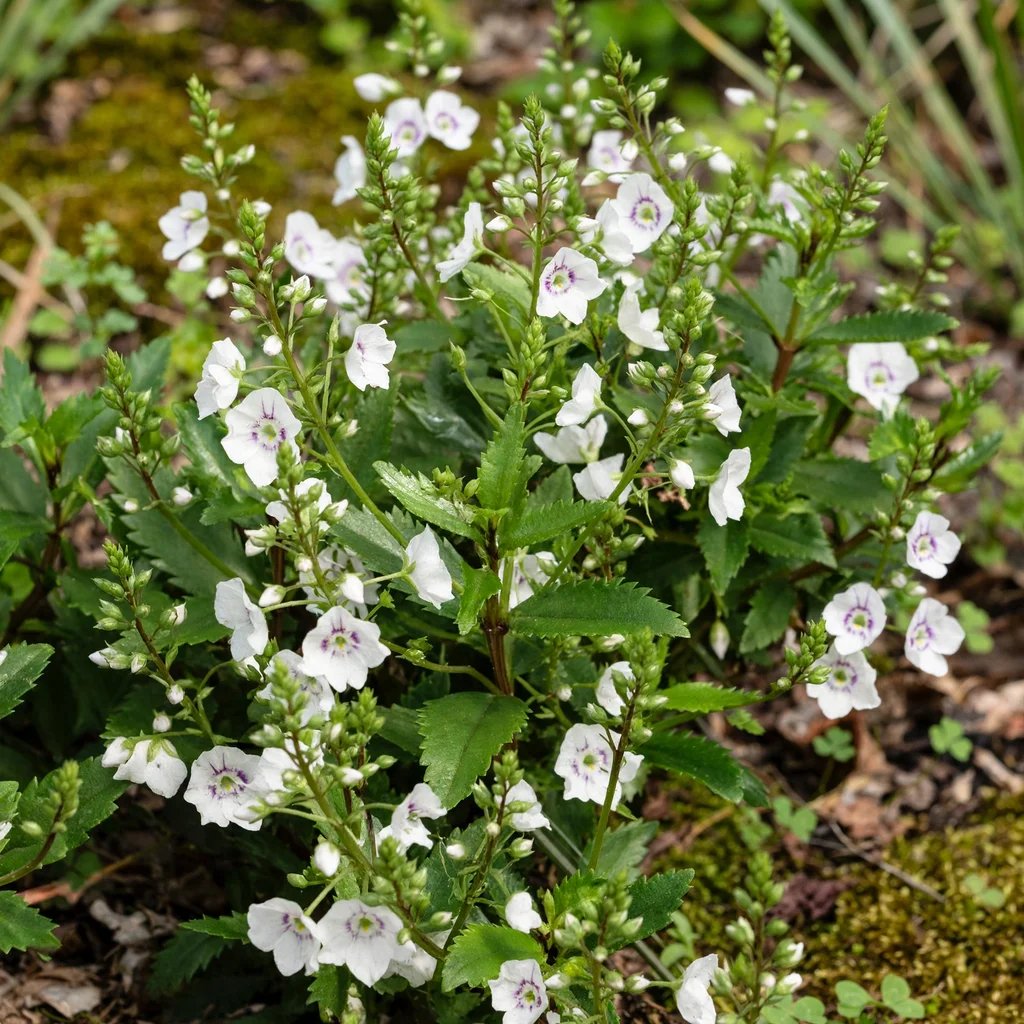
Veronica catarractae, the waterfall parahebe, is a low woody subshrub from New Zealand forming open, straggling patches with ascending to erect branches. The leaves are paired, narrow lance-shaped to oblanceolate and sharply toothed, dull green above and paler beneath, carried on short stalks.
It stays under a foot tall in gardens while spreading to 18 inches wide, rooting along the stems to knit sand, silt and rock crevices. The summer racemes carry 12 to 40 small white flowers with a purple ring and yellow throat, each on a long slender pedicel that holds the corolla clear of the foliage.
Uses & Benefits:
Essentials
At a Glance
Plant Type
Shrub
Height
12"
Width
18"
Light
Full Sun, Partial Sun
Zones
8, 9, 10
Water
Medium
Humidity
Low humidity preferred
Lifespan
Woody perennial subshrub
Native To
New Zealand, Fiordland South Island
Toxicity
Unknown
Bloom period
Early summer – Late summer
In flower about 3 months of the year
Planting
How to Grow
- Plant in full sun to light shade in moist, well-drained sandy or loamy soil sheltered from drying wind.
- Water to establish and through dry spells to keep the root zone evenly moist but never waterlogged.
- Top-dress with gravel and feed lightly in spring; avoid rich fertilizer that forces soft growth.
- Tip back spent flower stems after bloom to keep the patch compact.
Pro Tip
Site it cool, moist but sharply drained and sheltered from cold drying wind; it fails in prolonged drought and in hot humid summers.
Keep It Thriving
Care Guide
Do
- Do keep soil consistently moist with sharp drainage.
- Do shelter from cold drying winds.
- Do propagate from cuttings to replace leggy patches.
Don't
- Don't let plants sit wet in heavy clay or go through prolonged drought.
- Don't cut hard back into old bare wood.
- Don't site in hot, humid, poorly ventilated beds.
Seasonal Care Calendar
| Task | Jan | Feb | Mar | Apr | May | Jun | Jul | Aug | Sep | Oct | Nov | Dec |
|---|---|---|---|---|---|---|---|---|---|---|---|---|
| Mulch | ||||||||||||
| Pest Check | ||||||||||||
| Plant | ||||||||||||
| Propagate | ||||||||||||
| Prune |
Watch Out For
Pests & Diseases
Common Pests
Common Diseases
In the Garden
Landscape Uses & Companions
Landscape Uses
Companion Plants
Multiply
Propagation Methods
Good to Know
Common Questions
Waterfall Parahebe questions
What zones can Waterfall Parahebe grow in?
Waterfall Parahebe is hardy in USDA Zones 8–10: in that range it survives winter in the ground. Colder than Zone 8, grow it in a container you can move to shelter for the winter.
When does Waterfall Parahebe bloom?
Waterfall Parahebe typically blooms in summer. Exact timing shifts a week or two with your zone — Sow's bloom calendar maps it to your garden.
Does Waterfall Parahebe need full sun?
Waterfall Parahebe does best in full sun to part shade. In hot climates, afternoon shade keeps blooms fresher longer.
More Parahebe to compare
Keep exploring
Explore the genus
Hardy in your zone?
Grow Waterfall Parahebe with confidence
See it in a design of your actual yard, get zone-matched care reminders, and track it season by season in your garden journal.