The Story
Plant Bio
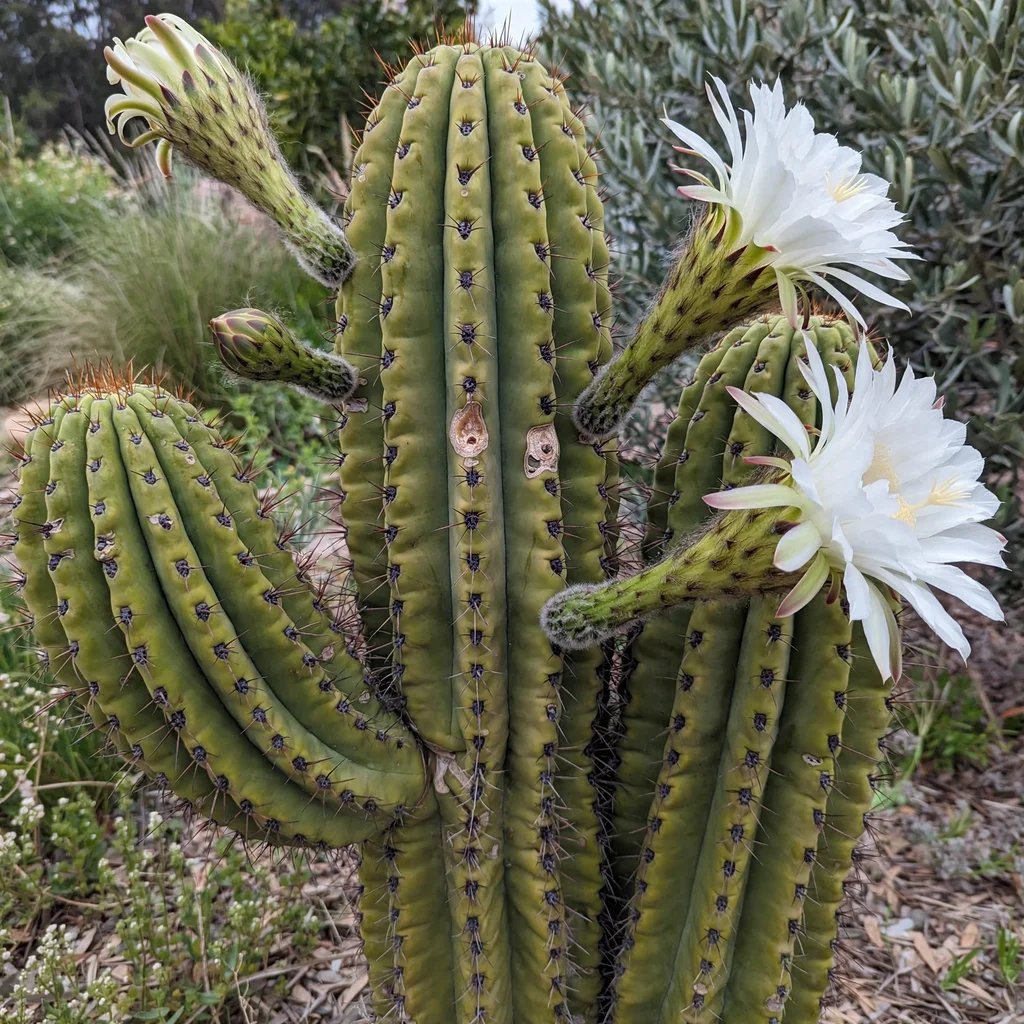
Leucostele terscheckii, still sold as Echinopsis terscheckii, is a treelike columnar cactus from dry shrubland in the Andes of northwestern Argentina to Bolivia, forming a single blue-green column with 8 to 14 ribs. Leafless stems carry large brown areoles set about an inch apart, each armed with 8 to 15 yellowish-brown spines to four inches long.
Plants stay single for years before pushing saguaro-like arms after about ten years, eventually reaching 25 to 40 feet tall and 10 to 15 feet wide in frost-free ground. In summer it opens very large white funnel-shaped flowers to eight inches long and six inches wide at night, closing by morning.
Uses & Benefits:
Essentials
At a Glance
Plant Type
Cactus Succulent
Height
480"
Width
180"
Light
Full Sun, Partial Sun
Zones
8, 9, 10
Water
Low
Humidity
Low
Lifespan
Long-lived perennial
Native To
NW Argentina to Bolivia
Toxicity
Non-toxic but sharply spined
Bloom period
Summer
In flower about 3 months of the year
Planting
How to Grow
- Plant in full sun with 6 or more hours direct sun in loose, gritty, fast-draining cactus mix, setting the base high so water never pools against the stem.
- Water deeply to wet the full root zone, then wait until the mix is completely dry before watering again.
- Feed sparingly or not at all in active growth; cut water back to monthly or less in winter.
- Give room for a 10- to 15-foot spread and keep dry before frost, as wet cold kills stem tissue.
Pro Tip
Soak deeply only after the mix has dried completely, and keep it bone-dry in winter cold; cold plus wet soil rots the base faster than cold alone.
Keep It Thriving
Care Guide
Do
- Give 6 or more hours of direct sun and sharp drainage.
- Let soil dry completely between soakings.
- Keep almost dry in winter.
Don't
- Do not overwater or leave in soggy soil.
- Do not cut into stems to prune; damage rarely heals cleanly.
- Do not expose wet roots to hard frost.
Seasonal Care Calendar
| Task | Jan | Feb | Mar | Apr | May | Jun | Jul | Aug | Sep | Oct | Nov | Dec |
|---|---|---|---|---|---|---|---|---|---|---|---|---|
| Fertilize | ||||||||||||
| Pest Check | ||||||||||||
| Plant | ||||||||||||
| Propagate | ||||||||||||
| Winter Prep |
Watch Out For
Pests & Diseases
Common Pests
Common Diseases
In the Garden
Landscape Uses & Companions
Landscape Uses
Multiply
Propagation Methods
Good to Know
Common Questions
Argentine Saguaro questions
What zones can Argentine Saguaro grow in?
Argentine Saguaro is hardy in USDA Zones 8–10: in that range it survives winter in the ground. Colder than Zone 8, grow it in a container you can move to shelter for the winter, or as an annual.
When does Argentine Saguaro bloom?
Argentine Saguaro typically blooms in summer. Exact timing shifts a week or two with your zone — Sow's bloom calendar maps it to your garden.
Does Argentine Saguaro need full sun?
Argentine Saguaro does best in full sun to part shade. In hot climates, afternoon shade keeps blooms fresher longer.
Is Argentine Saguaro drought tolerant?
Yes — once established (usually after the first full season), Argentine Saguaro handles dry spells with minimal watering. Water deeply its first year to build the root system that makes that possible.
More Echinopsis to compare
Keep exploring
Explore the genus
Hardy in your zone?
Grow Argentine Saguaro with confidence
See it in a design of your actual yard, get zone-matched care reminders, and track it season by season in your garden journal.